
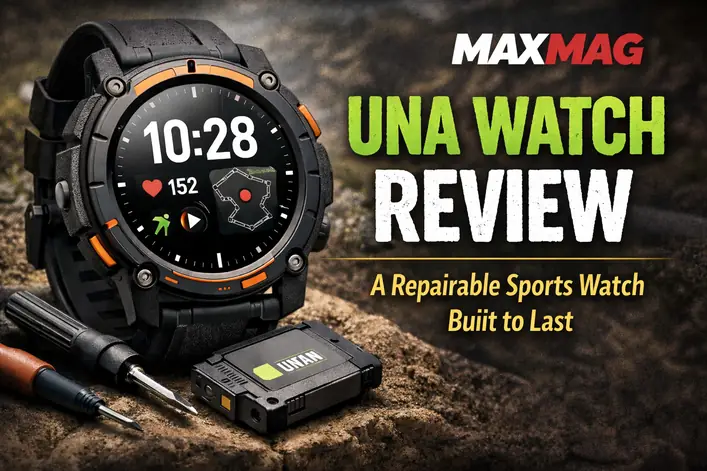
That is why this product has drawn more attention than the average crowdfunding gadget. On the surface, it offers the feature mix serious users expect: GPS for training, health sensors, endurance-focused battery claims, and a build aimed at active lifestyles. But the deeper appeal is philosophical. This watch is being positioned as something you can keep alive, repair at home, and potentially upgrade over time. In a category where too many devices quietly drift toward replacement, that alone is enough to make people stop scrolling.
What this watch is really trying to do
The watch is not best understood as a gadget with a sustainability label attached to it. It makes more sense to see it as a challenge to the idea that sports wearables have to be sealed, short-lived, and difficult to service. The product is built around modularity, a replaceable hard-shell battery, USB-C charging, and an open SDK that suggests the company wants the watch to grow beyond a closed, fixed experience. That is a bold move in a market where the largest brands tend to treat hardware decisions as something the user is meant to accept rather than shape.
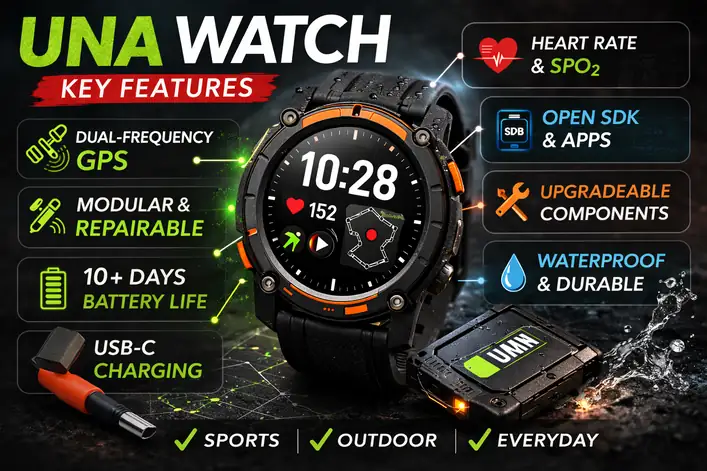
On paper, the feature list gives the concept more credibility than it might have had as a pure design story. The watch is presented as a sports-focused wearable with dual-frequency GPS, heart-rate monitoring, SpO2 support, and a battery life target that tries to keep it in serious-company territory. That matters. A repair-first watch would be easy to dismiss if it felt stripped down or compromised. What makes this one interesting is that it does not want to be an eco novelty. It wants to be taken seriously as training gear.
The company is also aiming at a broader mix of users than the average niche sports watch. Runners can understand the GPS story immediately. Cyclists will care about ride tracking and endurance. Hikers will notice the utility angle right away. Developers and tinkerers get a second hook through the open software direction. In other words, this is not a product trapped inside one tiny subculture. It has enough possible use cases to feel relevant across both fitness and technology conversations.
First impressions: the appeal is practical, not flashy
What stands out early is how grounded the idea feels. UNA Watch does not depend on luxury language, aggressive branding, or a fantasy lifestyle pitch. The attraction is simple. If you spend real money on a sports watch, you should be able to keep it running for years instead of treating it as a sealed appliance. That is such an ordinary, reasonable idea that it almost feels odd it has taken this long for someone to build a product identity around it.
That practicality also makes the product easier to like. There is a modest honesty to the pitch. The watch is not pretending it will instantly erase the advantages held by established players. It is making a narrower argument, and a smarter one: that even if large brands still have stronger ecosystems, they have been too comfortable selling hardware that is hard to repair and easy to replace. This newcomer is trying to exploit that blind spot.
That shift in emphasis changes the way the device is judged. Many wearable launches are evaluated by asking whether they beat Apple, Garmin, or Coros on day one. That is not quite the right test here. The better test is whether this watch makes those brands look slightly old-fashioned in how they think about ownership. If it does that while delivering a dependable everyday experience, then it becomes more than a curiosity.
Specs that matter in the real world
This product would not be worth discussing for this long if the hardware story ended with replaceable parts. The reason it remains compelling is that the underlying sports-watch package sounds sensible. Dual-frequency GPS is the kind of spec buyers associate with more accurate location data in difficult environments, whether that means city streets with heavy signal bounce or outdoor routes where clean tracking matters. Add heart-rate monitoring, SpO2 support, and solid battery claims, and the watch starts to sound like something built for regular use rather than occasional curiosity.
The battery discussion is especially important. Endurance is not a side feature in this category; it changes the whole feel of ownership. A watch that constantly needs topping up feels needy. A watch that fades during long outings feels untrustworthy. A watch that uses a proprietary cable feels mildly irritating every time you travel. Here, the combination of multi-day battery expectations and USB-C charging gives the product one of its strongest everyday advantages. Even people who are not obsessed with repairability understand the appeal of fewer chargers and fewer interruptions.
The open SDK deserves attention too, because it broadens the story beyond hardware. A repairable watch is useful. A repairable watch that invites software creativity is more ambitious. It suggests the company is not only building a device, but also trying to create a platform with room for experimentation. That could matter a great deal down the line, especially if the watch attracts a small but enthusiastic community of builders who want more control than mainstream smartwatch ecosystems tend to allow.
Design and repairability: the feature that changes the conversation
Repairability is the headline feature here for a reason. UNA Watch is built around the idea that damaged or aging parts should not automatically end the life of the whole product. That sounds obvious when written in plain language, which is exactly why it resonates. People understand broken screens. They understand worn batteries. They understand the frustration of replacing an expensive device because one part has failed. The watch does not need an elaborate explanation to make sense.
What makes this particularly interesting in a wearable is how rare the idea still is. Plenty of companies talk about durability. Far fewer talk about user serviceability in a meaningful way. Durability says the product might survive a hit. Repairability says the relationship does not have to end when it does not. That second promise is much more powerful. It turns the watch from a sealed object into something closer to a tool you actually own.
There is also an emotional dimension to this. People tend to keep sports gear that ages with them. A bike, a pair of boots, a backpack, a camera lens, or a favorite jacket can stay meaningful because it survives use and earns wear. Most smartwatches, by contrast, are designed to feel temporary. They are bought, admired, updated, and eventually replaced. If this product succeeds, it may be because it brings a more equipment-like mentality into a category that has felt too disposable for too long.
Who this watch makes the most sense for
The watch is easiest to recommend conceptually to four types of buyer. The first is the athlete who wants a capable training watch but is tired of paying premium prices for hardware that becomes difficult to justify after a few years. The second is the outdoor user who values battery life, charging convenience, and practical durability. The third is the right-to-repair minded buyer who is actively looking for products that respect ownership. The fourth is the tinkerer who sees an open SDK and immediately starts wondering what else a watch like this could become.
For runners, the appeal lies in accuracy and longevity. For cyclists, it lies in dependable tracking and rugged usefulness. For hikers, it lies in battery confidence and a sense that the watch is equipment rather than jewelry. For developers, it lies in possibility. These are not all the same audience, but they overlap more than they might appear. They are all people who want their gear to feel useful, practical, and worth keeping.
On the other hand, there are also buyers who will understandably hesitate. If someone wants the most mature software experience today, they are still likely to lean toward an established brand. If someone is deeply tied into the Apple ecosystem, Apple Watch remains the more obvious lifestyle choice. If someone is training seriously and values years of trusted data tools, Garmin and Coros still offer the safer road. That is not a weakness in the idea itself. It is simply the reality any newcomer has to face.
UNA Watch vs Garmin, Apple Watch, and Coros
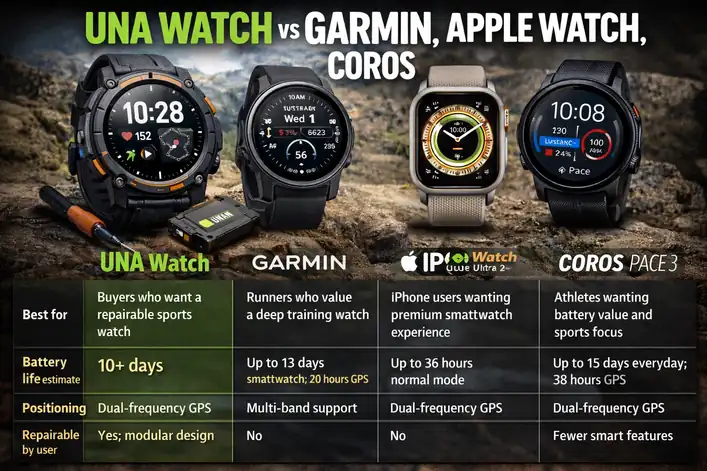
This is the point in the review where the product has to leave the comfort of its own mission statement and enter the real market. Sports-watch buyers do not compare devices in isolation. They compare them against the products already sitting in store windows, on training forums, and on the wrists of friends. That means this watch has to be measured not only by its ideals, but also by how it stands next to the brands people already trust.
UNA Watch has one immediate advantage in this comparison: it offers a clearer ownership argument than any of the mainstream rivals in this range. Garmin gives buyers a mature training ecosystem. Apple gives them the smoothest smartwatch polish, especially for iPhone users. Coros gives them efficiency, focus, and strong battery credibility. But none of those brands are built around the idea that owners should be able to repair, refresh, and keep the product going in a hands-on way.
| Watch | Best for | What stands out | Battery life claim | GPS positioning | Repairability / upgrade angle | Main tradeoff |
|---|---|---|---|---|---|---|
| UNA Watch | Buyers who want a repairable sports watch and a fresh ownership model | Modular design, replaceable battery, USB-C charging, open SDK approach | Over 10 days daily use; around 20 hours GPS use | Dual-frequency GPS | Strongest case here; repairability is central to the product identity | New platform with less proven software maturity and long-term track record |
| Garmin Forerunner 265 | Runners who want a mature training companion | Strong fitness metrics, trusted training tools, broad brand confidence | Up to 13 days smartwatch mode; up to 20 hours GPS mode | Multi-band GPS support | Low; designed for performance and durability, not user repair | Closed ownership model and less flexibility if hardware ages |
| Apple Watch Ultra 2 | iPhone users who want top-tier smartwatch polish | Best ecosystem integration, refined interface, premium feel | Up to 36 hours normal use; up to 72 hours in low power mode | Dual-frequency GPS | Low; premium but not built around user serviceability | Higher price and shorter endurance for serious multi-day use |
| COROS PACE 3 | Athletes who care about battery efficiency and value | Very light build, strong endurance, sports-first focus | Up to 15 days regular use; up to 38 hours full GPS | Dual-frequency GPS | Low; practical and efficient, but not modular | Less lifestyle polish and a smaller app ecosystem |
| COROS PACE Pro | Performance users wanting extra display and mapping power | AMOLED display, maps, faster platform, strong battery claims | Up to 20 days daily use; up to 38 hours GPS | Dual-frequency GPS | Low; performance-led rather than repair-led | Still does not change the replace-rather-than-repair ownership model |
The table makes the central point clear. This watch is not trying to beat every rival at every traditional measure on day one. It is trying to offer something the others still treat as secondary. That could become a major strength if the day-to-day experience is smooth, because buyers are increasingly willing to reward products that feel more sensible over the long haul.
At the same time, the mainstream brands still hold the obvious advantage in trust. Garmin, Apple, and Coros have years of software refinement, update history, accessory familiarity, and customer expectations behind them. That cannot be faked by a new entrant. The question is not whether those brands remain safer today. They do. The question is whether this product is pointing toward a better way to build sports wearables in the future. On that front, it already feels influential.
Where this watch gets things right
UNA Watch gets the most important thing right: it knows exactly why it exists. The product is not muddled. It is not trying to be luxury jewelry, office-tech companion, and ultramarathon instrument all at once. It has a clear identity. It is a repairable sports watch with modern location and sensor ambitions, a longer-life philosophy, and enough practical touches to sound genuinely usable. That kind of clarity is rare and valuable.
It also gets the tone right. There is a quiet confidence in a product that says, in effect, we think the category has accepted the wrong hardware model. That is much more compelling than a startup begging for attention with loud branding. The watch has a calm, practical confidence to it, and that carries through the whole concept.
Then there is the plain everyday logic of the thing. Replaceable battery. USB-C charging. Repairable design. Those are not glamorous talking points, but they are deeply human ones. They address the sort of annoyances people actually complain about after the first week of owning a device. In many ways, that is the smartest part of the product: it is trying to solve the problems that stay irritating long after the marketing glow disappears.
Where it still has to prove itself
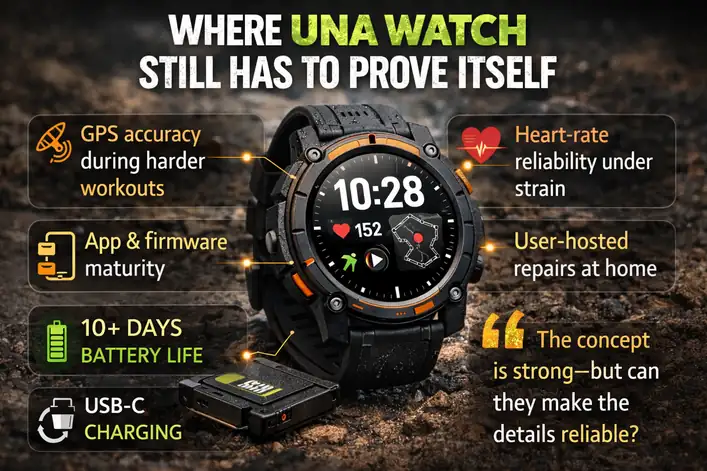
Here is the unavoidable caution: UNA Watch is still a young product from a young company. That does not mean it should be dismissed. It does mean that buyers should separate admiration for the concept from confidence in the finished experience. Sports watches live or die by the details. GPS consistency matters. Heart-rate reliability matters. App stability matters. Syncing matters. Update cadence matters. The best ideas in the world can still stumble if those quieter parts of the experience feel rough.
This is especially true in a wearable that is meant to be used actively and often. A watch worn on hard runs, long rides, hikes, travel days, and regular daily life must become boring in the best possible sense. It must feel dependable. It must record what it says it records. It must not create friction every time you want to check your data. That is where established rivals still hold the upper hand, and it is exactly where any new entrant must earn its place.
Crowdfunded hardware also carries the usual risks. Delivery timelines can move. Software roadmaps can stretch. Early batches can reveal small issues that only appear in the hands of wider users. None of that is unusual, but it does matter. Anyone considering the watch should be clear-eyed about the fact that they are not only buying a product. They are also buying into the company’s execution over time.
Is it worth the money?
At its current pricing level, this watch is not asking to be treated as a novelty impulse purchase. It wants to sit in the same conversation as serious sports wearables, and that is exactly how it should be judged. The value proposition here is not just about features per pound or euro. It is about lifespan. If the watch truly delivers on repairability, useful battery replacement, and a good-enough software experience, then its long-term value could look stronger than its sticker price first suggests.
That is the central tension in the buying decision. With a big brand, you pay for certainty. With this watch, you pay for a better ownership philosophy and the possibility that it matures into something genuinely important. For some buyers, that will feel risky. For others, it will feel like the most interesting value proposition in the category. Much depends on what kind of buyer you are. Some people want the safest option. Others want the option that may actually move the market forward.
Who should buy it, and who should wait
Buy it if…
- You are tired of sealed wearables and want a product that treats ownership more respectfully.
- You like the idea of a modular GPS sports watch that can be kept in service longer.
- You are comfortable backing a younger platform in exchange for a smarter long-term concept.
- You care about USB-C charging, practical battery life, and real repairability more than polished brand prestige.
Wait if…
- You want the safest and most mature software ecosystem available right now.
- You rely on advanced coaching tools from long-established platforms.
- You prefer proven brand support over a newer product story with more open questions.
- You are not comfortable with the normal uncertainty that comes with a young hardware platform.
Final verdict
UNA Watch may not be the safest sports-watch purchase in its class, but it is one of the most interesting. That distinction matters. Safe products often reinforce the status quo. Interesting products question it. This watch questions a lot: why premium wearables still feel disposable, why buyers must tolerate closed hardware, and why the most personal tech on our wrists is so often treated as temporary.
If the company executes well, this could become more than a successful device. It could become the product that nudges larger brands to treat repairability, longevity, and ownership as core features instead of awkward afterthoughts. If the execution falls short, the idea will still have value, because it has already exposed how ready many buyers are for a better model.
That is why the watch is easy to root for. It feels like a product made by people who noticed a problem that bigger companies have learned to live with. And even before every long-term question is answered, that makes it worth taking seriously. In a market full of sealed upgrades and familiar routines, UNA Watch is offering something rarer: a new argument about what a sports watch should be.
For readers who want to explore the product further, visit the official UNA website and the original Kickstarter campaign page.