
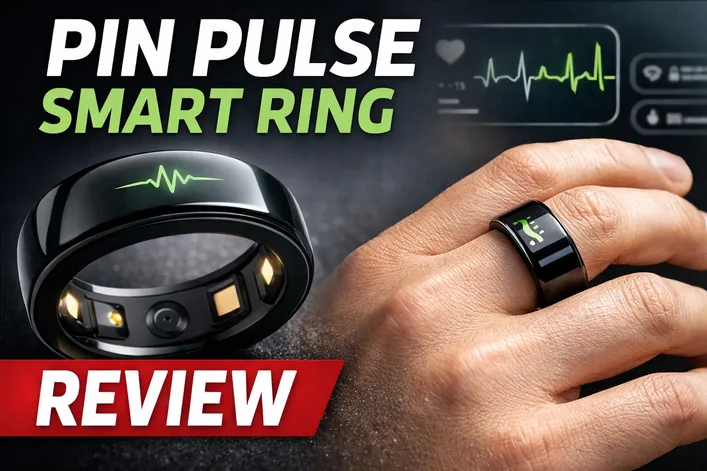
The smart-ring market has spent the last two years proving that people will wear health tech on a finger if it does one thing especially well: disappear into daily life while quietly collecting useful data. That is why PIN PULSE Smart Ring deserves attention right now. It is not entering the category as another sleep-and-steps tracker. It is trying to move the conversation toward on-demand blood pressure checks, glucose-risk insights, sleep-breathing awareness, and AI-assisted interpretation, all in a device small enough to compete with the category’s lightest wearables. In a field where most brands are refining familiar ideas, this one is making larger promises than usual—and that makes it interesting, but also easier to challenge.
That tension is what defines this review. The product is not hard to understand as an object: a titanium wellness ring with app-driven health tracking, wireless charging, 5ATM water resistance, and a headline feature set built around metabolic and cardiovascular trends. What is harder to judge is whether those headline features meaningfully expand the category or mostly expand the pitch. Early coverage has split along exactly those lines. Some outlets have treated the ring as an unusually ambitious entrant in a crowded market; more skeptical reporting has focused on the gap between wellness language and real-world proof, especially around non-invasive glucose-related claims. That is the right argument to have, because smart rings are now mature enough that novelty alone is no longer enough.
What the product is
PIN PULSE Smart Ring is a Kickstarter-backed smart ring from The Pin Universe, positioned as an all-in-one wellness wearable rather than a minimalist sleep companion. The campaign and official site describe 16 tracked metrics, including sleep and breathing analysis, heart-rate-related data, stress signals, activity tracking, temperature trends, blood pressure monitoring, and what the company calls non-invasive blood glucose insights or glucose-risk assessment. It is explicitly framed as a wellness device rather than a medical device, which is an important distinction and not legal fine print readers should skip past. The difference matters because it changes how buyers should interpret the product: as an early-warning pattern reader, not a diagnostic instrument.
In category terms, this is not an entry-level ring and it is not a conservative one. It sits in the experimental-premium tier: the sort of product that tries to win attention by bundling familiar wellness tracking with one or two bigger claims that competitors either do not offer or offer only as roadmap items. That puts it closer in spirit to ambitious challengers such as Circular than to the steadier, better-established playbooks used by Oura or Samsung. The upside of that positioning is obvious: if the advanced metrics are useful, it instantly feels more consequential than another polished sleep tracker. The downside is just as obvious: the more you promise, the more your unproven edges become the whole story.
First impressions
The first impression of the ring is less about styling than ambition. Most smart rings sell restraint. They talk about comfort, passive tracking, battery life, and the quiet pleasure of replacing a bulkier watch. This ring does some of that too, but the real first impression is that it wants to be interpreted as a broader health hub. The app language, AI framing, and emphasis on metabolic awareness suggest a device that wants to be consulted, not just worn. That makes it more intellectually interesting than a ring whose entire appeal is “Oura, but cheaper,” yet it also raises the bar for usability. A ring making more sophisticated claims has to explain itself better, not just measure more things.
Physically, the early public details are encouraging but not definitive. The company says the ring uses titanium, weighs as little as three grams, supports wireless charging, and lasts up to seven days on a charge. Those are competitive numbers on paper and broadly in line with what buyers expect at this level. But smart-ring veterans know the difference between lab-like battery claims and lived battery life can be substantial, especially once sync frequency, overnight monitoring, and app behavior enter the picture. As with many crowdfunded wearables, the industrial design sounds mature before the real-world software story has had time to prove itself.
Key features and specifications in real-world terms
16-metric tracking sounds impressive, but usefulness depends on coherence
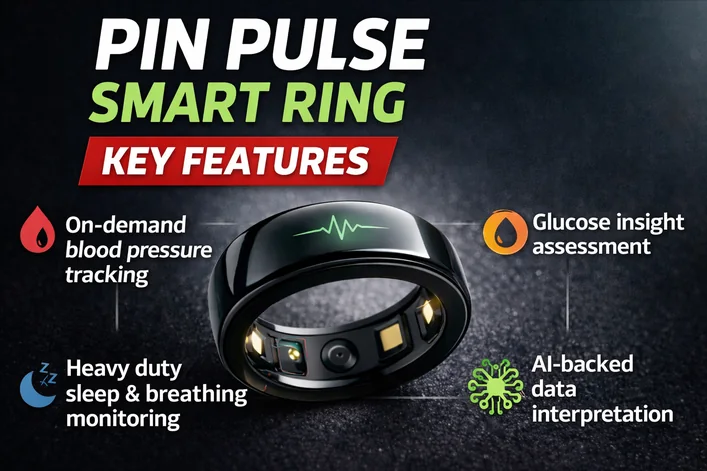
PIN PULSE Smart Ring promises 16 metrics in one device. On its own, that number means very little. Wearables often inflate perceived value by multiplying data points the user never meaningfully acts on. The stronger argument here is not quantity but consolidation. If a single ring can connect sleep quality, breathing irregularities, heart-rate variability, SpO₂, stress patterns, temperature shifts, steps, and activity output inside one readable dashboard, it reduces friction. That matters in day-to-day use because people rarely abandon health gadgets over a lack of raw data; they abandon them because the experience becomes fragmented, repetitive, or too abstract to inform a decision.
Blood pressure and glucose-risk features are the headline, and also the risk
The biggest differentiator is the promise of on-demand blood pressure readings and non-invasive glucose-related insight through PPG sensing and AI interpretation. In practical terms, that is the feature set that could make this ring feel genuinely category-expanding rather than merely competitive. It speaks directly to people who are curious about metabolic health, who dislike finger-prick testing, or who want more context around how meals, stress, sleep, and recovery affect the body over time. But it is also where caution becomes mandatory. The campaign language and third-party coverage repeatedly frame these as wellness insights, not diagnostic measurements, and Notebookcheck explicitly noted that readers should pay close attention to that distinction. So the real-world takeaway is not “this replaces medical monitoring,” but “this may offer trend-level guidance if the underlying models are good enough.” That is a far narrower and more realistic claim.
Sleep and breathing data could matter more than the flashy claim
Ironically, the less glamorous feature may be the more immediately useful one. Sleep tracking, breathing-risk awareness, and overnight pattern analysis are easier for smart rings to justify because the category already has a track record there. If the ring reliably maps sleep stages, rest disruption, HRV changes, blood oxygen patterns, and possible apnea-related warning signs, that would deliver ongoing value even for buyers who never fully trust the glucose-facing pitch. For many users, the practical win is not a medical revelation but a clearer answer to mundane questions: why energy collapsed after a late meal, why recovery felt off after poor sleep, or why stress seemed high before the day even started.
Battery life and water resistance are about wear compliance
The ring claims up to seven days of battery life and 5ATM water resistance. Those are not glamorous specs, but they matter because wearables only work when people leave them on. A ring that needs constant charging or removal during normal life loses both data continuity and user trust. Seven days is competitive with Samsung’s claim of up to seven days and close to Oura’s quoted five to eight days, which means the product is at least speaking the category’s language on endurance. The real question is whether advanced sensor use erodes that promise once owners begin using the more demanding features regularly.
Design, build, and usability
The company’s decision to use titanium is sensible rather than luxurious. Titanium in this category is less about jewelry theater than about solving three real problems at once: weight, durability, and comfort over long wear periods. A ring that weighs around three grams should, in theory, stay easy to forget during work, sleep, and exercise. That is the standard smart rings must hit. Nobody buys one to be reminded of it all day. Samsung, Oura, Circular, and Ultrahuman all understand that comfort is a product feature, not an aesthetic bonus, and the new ring is clearly trying to meet that expectation.
Still, there is a possible catch. Stuff’s early take suggested the ring looks bulkier than some rival hand-worn wearables, even while acknowledging that extra internal hardware may explain the size. That observation matters because ring wearability is unforgiving. A smartwatch can get away with a little bulk. A ring usually cannot. Even minor thickness can change whether it feels natural while typing, gripping gym equipment, or sleeping. If the device is trying to fit additional sensing hardware into a finger-worn form, comfort will be one of the first areas where engineering ambition meets daily reality.
Usability also lives or dies in the app. The company’s pitch focuses heavily on readable charts, trend interpretation, and an in-app AI chatbot that can explain what changes in the data may mean. That sounds appealing because raw biometric dashboards often fail ordinary users. But good health-software design is not the same thing as adding a chat layer. The app needs to do three harder things well: keep the data stable and trustworthy, distinguish signal from noise, and avoid turning mild fluctuations into anxiety theater. If it can manage those three, the AI angle could feel useful. If not, it will read as interface garnish.
Performance and experience in practical use
Because the device is at the campaign stage, a fully mature long-term performance verdict would be dishonest. What can be judged now is how plausible its intended experience looks relative to the category. On paper, the ring is trying to be the rare smart ring that is both passive and consultative: passive in the sense that it continuously gathers sleep, activity, and physiological trends, consultative in the sense that the owner is expected to actively check blood-pressure or glucose-risk views and use AI guidance to interpret them. That hybrid model is smart. Rings are best when they disappear, but they become more valuable when they occasionally give users a reason to look.
The challenge is whether the product can sustain confidence across different kinds of data. Buyers are already trained to trust smart rings, at least to a degree, for sleep, resting heart rate, HRV trends, and daily movement. They are not trained to automatically trust non-invasive glucose inference. That means the ring effectively contains two reputational products in one shell: a familiar wellness tracker and an experimental metabolic advisor. If the familiar half works well and the experimental half feels plausible, the device could earn patience. If the familiar half is merely average, the more controversial half will come to dominate the conversation.
What makes this different
The product is different because it is trying to win on interpreted health ambition, not just form factor. Oura leans on maturity, algorithmic refinement, and ecosystem credibility. Samsung leans on platform integration and the comfort of buying into a massive consumer-electronics brand. Ultrahuman emphasizes performance, recovery, and a subscription-free ownership pitch. Circular has chased feature breadth and futurist health claims. The newcomer’s specific angle is to collapse several big-ticket wellness narratives—metabolic awareness, cardiovascular trends, sleep breathing, stress, temperature, activity, and AI explanation—into one ring and one app story. That is not a trivial difference. It is the entire case for its existence.
But there is a second, harsher truth: differentiation is only valuable if it survives scrutiny. If the advanced metrics prove too fuzzy, too slow, too inconsistent, or too caveated to influence behavior, then the differentiation collapses into marketing architecture. In that scenario, what remains is a ring competing against stronger incumbents on the basics, which is a much harder fight. So yes, the product is differentiated—but precisely in the area where buyers should remain most critical.
Who the product is for
This ring is best suited to readers who are already interested in health tracking but are no longer satisfied by generic readiness scores and sleep summaries alone. The right buyer is someone who wants richer context around recovery, stress, breathing, temperature trends, and possible metabolic shifts, yet still prefers the low-profile form factor of a ring over a watch. It may also appeal to users who are curious about wellness experimentation and willing to tolerate some first-generation ambiguity in exchange for trying a more ambitious set of insights early.
It is less suitable for two groups. First, anyone looking for a medical-grade replacement for clinically established tools should step back immediately; the product is not presented that way, and buyers who need diagnostic certainty should not pretend otherwise. Second, shoppers who mainly want proven sleep and recovery tracking with the least friction may still be better served by more established options. The crowdfunded, high-claim pitch is part of the appeal here, but it is also part of the risk profile.
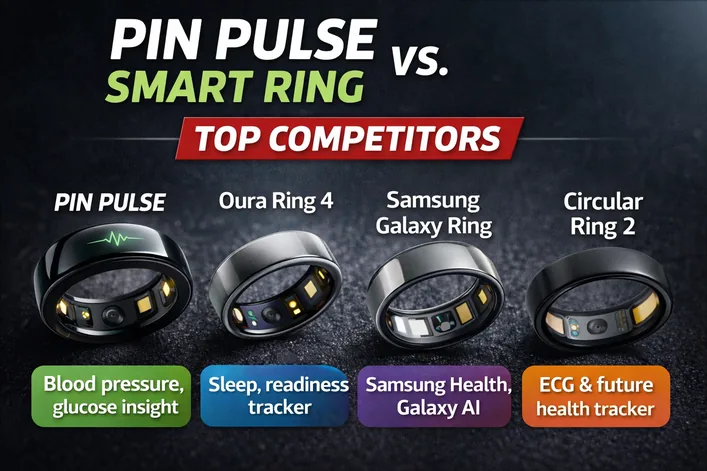
Smart ring comparison: Oura, Samsung, Circular, and Ultrahuman
| Product | Positioning | Key strengths | Main caution | Best for |
|---|---|---|---|---|
| This ring | Experimental-premium wellness ring | 16 metrics, blood pressure and glucose-risk ambition, sleep/breathing focus, AI-guided interpretation, no subscription language in coverage | Advanced claims still need real-world validation | Early adopters who want broader wellness insight in ring form |
| Oura Ring 4 | Mature premium benchmark | Established app, 5–8 day battery, broad health insights, strong credibility | Subscription required for full value | Buyers prioritizing polish and proven everyday tracking |
| Samsung Galaxy Ring | Mainstream ecosystem ring | Samsung Health and Galaxy AI integration, up to 7-day battery, familiar brand support | Most appealing inside Samsung’s ecosystem | Galaxy phone users who want easy onboarding |
| Circular Ring 2 | Feature-heavy challenger | ECG angle, broad health ambitions, no-subscription framing, titanium build | Execution and software confidence have drawn criticism | Users tempted by advanced features and willing to accept rougher edges |
| Ultrahuman Ring AIR | Performance and recovery ring | Recovery/sleep focus, no subscription, established fitness-oriented identity | Less dramatic differentiation for metabolic-health seekers | Buyers focused on recovery, movement, and long-term habit tracking |
The table makes one thing clear: this ring is not trying to beat every competitor on the same axis. It is trying to out-interest them. That can be a smart strategy, because Oura and Samsung are hard to out-polish, while Ultrahuman already owns a strong no-subscription performance niche. The way this ring competes is by offering a more provocative “why now?” story. If your main question is, “Which ring seems most proven today?” Oura still has the easier answer. If your question is, “Which ring is attempting something more ambitious than standard recovery tracking?” this product becomes more compelling.
Buyer type matters here. A Samsung loyalist should still prefer Samsung because ecosystem convenience is part of the product. An Oura shopper is usually buying confidence, not experimentation. An Ultrahuman buyer often wants a clean ownership model and performance framing. A Circular buyer tends to be attracted to breadth and futurist health features despite execution risk. The new ring lands closest to that last audience, but with a cleaner and more strategically focused message around metabolic and cardiovascular interpretation. Whether that is enough to convert cautious buyers will depend on shipping reality, not campaign language.
What it gets right
The clearest strength of PIN PULSE Smart Ring is conceptual. It recognizes that the smart-ring category needs more than incremental sleep scoring to stay exciting. By centering its pitch on metabolic awareness, cardiovascular trends, and an app that tries to translate metrics into guidance, it offers a sharper editorial hook than many rivals. It also appears to understand an important truth about health tech: users do not need more numbers nearly as much as they need better interpretation. If the company’s software can make patterns legible without becoming alarmist, that would be a meaningful win.
It also gets the hardware checklist mostly right on paper. Titanium, around three grams of weight, wireless charging, seven-day battery claims, and 5ATM water resistance are not enough to win the category, but failing any of them would have made the ring hard to take seriously. In other words, the company seems to understand that advanced health claims only matter if the baseline wearable experience feels normal, comfortable, and durable. That is a better foundation than many overly ambitious crowdfunded gadgets start with.
Where it still has to prove itself
This is the part of the review where restraint matters. The product has not yet earned the right to be treated like a finished benchmark product. The blood-pressure and glucose-facing features are exactly the sort of claims that attract attention early and scrutiny later. Buyers should want to know how repeatable the readings are, how environmental conditions affect them, how the app handles uncertainty, how often it asks for calibration or guided checks, and how clearly it communicates the limits of its models. Until broader real-world testing exists, these are open questions, not footnotes.
The second unresolved issue is software maturity. Many ambitious wearables fail not because the sensors are useless, but because the companion app turns promising hardware into a trust problem. Circular’s recent reception is a useful cautionary example here: broad feature ambition can be undermined by sync issues, incomplete execution, or unstable interpretation. That does not mean the new ring will repeat those mistakes. It does mean experienced buyers should withhold automatic confidence until the software proves calm, consistent, and legible over time.
Pricing and value for money
Kickstarter pricing is always a moving target, but public coverage has placed the entry package around $250 during the campaign, with the suggestion that retail pricing would be higher later. At that early-backer level, the value argument is strong enough to be taken seriously, especially if the product delivers even a respectable version of its more advanced wellness features. At a higher eventual retail price, the scrutiny increases fast, because the ring would be competing more directly against brands with better-known software and stronger post-purchase confidence. The value story, then, is unusually conditional: good at launch if execution is competent, far shakier later if the price rises faster than trust.
That is the central tension in the buy decision. Backers are not simply paying for a ring; they are pricing in belief. If you believe the company’s interpretation layer and advanced sensing will mature into something genuinely more useful than a standard sleep-and-recovery ring, the crowdfunding value may look attractive. If you are more skeptical, paying extra for proven software from an incumbent may be the more rational use of money.
Buy it if / Skip it if
Buy it if
You want a ring that is trying to expand the category rather than simply mirror it. You are specifically interested in metabolic-health trends, blood-pressure awareness, sleep-breathing data, and AI-assisted interpretation. You understand the distinction between wellness insight and medical diagnosis, and you are comfortable backing a product whose most exciting features still need broader real-world proof. Readers who enjoy being early to ambitious health tech may find this ring more compelling than safer, more familiar alternatives.
Skip it if
You want the least risky smart-ring purchase in 2026. You need clinically grounded certainty rather than directional wellness feedback. You mostly care about sleep, readiness, and recovery and would rather buy from a platform with years of software refinement behind it. And if you are wary of crowdfunded hardware in general, this product does not offer the kind of boring predictability that usually changes that instinct. That is not an insult; it is simply the truth of where it sits today.
Final verdict
PIN PULSE Smart Ring is one of the more interesting smart-ring launches of the year because it understands that the category cannot live on sleep scores alone. Its attempt to bring blood-pressure checks, glucose-risk insight, sleep-breathing awareness, and AI interpretation into one ring is exactly the kind of bigger swing that keeps a mature product category from becoming dull. But interest is not the same thing as endorsement. Right now, this feels less like a fully established winner than an ambitious, potentially competitive product that still has to validate its boldest claims in public use.
That leaves the verdict in a precise place: the product looks genuinely promising, clearly differentiated, and relevant to where wellness wearables are heading, but it also feels unfinished in the only way that matters—proof. For curious early adopters, that may be enough. For cautious buyers, it is a reason to watch rather than rush. As a Maxmag verdict, this is not a dismissal and it is not a recommendation without reservation. It is an editorial nod to a product that deserves attention because of what it is trying to do, paired with a firm reminder that trying is not yet the same as delivering.
Readers who want to explore the company’s broader wearable pitch can visit The Pin Universe official website, while anyone considering a backing decision should read the PIN Pulse smart ring Kickstarter campaign page in full before committing.
FAQ
Q1: What is PIN PULSE Smart Ring?
Q2: Is PIN PULSE Smart Ring a medical device?
Q3: What makes PIN PULSE Smart Ring different from other smart rings?
Q4: How long does the battery last on PIN PULSE Smart Ring?
Q5: Who should buy PIN PULSE Smart Ring?
Q6: Should cautious buyers purchase PIN PULSE Smart Ring now?