
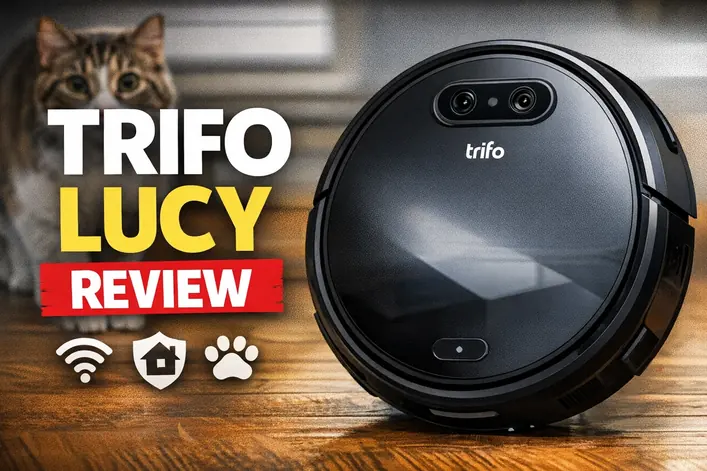
The robot vacuum market has spent the last several years chasing two overlapping promises: less manual cleaning and fewer reasons to think about cleaning at all. That has pushed brands toward smarter navigation, better object avoidance, and increasingly elaborate app ecosystems. Trifo Lucy arrived with a more unusual pitch. It was not content to be just another floor-cleaning disc. It wanted to be a patrol bot, a pet monitor, a motion-alert camera, and a vacuum-mop hybrid all at once. That combination still feels unusual now, not because the industry ignored the idea, but because it quietly proved how hard it is to get both halves right at the same time. The original Kickstarter campaign framed Lucy as “The AI Home Robot,” while Trifo’s own materials positioned it as a cleaning device with surveillance intelligence layered on top. Outside coverage and independent testing suggest that the concept was genuinely ahead of its moment, even if execution was more mixed.
That is why this product is still worth attention. Lucy matters less as a “should you buy this today at full retail” story and more as a revealing case study in where smart home hardware was headed: toward multi-role machines that promised convenience, awareness, and automation in a single body. Trifo launched Lucy publicly around CES 2020, promoted its 1080p HDR camera, depth sensor, room recognition, patrol routes, and obstacle detection, then pushed the campaign through Kickstarter and Indiegogo. The result was not a category-defining hit, but it was an important early example of a home security robot trying to compete inside the much more practical world of floor care.
What the product is
Trifo Lucy is a robot vacuum and light mopping system built around a more distinctive feature than suction alone: a forward-facing camera setup that supports live video, night vision, object recognition, patrol-style monitoring, motion-triggered alerts, and two-way audio alongside routine cleaning. On paper, that made it a robot vacuum with camera before that concept became more familiar in premium rivals. Official Trifo descriptions emphasized 1080p HDR video, a depth sensor for night vision and mapping, 3,000Pa suction, up to 120 minutes of runtime, app control, room labeling, and no-go zones. Some later independent reviews and listings cited 4,000Pa for certain versions, which suggests either regional variation, later revision, or inconsistent retail labeling; for editorial honesty, the safest baseline is to treat 3,000Pa as the original launch figure attached to Lucy’s initial public positioning.
In real-world terms, that means Lucy was never just selling “cleaner floors.” It was selling the idea that a moving appliance could also become a lightweight remote presence in the home. You could check in on pets, watch a room at night, or steer the unit manually through the app. That is a much bigger promise than most robot vacuums make, and it immediately changes the standard by which the product should be judged. It is not enough for a machine like this to be decent at a few things. Once it asks for trust as both cleaner and watcher, any weakness in performance, privacy confidence, app reliability, or long-term support matters more.
First impressions
Seen through a 2026 lens, Trifo Lucy still makes a strong first impression because the idea is instantly legible. Most robot vacuum launches ask buyers to care about pathing algorithms, suction numbers, and dock design. Lucy asked a simpler question: what if your vacuum could also keep an eye on the house? That is clever product framing because it translates technology into a human use case very quickly. It also helps explain why early coverage focused so heavily on the surveillance angle, the room-recognition story, and the promise of object avoidance for pet households. Even before reviewers got into cleaning results, many publications treated Lucy as a sign that the robot vacuum category was expanding into a broader smart-home identity.
The physical design also supported that pitch. Reviewers described a fairly large, sturdy machine with a visible forward sensor/camera area, a 0.6-liter dustbin, a 5,200mAh battery, and a thin body around 3.3 inches high. That translates into a robot that looks and feels more substantial than bargain models, with enough onboard capacity to clean without constant emptying and enough battery to cover a respectable amount of floor space before returning to dock. It also translates into a device that is not especially subtle about its intelligence. Lucy does not look like a minimalist appliance; it looks like a small robot that wants you to know it is seeing things.
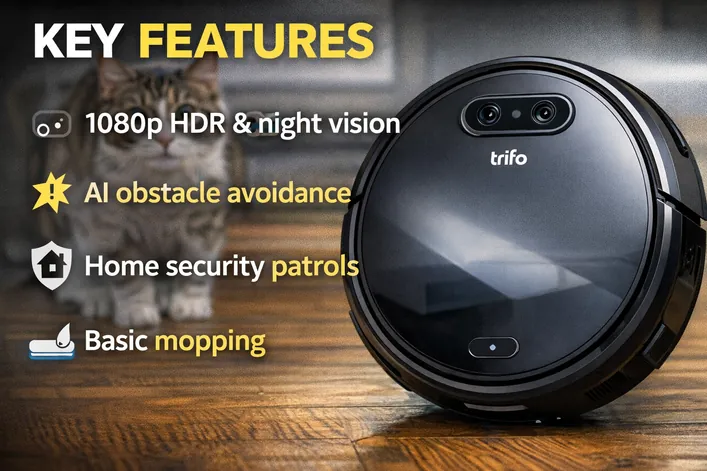
Key features and specifications in real-world terms
Trifo Lucy was built around six headline ideas: camera-based navigation, night-vision surveillance, room mapping, object recognition, vacuuming, and basic mopping. The most important thing to understand is that these are not equal features. The camera and perception system are the identity of the product. The vacuuming system is the duty of the product. The mopping system is the extra. That hierarchy matters because it shapes expectations. Lucy is best understood as an AI-heavy robot vacuum first, a home-monitoring gadget second, and only a light mop in the most limited sense.
The 1080p HDR camera and depth sensor were not just there for marketing drama. In practice, they were meant to improve AI obstacle avoidance, generate indoor maps, support remote video streaming, and enable patrol behavior after dark. For households with pets, clutter, or rooms that change shape during the day, that is more useful than a raw suction upgrade alone. A robot that can better understand slippers, socks, bowls, or animal mess is often more valuable than one that is simply louder and stronger. Trifo’s one-inch obstacle claim, repeatedly highlighted in launch materials, was therefore one of Lucy’s most important promises.
The quoted 120-minute runtime and 5,200mAh battery, meanwhile, translate into solid coverage for apartments and many medium-size homes, though not infinite endurance. In plain terms: enough battery for routine scheduled cleaning, but not enough to excuse poor route efficiency. If a robot covers space intelligently, two hours is useful. If it wastes passes, the spec becomes less impressive. That is why navigation mattered so much to Lucy’s value proposition. The company was effectively arguing that its intelligence would stretch the usefulness of its battery and cleaning time.
The mopping attachment deserves a more skeptical reading. Independent testing described it as a small, somewhat improvised add-on with limited water capacity, proprietary cloth fitting, and obvious compromises versus more serious hybrid mopping systems. In everyday use, that means “dust control and light wipe-down,” not meaningful stain removal or whole-home wet cleaning. Buyers expecting a true robot vacuum and mop would need to treat Lucy’s mop as a convenience layer, not a reason to choose the product.
Design, build, and usability
Trifo Lucy appears to have been built with more seriousness than some crowdfunded gadgets that feel half-finished the moment they leave the box. Reviewers noted a robust chassis, modular internal design, a large easy-to-remove bin, and a generally substantial construction. That matters because multi-function smart-home devices often fail at the basics: flimsy parts, annoying maintenance, awkward bins, or poor access for cleaning rollers and filters. Lucy seems to have avoided most of those beginner mistakes.
Usability, however, is more complicated than build quality. A product built around cameras, patrol routes, remote check-ins, and two-way audio inevitably asks more from its software than a standard robot vacuum does. That creates a wider gap between “what the hardware can do” and “what the ownership experience feels like day to day.” Independent reviews praised features such as live monitoring and smart mapping, but they also raised concerns around connectivity and the gap between Lucy’s huge feature list and its actual cleaning authority. In other words, the interface burden was real: the more ambitious the robot became, the less forgiving buyers should be about app friction or feature inconsistency.
Performance and experience in practical use
Trifo Lucy earned some of its best notices for the part many cheaper robots still struggle with: getting around intelligently. Reviewed’s testing described the Lucy Pet as “way better robot than it is a vacuum,” a brutal but useful phrase because it separates navigation competence from floor-cleaning results. That line captures Lucy’s central truth. This machine made a persuasive case for camera-guided movement, remote patrolling, and environmental awareness, but independent testing did not consistently place its debris pickup in the top tier of its class.
That distinction matters. Plenty of buyers say they want a smarter robot, but what they usually mean is that they want a robot that gets stuck less, misses fewer rooms, handles cords and pet clutter more gracefully, and needs less babysitting. On that front, Lucy’s concept clearly had merit. But once the robot is under the sofa, on the rugs, and along the edges, the mundane question remains: how much dirt did it actually remove? Here the consensus was more mixed. Reviewed explicitly found below-average debris removal, while other reviewers were more positive about overall experience and general robustness. That spread suggests Lucy was not a cleaning disaster, but it was also not the kind of standout floor-care machine whose performance would justify ignoring its quirks.
Noise is another practical issue. MBReviews described Lucy as unusually loud, partly due to internal fan behavior and strong exhaust. That may sound minor in a spec sheet, but it affects whether you actually want the robot running while you work, watch TV, or take calls. A loud robot can still be acceptable if it cleans exceptionally well or empties itself automatically. Lucy had neither of those compensating advantages. So noise becomes a real tax on the ownership experience, not just an engineering footnote.
What makes this different
Trifo Lucy was different because it took a category that normally sells invisibility and gave it personality, presence, and a security role. That sounds small, but it changes the entire emotional pitch. Most robot vacuums want to disappear into routine. Lucy wanted to become a visible smart-home actor. Its camera could stream, record, patrol, and notify. Its two-way audio could let owners talk through the machine. Its software wanted to understand room identity rather than just floor coverage. In the best reading, that was a genuine early attempt to fuse domestic robotics with home awareness. In the less flattering reading, it was a robot vacuum burdened with enough extra ambition to distract from the fundamentals. Both readings are fair.
This is also where the broader coverage converged. Launch and business coverage leaned into the AI-home-robot narrative, while hands-on reviews tended to split into two camps: admiration for the concept and skepticism about whether the cleaning side justified the compromise. That is a more interesting media reaction than simple hype or dismissal. People could see why Lucy existed. They just were not equally convinced that the combined package outperformed buying a better cleaner and a separate camera.
Who the product is for
Trifo Lucy makes the most sense for a very specific buyer: someone who values remote visibility, pet check-ins, and smarter object handling almost as much as raw vacuuming results. That includes pet owners who like the idea of a pet hair robot vacuum with live video, gadget-first households that enjoy multifunction devices, and users who dislike running separate indoor cameras. It is much less convincing for buyers who simply want the most reliable way to keep floors cleaner with minimal drama. Those buyers are usually better served by stronger cleaning-first brands with less identity confusion.
There is also a trust question. Camera-equipped home robots ask buyers to feel comfortable with an internet-connected device that moves through private spaces and relies heavily on app support. For some people, that is acceptable. For others, it is a deal-breaker. That line existed at launch, and it matters even more now, especially given community reports in later years about service and app instability around Trifo products. Those reports do not by themselves erase Lucy’s original innovation, but they do make long-term platform dependence part of any responsible recommendation.
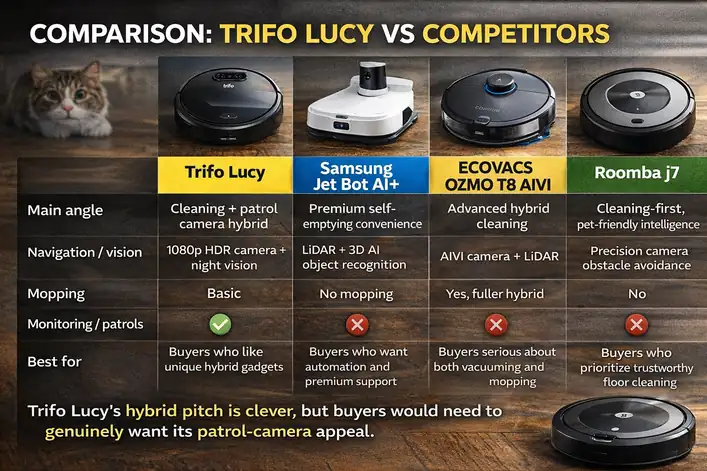
Comparison section with key competitors
| Model | Main angle | Navigation / vision | Mopping | Home monitoring | Best for |
|---|---|---|---|---|---|
| Trifo Lucy | Cleaning + patrol camera hybrid | 1080p HDR camera + depth sensor, camera-based mapping | Basic/light | Yes, with live view and alerts | Buyers who want one device to clean and watch |
| Samsung Jet Bot AI+ | Premium AI cleaning with self-empty focus | LiDAR + 3D sensor / AI object recognition | No | Yes, via front camera | Buyers who want smarter navigation with stronger premium support |
| ECOVACS DEEBOT OZMO T8 AIVI | AI obstacle avoidance plus fuller hybrid cleaning | AIVI camera system + advanced mapping | Yes | Yes, HD video monitoring | Buyers who want a more mature vacuum-mop-camera blend |
| iRobot Roomba j7 / j7+ | Cleaning-first pet-home intelligence | PrecisionVision obstacle avoidance | No | No dedicated patrol role | Buyers who prioritize dependable avoidance over gadget novelty |
The table makes Lucy’s position clear. It was not the obvious winner on cleaning power, dock convenience, or mature ecosystem. Its real appeal was conceptual integration. Samsung’s Jet Bot AI+ pushed higher into premium convenience with self-emptying and AI object recognition. Ecovacs offered a stronger hybrid value for people who genuinely wanted both vacuuming and mopping with video-aware smarts. iRobot’s j7 series represented the opposite philosophy: less theatrical, more disciplined, and better aligned with the buyer who wants fewer collisions and better day-to-day trust. Lucy’s buyer had to actively want the patrol-camera angle, not just tolerate it.
That is why Lucy feels more niche than category-shifting in hindsight. It predicted where the market was going in some respects, especially around object recognition and visual intelligence, but rivals were better at deciding what to optimize. Samsung optimized premium automation. Ecovacs optimized richer hybrid capability. iRobot optimized practical avoidance and household trust. Lucy optimized the story that your robot might also be your roaming home eye. For some households, that was enough. For the wider market, it was probably too specialized.
What it gets right
Trifo Lucy gets real credit for ambition that was not purely cosmetic. The camera was not decoration. The room-recognition idea was not just branding. The remote monitoring functions added genuine use cases for pet owners and anxious travelers. The object-awareness pitch made sense in homes where cables, slippers, bowls, and pet mess can ruin ordinary robot runs. Its sturdy body, large bin, respectable battery, and thoughtful hardware layout also suggest that Trifo was serious about engineering, not just crowdfunding theater.
Just as importantly, Lucy understood earlier than many rivals that navigation quality is part of cleaning quality. A robot that knows more about a room often feels smarter even before you measure dust pickup. That gave Lucy a sort of editorial charm. It was trying to solve a real inconvenience: not just dirty floors, but the annoying mismatch between “autonomous” marketing and the constant supervision many robot vacuums still required.
Where it still has to prove itself
Trifo Lucy still has three big problems. First, independent cleaning performance did not consistently match the sophistication of the pitch. Second, the mopping function looked more like a checkbox than a mature secondary system. Third, the product’s reliance on app-connected intelligence makes long-term ownership feel more fragile than with simpler competitors, especially in light of later user reports about Trifo platform instability. None of those criticisms are abstract. They hit the exact buyers who would otherwise be most interested in Lucy: people who value convenience, trust, and unattended operation.
The larger issue is that multifunction products do not get graded on a curve. If you merge a camera, security role, smart mapping, and floor care into one machine, “pretty good at several things” may still be less useful than “excellent at one thing.” Lucy never quite proved that its bundle was the better bargain than a stronger cleaner plus a separate home camera. That does not make the idea bad. It makes the standard of proof higher.
Pricing and value for money
Trifo Lucy launched into the market at a distinctly premium-for-its-time position. VentureBeat reported a $799 price when Trifo unveiled Lucy in early 2020, while campaign coverage highlighted Kickstarter entry pricing well below that, including early backer figures around the low-$500 range. That gap tells you exactly how Trifo wanted Lucy to be perceived: not as a budget robot, but as a feature-rich AI device whose value depended on buyers believing the surveillance layer meaningfully changed the product category. If you cared mostly about floor cleaning, that value argument was shaky. If you genuinely wanted cleaning plus remote visual monitoring in one machine, the math looked more plausible.
Today, value is even more conditional. As a historical product, Lucy is interesting. As a used-market proposition, buyers would need to think hard about software support, app dependency, and parts availability before treating it as a bargain. Hardware deals are not real deals if the ecosystem around them feels uncertain.
Buy it if / Skip it if
Buy it if: you are specifically drawn to the idea of one device handling routine floor cleaning, room patrols, live visual check-ins, and pet monitoring; you like experimental smart-home hardware; and you are willing to accept that the strongest part of the product may be its intelligence layer rather than its raw cleaning results.
Skip it if: your priority is best-in-class debris pickup, serious mopping, low noise, or the most dependable long-term ecosystem. Also skip it if you are uncomfortable with cameras inside the home or if you prefer simple appliances that keep working even when app platforms wobble. For a buyer who just wants less dirt and less hassle, something like a Roomba j7-family model or a stronger Ecovacs or Samsung alternative makes cleaner sense.
Final verdict
Trifo Lucy was one of those products that deserved attention even when it did not fully deserve unqualified praise. It was not empty hype. It really did try to push the robot vacuum into a more perceptive, more watchful, more multifunction future. And in some ways it got there early: camera-guided awareness, pet-home logic, room intelligence, remote viewing. But a serious review cannot stop at ambition. Lucy’s cleaning performance appears too mixed, its mop too secondary, and its long-term ownership story too dependent on software confidence to call it a fully convincing all-rounder. The fairest verdict is this: Lucy was genuinely interesting, occasionally smart in ways rivals later normalized, but never quite polished enough to turn its big idea into the most sensible choice for most buyers. For Maxmag readers, that makes it less a forgotten gem than an instructive near-hit—an ambitious niche machine that saw the future before it mastered the basics.
For readers who want to inspect the product lineage themselves, Trifo’s official Lucy product presence and the original Kickstarter campaign page still tell the story of how the brand wanted Lucy to be understood.