Floor care has become one of the strangest battlegrounds in home tech. Brands keep promising that one more wet-dry cleaner, one more steam function, one more self-cleaning dock will finally end the old routine of sweeping first and mopping later. What usually changes is convenience, not the underlying logic. What makes the BSTY Dual-Tank Floor Washing Machine worth attention is that it tries to change that logic: instead of asking one roller to deal with everything at once, it separates suction and mopping into a front-and-back cleaning path built around keeping dry debris away from the wet stage. That is a more intelligent pitch than the average “all-in-one” appliance, and it arrives at a moment when buyers are getting more skeptical about machines that claim to do everything but still smear mess around the house.
That does not automatically make it a winner. It does make it worth taking seriously. BSTY’s Kickstarter campaign describes a cordless 5-in-1 cleaner with 20,000Pa suction, a dual-lane cleaning path, a lie-flat design, high-temperature steam, self-cleaning, and self-drying, while BSTY’s own website positions the company as a newer home-cleaning brand founded in 2022 under Ant Technology and focused on rethinking floor care. The outside coverage has largely centered on the same theme: this machine is interesting because it claims to solve one of the most persistent flaws of the category, namely dirty-water redistribution and hair tangling, not because it simply adds another mode button.
What the product is
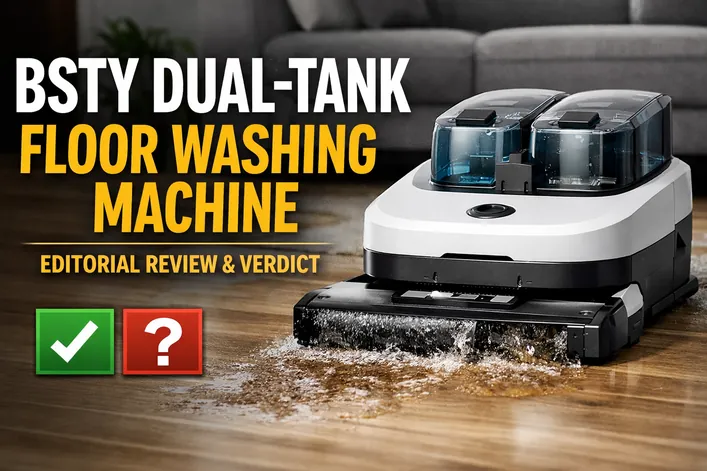
The BSTY Dual-Tank Floor Washing Machine is best understood as an attempt to redesign the vacuum-mop workflow rather than just accessorize it. According to the campaign and the coverage around it, the machine uses front suction to collect dry debris before a rear mopping stage handles the wet clean. That is paired with separate tanks for clean water and wastewater, plus claims around anti-tangle performance, odor reduction, high-temperature steam, and automated maintenance. On paper, that makes it part cordless floor washer, part steam floor cleaner, and part answer to a complaint many users already have with wet dry vacuum mop systems: they are convenient, but not always hygienic-feeling. For readers who want the source material, the official BSTY website and the Kickstarter campaign page are the two core references.
That positioning puts it in an intriguing middle ground. It is not a robot. It is not a bare-bones hard floor cleaner either. It is a premium-leaning manual cleaner designed for people who still want control over how the floor is cleaned but no longer want separate tools for crumbs, pet hair, damp spills, and post-cleanup maintenance. That is a real category need, especially in homes with mixed daily messes rather than occasional deep-clean sessions. The question is whether BSTY has solved that need in practice or simply packaged it more persuasively than others have.
First impressions
The BSTY Dual-Tank Floor Washing Machine makes a better first impression than many crowdfunding cleaners because its central idea is immediately understandable. “Vacuum first, mop after” is not marketing poetry; it is a direct appeal to common sense. If the machine really keeps dry debris from ever reaching the wet roller and waterway, it attacks two frustrating problems at once: sludge buildup inside the machine and the dirty-streak feeling some combo cleaners leave behind. That clarity helps explain why outside write-ups from Homecrux, Yanko Design, MensGear, and Gadgetify all gravitated to the same talking points. They did not treat it as just another cordless mop-vac; they treated it as a product with a distinct theory of cleaning.
It also helps that the spec sheet is aimed at familiar pain points rather than abstract smart-home theater. Buyers are being told about suction, hot water, tangle reduction, quieter modes, self-drying, and under-furniture reach. Those are everyday-use arguments. Even so, first impressions are still only first impressions. At this stage, much of the public case for the product is creator-led, campaign-led, or coverage-led rather than built on broad independent testing. For a cleaning appliance in this price range, that distinction matters.
Key features and specifications in real-world terms
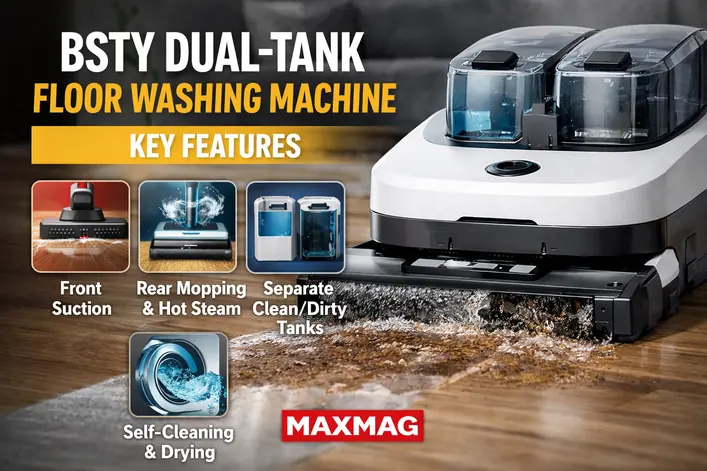
The BSTY Dual-Tank Floor Washing Machine is loaded with the kind of numbers that can sound impressive without telling a buyer much, so they need translation. The headline 20,000Pa suction claim means this is being pitched as far more than a damp mop with a motor. In practical terms, BSTY is arguing that the front section can pick up hair, crumbs, and larger debris before the rear section gets involved, which is precisely the promise that separates a dual tank mop vacuum from a standard one-path cleaner. The cited 600ml clean-water tank and 1L dirty-water tank suggest a machine built for medium-size sessions rather than whole-day cleaning, while the claimed 40-minute runtime and roughly 100 square meters of coverage place it in the normal cordless range for apartments and average family rooms, not huge multi-floor homes.
The steam and hot-water claims are where the product becomes more ambitious. Coverage says the rear system uses hot water up to 100°C and the campaign language references 180°C “true steam.” Those figures sound powerful, but buyers should read them carefully. High-temperature cleaning can absolutely help with sticky residue, oily kitchen film, and the general “did this really get sanitized?” question. But what matters in the home is not just peak temperature in a chamber; it is how much heat actually reaches the floor, how consistently it is delivered, and whether it improves stain removal without making the machine more cumbersome. Those are meaningful distinctions that only wider real-world testing can settle.
BSTY also claims five modes, including Smart, Steam, Water, Quiet, and Vacuum, plus self-cleaning and high-temperature self-drying. That matters because maintenance is where many self-cleaning floor washer products start to lose goodwill. A machine can be excellent for ten minutes and still be annoying over six months if the brush smells, the dirty tank is unpleasant to empty, or the internals stay damp. On paper, BSTY understands that problem. Whether it has solved it better than established brands is still the bigger question.
Design, build, and usability
The BSTY Dual-Tank Floor Washing Machine appears designed around movement and access rather than just raw cleaning force. The campaign and coverage describe a 180-degree lie-flat reach, power-assisted traction, an ergonomic handle, and a slide-in charging dock, all of which matter more than they may sound on paper. A 6.2kg cleaner is not featherweight, but a self-propelled or assisted machine can feel dramatically lighter in use than the number suggests. Likewise, lie-flat cleaning is not a luxury feature; it is one of the few hardware decisions that directly reduces how often users abandon a cleaner and grab a cloth for the awkward spaces anyway.
There is, however, a slight tension in the product’s promise. Any machine that tries to combine strong suction, hot-water or steam treatment, dual-tank separation, and automatic maintenance risks becoming physically larger and mechanically more complex than a simpler wet floor cleaner. Complexity is not automatically bad, but it usually carries trade-offs in noise, long-term upkeep, repairability, and dock footprint. This is where a newer brand has to work harder than a legacy one: not just to impress in demos, but to reassure buyers that the product will remain dependable after repeated real household abuse.
Performance and experience in practical use
The BSTY Dual-Tank Floor Washing Machine looks strongest when the mess is mixed: pet hair near a damp kitchen spill, fine dust before a mopping pass, or daily traffic grime that does not justify dragging out separate appliances. In theory, the split cleaning path is better suited to these scenarios than a single-path roller that tries to suck, scrub, and stay clean at the same time. That is the core practical case for the machine. It is not promising miraculous cleaning science; it is promising a workflow that better reflects how people already know floors should be cleaned.
What remains uncertain is how well the execution holds up on difficult edges of real use: dried-on stains, larger wet debris, hair-heavy homes, and repeated cleaning sessions without performance drop-off. Other premium cordless floor washers show why this matters. Dreame’s H15 Pro Heat, for example, pushes hot-water cleaning and long runtime but has already been criticized in review coverage for design choices that can interfere with glide and large-debris pickup. That is a useful reminder that a clever concept can still stumble in floorhead behavior, maneuvering, or debris handling. BSTY’s architecture may avoid some of those issues, but until it is tested more broadly, that remains an informed possibility rather than a settled conclusion.
What makes this different
The BSTY Dual-Tank Floor Washing Machine is differentiated less by having steam or self-cleaning than by where it places the split between dry and wet work. Plenty of rivals already separate clean and dirty water. Plenty already self-clean. Plenty now market steam, hot water, anti-tangle features, or lie-flat reach. What BSTY is really selling is the idea that the most flawed part of the category is the one-pass mixing of debris and moisture, and that a dual-lane cleaner can make the process feel cleaner in both senses of the word. That is a meaningful distinction, and a better one than generic “smart cleaning” language.
If the machine works as claimed, its advantage is not branding or ecosystem. It is engineering logic. If it does not, then the differentiation weakens quickly, because the rest of the pitch starts to resemble what premium rivals already offer. That is why the product is interesting: not because it is obviously dominant, but because it has a sharper thesis than most campaign hardware in this category.
Who this product is for
This machine makes the most sense for buyers who actively dislike the compromises of ordinary mops and ordinary vacuum-mops. Think pet owners dealing with hair and tracked-in grime, families cleaning kitchens and dining zones repeatedly, or anyone who wants a cordless floor washer that can handle both dry and damp mess without the “am I just spreading this around?” feeling. It is less compelling for very small homes with light cleaning needs, and less obviously ideal for bargain shoppers, because its value depends on whether the workflow advantage proves real enough to justify paying above basic alternatives.
It is also best for buyers who understand crowdfunding risk. This is not the same as buying a mature, widely reviewed product from a long-established support network. Serious potential buyers should separate the appeal of the concept from the certainty of the ownership experience. Those are not the same thing.
Comparison with key competitors
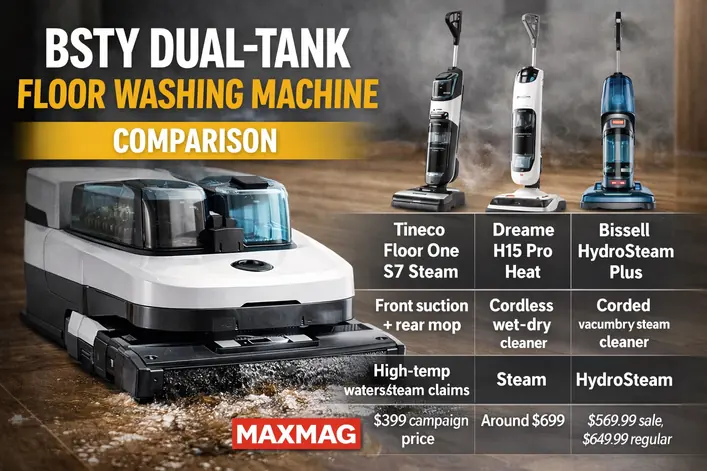
The BSTY Dual-Tank Floor Washing Machine enters a market where established brands already cover the familiar premium talking points: separate tanks, heat or steam, self-cleaning docks, and edge access. What BSTY is trying to do differently is re-sequence the cleaning process itself. That makes the most relevant comparisons less about headline specs and more about buyer priorities.
| Product | Core approach | Heat / steam | Runtime / power | Maintenance features | Positioning / price |
|---|---|---|---|---|---|
| BSTY F3-A | Front suction + rear mop, dual-lane cleaning | High-temp water / steam claims | 20,000Pa, 40 min, 3900mAh | Self-cleaning, high-temp self-drying | Crowdfunded premium concept, $399 campaign price |
| Tineco Floor One S7 Steam | Established premium cordless wet-dry cleaner | Steam | 40 min | Self-cleaning, smart sensing | Brand-name premium, around $699 |
| Dreame H15 Pro Heat | Hot-water wet-dry vacuum with AI features | 85°C hot water, 100°C brush wash | 22,000Pa, up to 72 min | Self-cleaning, self-drying | Feature-heavy premium, $569.99 sale / $649.99 regular |
| Bissell CrossWave HydroSteam Plus | Vacuum, wash, and steam with corded convenience | HydroSteam | Corded | Self-clean cycle | Mainstream value option, $299.99 |
Those trade-offs are fairly clear. Tineco is the easier recommendation for buyers who want a known premium ecosystem and proven retail presence. Dreame appeals to spec chasers who want stronger runtime and an already-commercialized high-heat story. Bissell remains attractive for buyers who care more about price and established retail support than cordless freedom. BSTY’s opening is that none of those products sell the “vacuum first, mop after” architecture in quite the same way. So the buyer it fits best is not simply the person wanting the cheapest hard floor cleaner or the most famous one; it is the buyer who believes the category’s biggest flaw is process design and is willing to bet on a newer brand addressing that directly.
What it gets right
The BSTY Dual-Tank Floor Washing Machine gets the theory right. It identifies a real frustration, frames it clearly, and proposes a solution that sounds grounded rather than gimmicky. The separation of suction and mopping is easy to understand. The attention to tangles, odor, self-drying, and under-furniture reach shows the brand is thinking about ownership friction, not just lab-demo performance. Just as importantly, the campaign price of $399 places it below some of the most aggressive premium rivals while still presenting itself as more ambitious than many midrange cleaners. That combination gives it a plausible lane in the market.
Where it still has to prove itself
The BSTY Dual-Tank Floor Washing Machine still has to prove nearly everything that separates a clever crowdfunding appliance from a truly recommendable home product: durability, parts availability, warranty confidence, consistency of steam or hot-water performance, edge cleaning, hair-heavy reliability, and whether the dual-lane architecture is genuinely superior over months rather than minutes. The public coverage so far is mostly descriptive and concept-driven. That is understandable for a newer release, but readers should not confuse a strong narrative with settled performance evidence.
There is also a small credibility issue in the surrounding brand presentation. BSTY’s official website clearly confirms the company and the F3-A, but parts of the site look unfinished or templated, which does not inspire the same confidence as a mature, polished retail presence. That does not invalidate the product. It simply reinforces that buyers are being asked to evaluate a promising machine from a still-developing brand.
Pricing and value for money
The BSTY Dual-Tank Floor Washing Machine was promoted at $399 on Kickstarter, with the campaign ultimately raising $482,879 from 157 backers against a $10,000 goal. At that figure, the value proposition is understandable. It sits above basic mainstream cleaners but below some premium cordless rivals, which is exactly where an innovative crowdfunded product should try to land. If BSTY delivers close to its claims, the price could look smart. If the execution turns out inconsistent, the savings versus a mature Tineco or Dreame may not feel large enough to offset the risk.
Buy it if / Skip it if
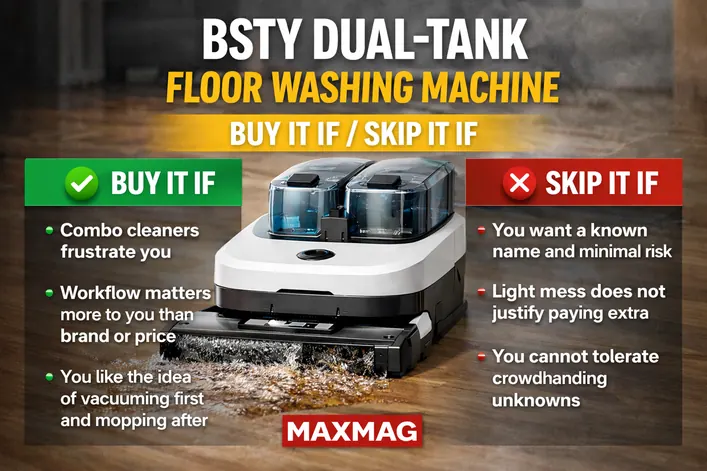
Buy it if
You are specifically frustrated by combo cleaners that seem to remix hair, crumbs, and dirty water into one damp compromise; you want a cordless floor washer with a more logical cleaning sequence; and you are comfortable backing a newer brand because the concept itself matches your needs better than the usual one-pass design.
Skip it if
You want mature support infrastructure, abundant independent reviews, and minimal risk; you only clean light messes and do not need a more elaborate machine; or you would rather buy from an established retail brand even if that means paying more or giving up the dual-lane concept.
Final verdict
The BSTY Dual-Tank Floor Washing Machine is one of the more genuinely interesting floor-care launches to come through crowdfunding lately, not because it piles on buzzwords, but because it targets a real weakness in the category with a coherent engineering idea. Its promise is easy to grasp and potentially useful: keep the dry mess out of the wet stage, make maintenance easier, and make combo cleaning feel less compromised. That gives it real editorial interest. What it does not yet have is the depth of independent validation needed to call it a fully proven buy. For now, this looks less like a category-shifting certainty and more like an intelligently designed contender that could be genuinely competitive if the real-world performance matches the pitch. That makes it worth attention, but not blind trust.