
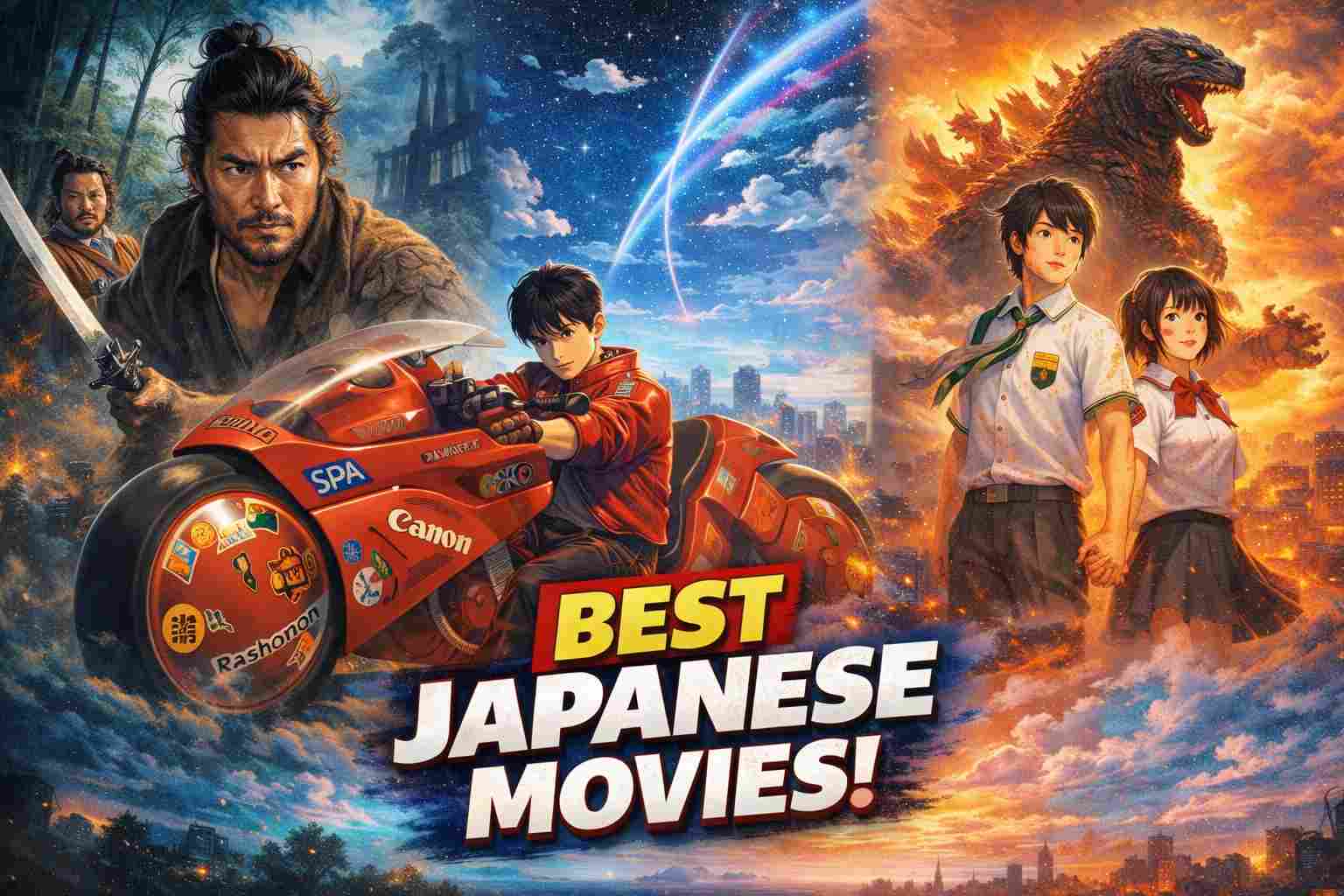
Japanese movies have a gift for turning quiet moments into deep jolts of feeling. One night you can ride into the mud-and-rain heroism of Seven Samurai, where dignity is tested by hunger and fear. Another night you can sit with Tokyo Story, a family drama so restrained it can feel like real life catching up to you. Animation is not a side street in Japan, either, and Spirited Away proves wonder can be both funny and unsettling. Across decades, classic Japanese cinema keeps returning to the same questions about duty, community, and what we owe each other. It’s cinema built for rewatching. Even the loudest stories tend to make room for silence. That balance is the tradition’s secret weapon.
How we picked Japanese movies
We built this list to represent range: classic Japanese cinema, samurai epics, contemporary character dramas, and Japanese animated films that still feel fresh. Every pick had to clear an IMDb rating of at least 6.0/10, and we weighed cultural impact, rewatch value, and viewer sensitivity when choosing. The ranking is ordered by IMDb score from #24 (lowest) up to #1 (highest), with ties broken by editorial judgment. All IMDb ratings in this article were verified on 13 January 2026. You’ll also see tone and suitability notes so it’s easier to press play with confidence.
24. Drive My Car (2021)
- Actors: Hidetoshi Nishijima, Toko Miura, Masaki Okada
- Director: Ryusuke Hamaguchi
- Genre: drama
- Tone: meditative, quietly intense
- Suitable for: adults and mature teens
- IMDb rating: 7.5/10
A theater director takes a residency in Hiroshima and is assigned a quiet young chauffeur. During long drives, their guarded conversations turn into a slow exchange of grief, guilt, and unexpected trust. The film listens more than it speaks. It’s patient. Scenes play out in extended takes that let feelings surface without being announced. Content note: the story deals with bereavement and infidelity, and it can feel emotionally heavy. It deserves its spot for showing how Japanese movies can be intimate while still expansive. Best for viewers who like reflective storytelling and don’t mind a slow burn.
23. Battle Royale (2000)
- Actors: Tatsuya Fujiwara, Aki Maeda, Takeshi Kitano
- Director: Kinji Fukasaku
- Genre: action, thriller
- Tone: brutal, adrenaline-charged
- Suitable for: adults only
- IMDb rating: 7.5/10
A class of teenagers is forced into a government-run death match on an isolated island. Friendships and rivalries explode under pressure as the rules push everyone toward panic. The setup is simple, but the emotions are messy. It hits hard. The pacing is fast and jagged, mixing satire, despair, and sudden bursts of chaos. Content note: graphic violence involving minors makes this strictly adults only. It earns its place because Japanese movies sometimes capture social panic with ferocious clarity. Watch it if you want provocation rather than comfort.
22. The Wind Rises (2013)
- Actors: Hideaki Anno, Hidetoshi Nishijima, Miori Takimoto
- Director: Hayao Miyazaki
- Genre: animation, drama
- Tone: bittersweet, reflective
- Suitable for: teens and adults
- IMDb rating: 7.8/10
A young engineer dreams of designing planes and chases that dream through love, illness, and political change. His talent is real, but the world around him keeps asking what that talent will serve. It’s gentle, then unsettling. Beauty comes with a cost. Miyazaki’s animation stays airy even when history turns darker, creating quiet tension throughout. Romance softens the story, but it never erases the moral questions. It belongs here because Japanese movies can hold adult ambiguity with grace, even in animation. Best for viewers who like reflective biographical drama more than action.
21. Shoplifters (2018)
- Actors: Lily Franky, Sakura Ando, Mayu Matsuoka
- Director: Hirokazu Kore-eda
- Genre: drama
- Tone: compassionate, quietly devastating
- Suitable for: adults and mature teens
- IMDb rating: 7.9/10
A makeshift household survives in Tokyo on thin wages and petty theft, held together by affection and routine. When they take in a neglected child, the family’s warmth becomes inseparable from its secrets. The movie feels tender, then sharp. It sneaks up on you. Kore-eda films everyday moments with such care that even a supermarket run can feel like a confession. Content note: child neglect and emotional distress are central themes, though handled with empathy. It earns its place by widening what family can mean in Japanese movies. Great for viewers who want a human story that lingers.
20. Tampopo (1985)
- Actors: Tsutomu Yamazaki, Nobuko Miyamoto, Ken Watanabe
- Director: Juzo Itami
- Genre: comedy
- Tone: playful, cheeky
- Suitable for: adults and older teens
- IMDb rating: 7.9/10
A widowed ramen-shop owner teams up with a truck driver to perfect the ultimate bowl of noodles. Along the way, comic side stories riff on etiquette, obsession, and the strange rituals of eating. The film is mischievous and inventive. Laughs come easy. Itami’s tone jumps from sweet to absurd without losing its affectionate core. Content note: a few sexual and suggestive moments make it better for older teens and adults. It deserves a slot here because Japanese movies can be as buoyant as they are profound. Pick it when you want something smart and warm.
19. Akira (1988)
- Actors: Mitsuo Iwata, Nozomu Sasaki, Mami Koyama
- Director: Katsuhiro Otomo
- Genre: animation, sci-fi
- Tone: explosive, apocalyptic
- Suitable for: adults and older teens
- IMDb rating: 8.0/10
In a fractured Neo-Tokyo, a biker gang collides with secret experiments and forces nobody can control. Street bravado turns into nightmare as power awakens in the wrong hands. The world is loud and electric. Neon burns. The themes—trauma, authority, and social collapse—feel eerily current despite the setting’s future shock. Content note: graphic violence and body horror make this a mature watch. It earns its place because Japanese movies helped redefine global sci-fi animation through this one. Best for viewers who like dystopias with scale and bite.
18. Perfect Blue (1997)
- Actors: Junko Iwao, Rica Matsumoto, Shinpachi Tsuji
- Director: Satoshi Kon
- Genre: thriller
- Tone: paranoid, psychologically sharp
- Suitable for: adults only
- IMDb rating: 8.0/10
A pop idol leaves her group to pursue acting, and her identity starts to fracture under stalking and pressure. Reality, performance, and paranoia collapse into one another until the ground won’t hold still. The film feels like a spiral. It tightens fast. Kon’s editing turns pop culture into menace, with images that echo like bad dreams. Content note: disturbing violence and sexual assault themes make this adults only. It belongs here because Japanese movies can deliver horror through psychology as much as shadow. Choose it if you want a tense mind-game.
Why Japanese movies still resonate today
The first part of the ranking leans modern, sharper-edged, and sometimes uncomfortable, but the next stretch opens into deeper emotional and historical terrain. Here you’ll feel the craft of older film classics, the moral clarity of samurai epics, and the dream logic that later shaped so much world cinema. These films don’t chase novelty for its own sake. They chase truth, even when it stings.

17. The Tale of the Princess Kaguya (2013)
- Actors: Aki Asakura, Kengo Kora, Takeo Chii
- Director: Isao Takahata
- Genre: animation, fantasy
- Tone: lyrical, heartbreaking
- Suitable for: families with older kids
- IMDb rating: 8.0/10
A bamboo cutter discovers a tiny girl who grows at miraculous speed, and her life becomes a tug-of-war between freedom and expectation. Takahata’s brushstroke animation makes every gesture feel alive, like a folktale painted in motion. It is beautiful. So is the ache. As Kaguya is pushed toward courtly perfection, joy becomes fragile and fleeting. The pacing is gentle, but the emotion lands with force by the end. It earns its place for showing Japanese movies can be playful and piercing at once. Best for families with older kids and anyone who likes bittersweet myths.
16. Departures (2008)
- Actors: Masahiro Motoki, Ryoko Hirosue, Tsutomu Yamazaki
- Director: Yojiro Takita
- Genre: drama
- Tone: tender, life-affirming
- Suitable for: teens and adults
- IMDb rating: 8.0/10
A musician loses his job and accidentally becomes an apprentice in traditional funeral preparation. At first he hides the work, but the rituals slowly teach him what dignity looks like in the face of death. It’s quietly moving. Small gestures matter. The film balances humor and grief so the heaviness never overwhelms the warmth. Content note: frequent funeral scenes may be difficult for some viewers, even though the tone is humane. It belongs here because Japanese movies can turn ceremony into empathy without preaching. Watch it when you want something restorative.
15. My Neighbor Totoro (1988)
- Actors: Noriko Hidaka, Chika Sakamoto, Hitoshi Takagi
- Director: Hayao Miyazaki
- Genre: animation, family
- Tone: comforting, magical
- Suitable for: whole family
- IMDb rating: 8.1/10
Two sisters move to the countryside while their mother is in the hospital, and they find wonder in the woods around their new home. The story avoids loud villains and instead honors the quiet fears children carry when adults are worried. It feels like summer. It feels safe. The forest spirits are playful, but the film’s real magic is its attention to everyday sound, weather, and touch. The pacing is soft and episodic, like memories arriving in bright fragments. It earns its place by proving Japanese movies can be gentle without being slight. Perfect for family nights that need warmth.
14. Rashomon (1950)
- Actors: Toshiro Mifune, Machiko Kyo, Takashi Shimura
- Director: Akira Kurosawa
- Genre: drama, mystery
- Tone: tense, philosophical
- Suitable for: teens and adults
- IMDb rating: 8.1/10
A violent incident in a forest is retold through conflicting testimonies, each reshaping the truth to protect the teller. What looks like a mystery becomes a meditation on pride, memory, and self-deception. Doubt drives everything. Truth keeps slipping. Kurosawa’s staging is direct and vivid, turning repetition into a blade rather than a loop. Content note: the central crime involves sexual violence and should be approached with care. It belongs in any guide to Japanese film history because it changed how movies could treat perspective. Best for viewers who like moral puzzles more than neat answers.
13. Tokyo Story (1953)
- Actors: Chishu Ryu, Chieko Higashiyama, Setsuko Hara
- Director: Yasujiro Ozu
- Genre: drama
- Tone: bittersweet, quietly devastating
- Suitable for: adults and teens
- IMDb rating: 8.1/10
An elderly couple travels to Tokyo to visit their grown children and discovers how distance can hide inside politeness. Ozu doesn’t scold anyone; he simply watches routines and silences do their work. It is deceptively simple. It breaks hearts softly. The pace is gentle and the camera stays calm, so every small dismissal lands harder. Grief arrives in ordinary moments, like a meal unfinished or a train schedule kept. It deserves its place because it distills classic Japanese cinema into pure emotional clarity. Best for viewers who want a humane film that feels true to life.
12. Ugetsu (1953)
- Actors: Masayuki Mori, Machiko Kyo, Kinuyo Tanaka
- Director: Kenji Mizoguchi
- Genre: drama, fantasy
- Tone: eerie, mournful
- Suitable for: teens and adults
- IMDb rating: 8.1/10
In a countryside shaken by war, two men chase profit and status while their families pay the price. Their ambition draws them into a ghostly seduction that feels like a dream turning sour. The film is haunting. Beauty stings. Mizoguchi’s long takes create dread without cheap shocks, so the mood seeps in slowly. The pacing is patient, letting tragedy unfold with the calm of an old tale told at night. It earns its place in Japanese movies by showing how fantasy can sharpen moral consequence. Best for viewers who like atmospheric classics with emotional weight.
11. Late Spring (1949)
- Actors: Setsuko Hara, Chishu Ryu, Haruko Sugimura
- Director: Yasujiro Ozu
- Genre: drama
- Tone: tender, quietly wrenching
- Suitable for: adults and teens
- IMDb rating: 8.2/10
A devoted daughter cares for her widowed father, and marriage becomes a question of how to let go with grace. The plot is spare, but the emotions live in glances, pauses, and everyday chores. It is intimate. It hurts quietly. Ozu turns domestic spaces into emotional landscapes, where a hallway or a kettle can carry meaning. The pacing is unhurried, letting you feel time pass in real-life terms rather than plot beats. It belongs among Japan’s great domestic dramas because it captures social change without speeches. Best for viewers who appreciate subtle feeling and precise observation.
10. Yojimbo (1961)
- Actors: Toshiro Mifune, Tatsuya Nakadai, Yoko Tsukasa
- Director: Akira Kurosawa
- Genre: action, drama
- Tone: sardonic, swaggering
- Suitable for: teens and adults
- IMDb rating: 8.2/10
A wandering ronin walks into a crooked town split between rival gangs and decides to play both sides. His schemes feel funny at first, then turn dangerous as the cruelty underneath the town shows itself. It is sharp. It has swagger. Kurosawa’s staging is crystal clear, and Mifune swings from comedy to menace in a blink. The pacing moves briskly, building toward confrontations that feel both mythic and street-level. It earns its place for showing Japanese samurai films can be cynical, entertaining, and morally pointed at once. Great for viewers who want action with personality and bite.
9. Ran (1985)
- Actors: Tatsuya Nakadai, Akira Terao, Jinpachi Nezu
- Director: Akira Kurosawa
- Genre: drama, war
- Tone: tragic, operatic
- Suitable for: adults and mature teens
- IMDb rating: 8.2/10
An aging warlord divides his kingdom among his sons, and the decision detonates everything he believes he controls. Betrayal spreads across castles and fields until family becomes the sharpest weapon. The scale is enormous. So is the despair. Kurosawa uses color and silence to make violence feel inevitable rather than thrilling. The pacing is measured, building toward set pieces that unfold like history collapsing in real time. It deserves its place in Japanese movies because it turns a samurai epic into a meditation on power and ruin. Best for viewers ready for tragedy with grandeur.
Discover Japanese movies for every mood
From this point on, the IMDb scores climb into the stratosphere, and so does the craft. Try grouping the remaining titles into mini-marathons: a night of Japanese animation, a night of Japanese crime thrillers, then a double feature of earlier classics. Pair High and Low with Rashomon for a Kurosawa mood shift, or Totoro with Kaguya for two very different kinds of tenderness. The list is meant to be mixed and matched.

8. Ikiru (1952)
- Actors: Takashi Shimura, Shinichi Himori, Haruo Tanaka
- Director: Akira Kurosawa
- Genre: drama
- Tone: humane, quietly inspiring
- Suitable for: teens and adults
- IMDb rating: 8.3/10
A weary bureaucrat learns he is seriously ill and realizes he has spent decades avoiding real life. His search for purpose is not flashy, but it becomes quietly radical as he chooses one meaningful act. The film feels simple. It is not. Kurosawa builds compassion through ordinary encounters, showing how small kindness can change a person’s last months. The pacing shifts from observation to urgency, mirroring the character’s new clarity. It belongs here because Japanese movies often find power in humility. Best for viewers who want hope that still feels earned.
7. Princess Mononoke (1997)
- Actors: Yoji Matsuda, Yuriko Ishida, Yuko Tanaka
- Director: Hayao Miyazaki
- Genre: animation, fantasy
- Tone: epic, morally complex
- Suitable for: older kids, teens, and adults
- IMDb rating: 8.3/10
A young warrior is cursed and pulled into conflict between an industrial settlement and a forest of ancient spirits. The film refuses easy heroes, letting humans and gods share blame, courage, and blindness. It is huge. It is intimate. Action scenes are fierce, but the real tension is philosophical, about coexistence and the price of progress. Content note: violence and gore are stronger than many animated films, so it suits older kids and up. It earns its place because Japanese animation can deliver spectacle while staying morally nuanced. Great for viewers who like adventure with ideas.
6. High and Low (1963)
- Actors: Toshiro Mifune, Yutaka Sada, Tatsuya Nakadai
- Director: Akira Kurosawa
- Genre: crime, thriller
- Tone: tense, methodical
- Suitable for: teens and adults
- IMDb rating: 8.4/10
A wealthy executive faces an extortion plot that forces him to choose between money and a child’s life. The first half is a pressure cooker in one room, then the story expands into a citywide hunt with relentless logic. It is pure suspense. Every detail counts. Kurosawa makes police work tactile, from train timetables to street corners, while keeping moral stakes front and center. The pacing stays brisk because each scene adds information and consequence. It belongs here as one of the sharpest Japanese crime thrillers ever made. Best for viewers who love smart procedures with real emotion underneath.
5. Your Name (2016)
- Actors: Ryunosuke Kamiki, Mone Kamishiraishi, Masami Nagasawa
- Director: Makoto Shinkai
- Genre: animation, romance
- Tone: romantic, exhilarating
- Suitable for: teens and adults
- IMDb rating: 8.4/10
Two teenagers begin switching bodies without warning and leave notes to keep each other’s lives from collapsing. What starts as comedy becomes longing, then becomes a race against time with real emotional stakes. It is tender. It is thrilling. Shinkai’s visuals turn sky and city lights into a language of desire, memory, and fate. The pacing accelerates in waves, mixing everyday charm with mounting urgency. It earns its place among Japanese movies because it proves a modern love story can feel mythic and immediate at once. Best for viewers who want romance with a big, heartfelt hook.
4. Grave of the Fireflies (1988)
- Actors: Tsutomu Tatsumi, Ayano Shiraishi, Akemi Yamaguchi
- Director: Isao Takahata
- Genre: animation, war drama
- Tone: devastating, intimate
- Suitable for: adults and mature teens
- IMDb rating: 8.5/10
Two siblings struggle to survive in the final months of World War II, protecting each other as society collapses around them. The story is straightforward, and that plainness makes it almost unbearable. It is heartbreaking. Bring tissues. Takahata refuses sentimentality, showing how hunger, pride, and shame grind people down through daily choices. The pacing is calm, which makes the tragedy feel even more inevitable. Content note: the film centers on child suffering and is emotionally intense, so it is not a casual family pick. Best for viewers prepared for a powerful, sobering classic.
3. Spirited Away (2001)
- Actors: Rumi Hiiragi, Miyu Irino, Mari Natsuki
- Director: Hayao Miyazaki
- Genre: animation, fantasy
- Tone: wondrous, adventurous
- Suitable for: older kids and whole family
- IMDb rating: 8.6/10
A timid girl wanders into a spirit bathhouse and must work to save her parents and find her way home. The world is strange, funny, and sometimes frightening in the exact way childhood fears feel real. It is pure imagination. It also has teeth. Miyazaki fills the frame with creatures and rituals, but the emotional arc stays grounded in courage and empathy. The pacing is brisk, with set pieces that feel like dreams you can walk through. It earns its place in Japanese movies by proving fantasy can be as emotionally precise as realism. Perfect for families who want wonder with a hint of darkness.
2. Seven Samurai (1954)
- Actors: Toshiro Mifune, Takashi Shimura, Keiko Tsushima
- Director: Akira Kurosawa
- Genre: action, drama
- Tone: epic, rousing
- Suitable for: teens and adults
- IMDb rating: 8.6/10
A poor farming village hires ronin to defend it from bandits, and the recruitment becomes a study in character as much as strategy. Each samurai arrives with a different wound, pride, or principle, and the group slowly becomes a community. It is long. It flies. Kurosawa’s action is clear and muscular, but the heart lies in class tension and hard-earned solidarity. The pacing builds patiently, then erupts into battles that still feel modern in rhythm and clarity. It earns its place because samurai epics rarely reach this mix of spectacle, humor, and human truth. Best for viewers who want a big classic that still feels alive.
1. Harakiri (1962)
- Actors: Tatsuya Nakadai, Akira Ishihama, Shima Iwashita
- Director: Masaki Kobayashi
- Genre: drama
- Tone: fierce, morally blistering
- Suitable for: adults and mature teens
- IMDb rating: 8.6/10
A ronin arrives at a clan estate requesting a ceremonial suicide, and the request forces the household to confront its own cruelty. Controlled revelations turn dignity into accusation, and tradition into something sharp and dangerous. It is devastating. It is precise. Kobayashi stages the drama like a courtroom in armor, where every detail exposes hypocrisy. The pacing is deliberate, building toward a finale that feels both inevitable and shocking. Content note: suicide themes and violence are present and can be intense. It deserves the top slot because Japanese movies can use tradition to deliver moral clarity with real heat. Best for viewers who want a classic with no easy comfort.
Conclusion: revisiting Japanese movies
If you work through these picks slowly, Japanese movies start to feel like a set of emotional tools you can return to. Some titles comfort you, others challenge you, and the best ones do both at once. Build your own mini-season, rotating between Japanese samurai films, contemporary character dramas, and gentler Japanese coming-of-age films when you want warmth. The payoff is a wider range of movie nights that still feel personal.
To keep exploring with reliable context, institutions and archives can be more useful than any algorithmic carousel. MoMA’s exhibition materials on the history of Japanese film are a smart starting point for deeper digging across eras and styles. Use them to find directors you connect with, then follow the threads into their earlier and later work.
And when you want a critic’s lens on how a modern hit sits inside a longer tradition, Japanese movies are well served by strong cultural writing too. The New Yorker’s look at Your Name and its global impact is a helpful companion piece before you dive into more contemporary animation. Keep this list as a living checklist and let your favorites guide the next month of viewing.