

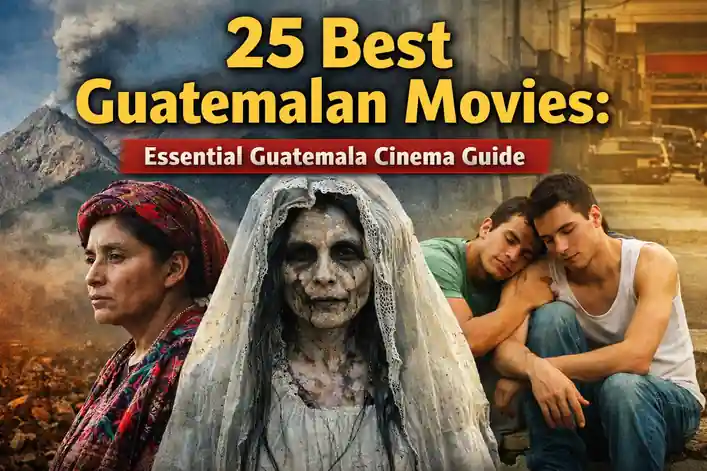
Guatemalan movies arrive with volcanic landscapes, intimate realism, and the aftershock of history. Even when the stories are private, the country’s public wounds press close to the frame. You’ll see Maya indigenous storytelling treated with texture and respect, not postcard gloss, and you’ll hear silence used as a dramatic tool. Small industry, big nerve here. Across eras, the cinema circles migration, class, faith, and accountability, often with patient pacing and sharp moral focus. From the border-crossing classic El Norte to the volcanic tragedy of Ixcanul and the political ghost story La Llorona, the range is striking. Humor shows up too, usually dry and observant. What links the best work is craft that stays close to people while keeping the larger system in view.
This guide helps you navigate films from Guatemala by tone first, then by era and intensity. Each entry gives you a quick snapshot—year, director, genre, tone, suitability, and an IMDb rating—so you can choose confidently. Pick a mood, then go deeper. If you’re new, start with the most accessible dramas and the lighter comedies before moving into the heavier documentaries. If you’re a film student, you can trace a line from historical testimony to modern auteur storytelling and see how style evolves. Families and mixed households will find options that work with older teens, while cinephiles can dig into formally daring titles. The list is ranked from lower to higher ratings, so you can climb toward the consensus essentials. Press play, then follow the threads.
How we picked Guatemalan movies
These picks span social dramas, thrillers, comedies, and documentaries tied to Guatemalan cinema, with a few Guatemala-centered international titles included for context within Latin American film. We favored films with strong craft, cultural impact, and rewatch value, while noting intensity and household comfort when relevant. Only titles with an IMDb rating of 6.5/10 or above were considered, and the ranking climbs from the lowest qualifying score at #25 to the highest at #1. All IMDb ratings in this article were verified on 20 February 2026.
25. Giants Don’t Exist (2017)
- Actors: Rafael Rojas, Patricia Orantes, Luis Carlos Pineda
- Director: Chema Rodríguez
- Genre: historical drama
- Tone: somber, reflective
- Suitable for: adults, mature teens
- IMDb rating: 6.5/10
A quiet boy grows up in rural Guatemala during the early 1980s as violence seeps into daily life. He watches adults negotiate fear, loyalty, and survival in a village that can’t hide from the conflict. The film’s heart is memory and testimony. It treats trauma with restraint rather than shock. Scenes move in measured beats, letting small gestures do the heavy lifting. It’s intense, but never sensational. By focusing on ordinary routines, it shows how history reshapes a childhood from the inside out. Choose it for a serious, contemplative night.
24. The Silence of Neto (1994)
- Actors: Oscar Isaacs, Giancarlo Esposito, Jacob Vargas
- Director: Luis Argueta
- Genre: coming-of-age drama
- Tone: warm, bittersweet
- Suitable for: teens, adults
- IMDb rating: 6.6/10
A schoolboy comes of age in Guatemala City as radio, rumor, and politics press in from every corner. Family life stays loving, but the streets keep changing, fast. It captures the pull between curiosity and caution. The humor lands softly. You can feel the era in the costumes, slang, and music cues. The tension arrives in waves. As a portrait of a city learning to live with uncertainty, it earns its classic status. Best for viewers who like character-first stories.
23. José (2018)
- Actors: Enrique Salanic, Manolo Herrera, Maria Mercedes Coroy
- Director: Li Cheng
- Genre: romantic drama
- Tone: tender, intimate
- Suitable for: adults, older teens
- IMDb rating: 6.6/10
A young man in Guatemala City balances a tough home life with the first rush of secret love. He moves between work, family expectations, and stolen hours that feel like oxygen. The film is about desire and constraint. It is also about dignity. Camera work stays close, almost breathing with him. Nothing is rushed. Its honesty makes the romance hit harder than melodrama ever could. Watch it when you want something quiet and human.
22. La Llorona (2019)
- Actors: María Mercedes Coroy, Sabrina De La Hoz, Margarita Kenéfic
- Director: Jayro Bustamante
- Genre: horror drama
- Tone: haunting, elegiac
- Suitable for: adults, brave teens
- IMDb rating: 6.6/10
A disgraced general faces a reckoning inside his own mansion as protests thunder outside the gates. A new maid arrives, and the household’s routines begin to fracture. This is horror as moral pressure, not jump scares. Quiet horror, huge implications for all. The sound design turns water, footsteps, and whispers into dread. The pace is deliberate. Among Guatemalan movies, it stands out for turning history into a ghost story with real bite. Best for viewers who like prestige horror with purpose.
21. Tremors (2019)
- Actors: Juan Pablo Olyslager, Diane Bathen, Mauricio Armas Zebadúa
- Director: Jayro Bustamante
- Genre: family drama
- Tone: tense, empathetic
- Suitable for: adults, mature teens
- IMDb rating: 6.6/10
A respected father in a conservative community is forced into “therapy” after he comes out as gay. His wife, children, and church circle become a pressure cooker around him. The film looks hard at faith and control. It never mocks belief. Performances are stripped back and raw. Silences do the shouting. What makes it powerful is its refusal to offer easy villains, only systems that hurt people. Pick it when you can handle heavy emotions.
20. Our Mothers (2019)
- Actors: Armando Espitia, Emma Dib, Aurelia Caal
- Director: César Díaz
- Genre: social drama
- Tone: gritty, compassionate
- Suitable for: adults, mature teens
- IMDb rating: 6.6/10
A young forensic anthropologist in Guatemala searches mass graves while his mother waits for answers. A new discovery hints his own father may be among the disappeared. It’s a film about work as mourning. And mourning as duty. The images are sunlit yet heavy, creating a painful contrast. The violence is mostly offscreen. Its calm, procedural rhythm makes the emotional punches land cleanly. Best for viewers drawn to serious human-rights stories.
19. Plaza Catedral (2021)
- Actors: Ilse Salas, Manolo Cardona, Fernando Cuautle
- Director: Abner Benaim
- Genre: drama
- Tone: reserved, cathartic
- Suitable for: adults, mature teens
- IMDb rating: 6.7/10
Two strangers in Panama City meet at a fragile moment and build trust without big speeches. One is grieving, the other is running from his own turmoil. The film studies loneliness in public spaces. It also believes in small kindness. The storytelling is minimalist and steady. No fireworks here. That restraint makes the final turns feel earned rather than engineered. Watch it for a low-key, emotional release.
18. Cadejo Blanco (2021)
- Actors: Karen Martínez, Rudy Rodriguez, Brandon López
- Director: Justin Lerner
- Genre: crime thriller
- Tone: gritty, tense
- Suitable for: adults, older teens
- IMDb rating: 6.7/10
A teenage girl pushes into a dangerous world to find her missing sister, one risky step at a time. Her search leads her to a criminal crew where loyalty is always conditional. It plays like a street-level noir. The danger feels close. Scenes are lean and forward-moving, with little room to breathe. Violence is present, but not glamorized. The film works because it mixes thriller momentum with genuine empathy for a young protagonist. Choose it when you want suspense over comfort.
17. Puro Mula (2011)
- Actors: Gustavo Véliz, Alfonso Lee, María Mercedes Coroy
- Director: Enrique Pérez
- Genre: comedy drama
- Tone: playful, rueful
- Suitable for: teens, adults
- IMDb rating: 6.8/10
A charming slacker drifts through Guatemala City, hustling his way out of responsibility. When his life jolts, he tries on adulthood like an outfit that doesn’t fit yet. The comedy is observational. It stays kind. City details—traffic, talk, nightlife—do a lot of world-building. It moves at an easy pace. As a snapshot of youth culture and aimlessness, it’s one of the country’s most approachable films. Great for a lighter, late-night watch.
Did you know that the most famous Guatemalan movies movie is:
El Norte (1983) is widely treated as the signature reference point because it carried a Guatemalan story into mainstream international conversation. Reliable ticket-sale totals aren’t consistently published for the film’s original run, so a useful proxy for its global footprint is critical aggregation, where Rotten Tomatoes lists 60 critic reviews. Those figures come from Rotten Tomatoes’ public tally and are echoed in standard reference summaries of the film’s reception. Director Gregory Nava and leads Zaide Silvia Gutiérrez and David Villalpando give the journey a grounded, lived-in urgency. The premise follows two siblings escaping violence and rebuilding life across borders, with survival constantly negotiated in small choices. It’s famous for blending social realism with emotional sweep, and for earning major awards attention that helped widen the audience for Central American stories. Its international reach has grown through decades of repertory screenings, classroom use, and diaspora viewing. Critics often cite it as a landmark immigration narrative and a durable piece of 1980s independent cinema. Right now it most commonly appears via major rental platforms and library-oriented catalogs rather than a single fixed streamer. A classic that still stings.

16. Ixcanul (2015)
- Actors: María Mercedes Coroy, Marvin Coroy, María Telón
- Director: Jayro Bustamante
- Genre: drama
- Tone: earthy, urgent
- Suitable for: adults, mature teens
- IMDb rating: 7.1/10
A young Kaqchikel woman lives on the slopes of a volcano, shaped by family, labor, and tradition. When she tries to choose her future, institutions close in with blunt force. The film is rooted in landscape and language. It feels tactile and real. Performances are naturalistic, with emotion carried in glances and pauses. It can be distressing. Among Guatemalan movies, it’s a landmark for bringing Indigenous life to the screen without tourist gloss. Best for viewers ready for a serious, immersive drama.
15. The Biggest House in the World (2015)
- Actors: Gloria López, Stella Martínez, Gabby Brazzil
- Director: Ana V. Bojórquez
- Genre: family drama
- Tone: gentle, hopeful
- Suitable for: older kids with parents, teens, adults
- IMDb rating: 7.1/10
A boy in a remote village dreams of building the “biggest house” after his father’s accident changes everything. His mother’s resilience becomes the film’s quiet engine. It’s a story about imagination as survival. And survival as love. The pacing is patient, letting small daily moments accumulate. It’s tender, not sugary. By the end, the dream feels less like architecture and more like a promise to keep going. Perfect for a sensitive, family-friendly evening.
14. 10 Kilos of Cocaine (2025)
- Actors: Daniella Kertesz, Maya Eshet, Leeoz Levy
- Director: Doron Eran
- Genre: crime drama
- Tone: tense, propulsive
- Suitable for: adults, older teens
- IMDb rating: 7.2/10
A true-crime inspired story follows a chain of people pulled toward a risky drug deal in Central America. Plans shift, alliances crack, and every decision tightens the knot. It’s about greed and panic. The stakes stay practical. Scenes cut quickly and keep momentum high. You’ll feel the clock ticking. What elevates it is the focus on consequences rather than swagger. Best when you want a sharp, plot-driven ride.
13. Granito: How to Nail a Dictator (2011)
- Actors: Rigoberta Menchú, Fredy Peccerelli, Kate Doyle
- Director: Pamela Yates
- Genre: documentary
- Tone: investigative, stirring
- Suitable for: teens, adults
- IMDb rating: 7.2/10
Filmmaker Pamela Yates returns to Guatemala as legal cases reopen the story of genocide and accountability. Her earlier footage becomes evidence, and the past comes back into courtrooms and living rooms. It’s a documentary about memory with teeth. And about justice, slowly built. The narrative combines archival material with present-day momentum. It’s dense, but gripping. Few films show so clearly how images can become tools for truth. Watch it when you want history and process, not spectacle.
12. Living on One Dollar (2013)
- Actors: Chris Temple, Zach Ingrasci, Sean Leonard
- Director: Chris Temple
- Genre: documentary
- Tone: grounded, empathetic
- Suitable for: older kids with parents, teens, adults
- IMDb rating: 7.3/10
Four friends try living on less than a dollar a day in rural Guatemala to understand poverty beyond statistics. They meet families who share food, labor, and hard-earned wisdom. It’s straightforward and personal. No lectures. The film keeps its focus on daily decisions—medicine, meals, and work. Some scenes are uncomfortable. Its value is the way it connects global economics to a single household’s week. Best for groups who want discussion afterward.
11. Finding Oscar (2016)
- Actors: Kate Doyle, Scott Greathead, Fredy Peccerelli
- Director: Ryan Suffern
- Genre: documentary
- Tone: tense, investigative
- Suitable for: adults, mature teens
- IMDb rating: 7.3/10
A team of investigators uncovers the truth behind a massacre and tracks the men responsible. The film follows documents, witnesses, and the long shadow of impunity. It’s a procedural story with human stakes. Faces stay with you. Editing keeps the pace brisk while still letting testimony breathe. It is emotionally heavy. Its strength is showing how evidence, patience, and courage can move a case forward years later. Best for viewers who can handle painful history.
10. The Art of Political Murder (2020)
- Actors: Jack Palladino, Helen Mack, Francisco Goldman
- Director: Paul W. Taylor
- Genre: documentary
- Tone: urgent, forensic
- Suitable for: adults, mature teens
- IMDb rating: 7.3/10
This investigation revisits a high-profile assassination and the web of power around it. Lawyers, activists, and journalists map how truth gets buried—and how it resurfaces. The film is detailed and relentless. It demands attention. Interview segments are cut with clarity, keeping complex politics legible. It can be upsetting. As a case study in modern accountability, it’s one of the sharpest documentaries tied to Guatemala’s recent past. Choose it when you’re in a focused, serious mood.
9. Estrellas de La Línea (2006)
- Actors: Valeria, Vilma, Mercy
- Director: Celeste Rojas Mugica
- Genre: documentary
- Tone: raw, empathetic
- Suitable for: adults, mature teens
- IMDb rating: 7.4/10
Three women who work the streets speak about money, survival, and the small freedoms they fight for. Their stories are direct, sometimes funny, sometimes heartbreaking. This documentary doesn’t romanticize anything. It listens. The camera stays close and respectful, letting the subjects control the emotional tempo. Some details are explicit. Its power comes from honoring voices that cinema often erases. Best for viewers who want honest social portraiture.
The Guatemalan movies is mostly famous for:
The signature trait is realism that feels intimate, even when the subject is national trauma. A second hallmark is the way sound—silence, prayers, street noise—does as much storytelling as dialogue. Historically, the arc runs from testimonial documentaries shaped by the Guatemalan civil war to a modern wave of auteur features that travel festivals and reach wider distribution. The industry is small, so co-productions, grants, and festival labs often matter as much as traditional studios. Social drama and documentary remain dominant because they match local urgencies and give filmmakers room to speak plainly. International visibility tends to come through Cannes, Berlin, Sundance-style circuits, and then through specialty streaming windows. Language and culture specificity—especially Maya indigenous storytelling and everyday Spanish—makes the films feel textured rather than generic. Today the challenge is funding and safety, but digital distribution also lets Central American cinema find audiences without waiting for big theatrical runs. Newcomers should start with one narrative landmark, one modern social drama, and one investigative documentary, then build mini-marathons by theme. With that context, the next stretch of films lands deeper.
8. The Silence of the Mole (2021)
- Actors: Elías Barahona, Anaïs Taracena, Pedro G. García
- Director: Anaïs Taracena
- Genre: documentary
- Tone: moody, revealing
- Suitable for: adults, mature teens
- IMDb rating: 7.5/10
A journalist known as “The Mole” once infiltrated a repressive government and later struggled with what he carried. The film pieces together interviews and fragile archives to reconstruct his life and Guatemala’s hidden stories. It’s a puzzle built from memory. And from loss. The visual style leans poetic, with damaged film textures and quiet narration. It’s intense, but not sensational. What lingers is the idea that truth can be both heroic and lonely. Watch it when you’re ready for reflective, politically charged cinema.
7. V.I.P.: Very Important Prisoners (2007)
- Actors: Juan Pablo Olyslager, Monica Palmieri, Jorge ‘El Pumita’ Asturias
- Director: Carolina Rabineau
- Genre: documentary
- Tone: observational, humane
- Suitable for: teens, adults
- IMDb rating: 7.6/10
Inside a prison, the film watches daily routines where dignity has to be negotiated, not assumed. Conversations, friendships, and quiet conflicts unfold without narration pushing you around. It’s observational filmmaking at its purest. Patient and clear. Moments of humor appear in unexpected places. So do moments of despair. By the end, you understand the institution as a whole ecosystem, not a headline. Best for viewers who like immersive, fly-on-the-wall docs.
6. The Golden Dream (2013)
- Actors: Brandon López, Rodolfo Domínguez, Karen Martínez
- Director: Diego Quemada-Díez
- Genre: drama
- Tone: harrowing, compassionate
- Suitable for: adults, mature teens
- IMDb rating: 7.6/10
Three teenagers from Guatemala head north, chasing work and the promise of a different life. On the road, every kindness has a cost, and every shortcut comes with danger. It’s a migration story told with empathy. No sentimentality. The film moves with the rhythm of travel—bursts of panic, long stretches of waiting. It is tough to watch. Its power lies in making the journey feel physical, not abstract. Choose it when you can handle intensity and want something deeply humane.
5. When the Mountains Tremble (1983)
- Actors: Rigoberta Menchú, Vicente Menchú, Nicolás
- Director: Pamela Yates
- Genre: documentary
- Tone: incisive, urgent
- Suitable for: adults, mature teens
- IMDb rating: 7.6/10
This landmark documentary surveys Guatemala’s conflict through testimony, interviews, and on-the-ground footage. It brings Indigenous voices into the center, refusing the comfort of distance. The film is direct and historically important. Very hard, at times. Editing moves between street-level reality and the structures of power above it. There is no easy catharsis. As a foundation for understanding later films and debates, it remains essential viewing. Watch it when you have emotional space.
4. La Isla: Archives of a Tragedy (2009)
- Actors: Rolando, Armando Morales, Verónica Morales
- Director: Uli Stelzner
- Genre: documentary
- Tone: sobering, investigative
- Suitable for: adults, mature teens
- IMDb rating: 7.7/10
A vast archive of police records becomes a doorway into decades of state violence and disappearance. Researchers and volunteers handle paper like evidence and grief at once. It’s a film about archives as witnesses. Chilling, but vital. The storytelling stays clear, using personal testimonies to keep the scale comprehensible. It can be emotionally draining. Few documentaries show so well how bureaucracy can be weaponized—and then, slowly, exposed. Best for viewers who want rigorous, reality-based cinema.
3. El Norte (1983)
- Actors: Zaide Silvia Gutiérrez, David Villalpando, Ernesto Gómez Cruz
- Director: Gregory Nava
- Genre: drama
- Tone: tense, bittersweet
- Suitable for: adults, mature teens
- IMDb rating: 7.7/10
Two siblings flee political violence in Guatemala and chase safety across borders and strange new cities. Their journey becomes a test of identity, endurance, and hope under pressure. It’s both a road movie and a tragedy. The emotional beats are sharp. Humor and fear share the same air, making the story feel painfully true. Some scenes are upsetting. Among Guatemalan movies, it’s the one that most clearly bridged local history and international audiences. Best for viewers who want a classic with lasting bite.
2. 500 Years (2017)
- Actors: Irma Alicia Velásquez Nimatuj, Matilde Terraza Gallego, Daniel Pascual Hernández
- Director: Pamela Yates
- Genre: documentary
- Tone: mobilizing, clear-eyed
- Suitable for: teens, adults
- IMDb rating: 7.8/10
This documentary tracks a massive civic movement as Indigenous communities and allies demand accountability. Courtrooms, streets, and villages become stages for a national reckoning. The film is about democracy in motion. It’s energizing. You see strategy, debate, and courage rather than a single heroic figure. The pacing stays brisk. As an on-ramp into modern Guatemala, it explains complex politics with uncommon clarity. Great for viewers who want context and momentum.
1. Comparsa (2025)
- Actors: Lesli Noemi Canela Perez, Guadalupe ‘Lupe’ Pérez, Mayra Guadalupe Canela Perez
- Director: Vickie Curtis
- Genre: documentary
- Tone: urgent, compassionate
- Suitable for: adults, mature teens
- IMDb rating: 8.0/10
This documentary follows women pushing for justice in a system designed to wear them down. Their testimonies, daily work, and solidarity build a portrait of courage under pressure. It’s focused and unflinching. Short, sharp scenes. The filmmaking avoids spectacle, letting the women’s words carry the weight. Some details may be distressing. Among Guatemalan movies, it feels like a contemporary call to attention that refuses to look away. Best for viewers ready for serious, real-world stakes.
Conclusion: revisiting Guatemalan movies
Use this ranking as a mood map: start with the accessible dramas and comedies, then move toward the investigative documentaries when you want context and weight. If you’re sampling Guatemalan movies for the first time, try one narrative feature and one documentary back-to-back to feel how story and evidence speak to each other. Return later by theme—migration, faith, justice, family—and you’ll notice new details on repeat viewings.
What stays memorable is range: a Spanish-language drama can sit beside poetic nonfiction, and both can feel formally confident without losing warmth. As Guatemalan cinema continues to travel, it also deepens the conversation inside Latin American film, proving that small industries can produce outsized artistic signatures. When you want to go deeper into Guatemalan movies, revisit the top five and build outward from there.
For wider context, browse the Library of Congress National Film Registry to see how preservation frames cultural impact, then compare coverage and criticism in The New York Times movies section. Follow the threads, not the hype.