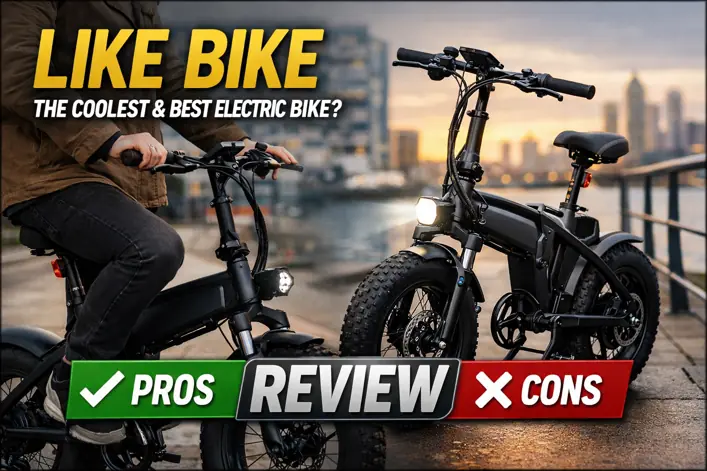
Electric bicycles are no longer a curiosity for gadget lovers. In many cities, they have become part of the daily rhythm: office workers trying to cut commute times, riders tired of traffic, and people who want something more practical than a car for shorter trips. Into that environment comes Like Bike, a compact electric bicycle built around a simple promise. It is supposed to be easy to live with, easy to ride, and easier to afford than a lot of the e-bikes competing for attention right now.
That sounds sensible. It also sounds familiar, because the e-bike category is now full of products claiming to be the ideal urban solution. The challenge is no longer getting noticed. The challenge is proving that a bike can hold up once the marketing language fades and real-world use begins. That is what makes this project interesting. Like Bike does not pitch itself as a high-performance specialist product. It is not trying to be an elite mountain bike, a cargo hauler, or a luxury commuter object. It is aiming at the large middle of the market: people who want a straightforward electric bicycle for normal life.
There is a genuine opening there. Plenty of riders want electric assistance, but they do not want a giant frame, intimidating price tag, or a machine that feels oversized for city streets. The appeal of Like Bike is that it seems to understand that audience. The bigger question is whether its practicality is as strong as its pitch.
What the Product Is
Like Bike is presented as a folding electric bike aimed at commuting and everyday riding. The basic formula is easy to grasp. It pairs a compact frame with motor assistance, a removable battery, and wide tires intended to make urban riding feel more stable and less fussy. Its natural audience is not the cyclist obsessing over premium components. It is the everyday rider who wants help with hills, longer trips, or the general drag of city travel.
That positioning matters. Electric bikes are often separated into very different camps. Some are built for aggressive off-road use. Some are designed around long-distance comfort. Some are essentially status objects with premium finishing and premium pricing. Like Bike appears to sit closer to the accessible commuter end of the spectrum. In theory, that is where a lot of demand lives.
The folding aspect is especially important. A foldable e-bike can make sense for people in apartments, for mixed commutes that involve a train or bus, or simply for riders who do not have the luxury of spacious storage. That alone gives it a stronger everyday logic than many full-size electric bikes that are awkward to carry, awkward to park, and awkward to keep indoors.
First Impressions
Visually, the bike makes a decent first impression. It looks modern without trying too hard. That is a useful balance. Some e-bikes go so aggressively futuristic that they start to resemble concept vehicles rather than practical transport. Others look too generic and disappear into a crowded market. Like Bike seems to aim for a middle path: compact, urban, recognizable, but not theatrical.
The wide tires do a lot of the visual work. They make the bike look tougher and more planted, and they also suggest comfort. For casual riders, that matters. Narrow tires can feel nimble, but they also make rough pavement, shallow potholes, and uneven surfaces more annoying than they need to be. Wide tires imply a softer, less nervous ride. For city use, that is a real advantage, not just a styling choice.
The proportions also help communicate its purpose. This is not a bike that wants to dominate the road. It wants to fit into everyday life. That is often more valuable.
Key Features and Specifications in Real-World Terms
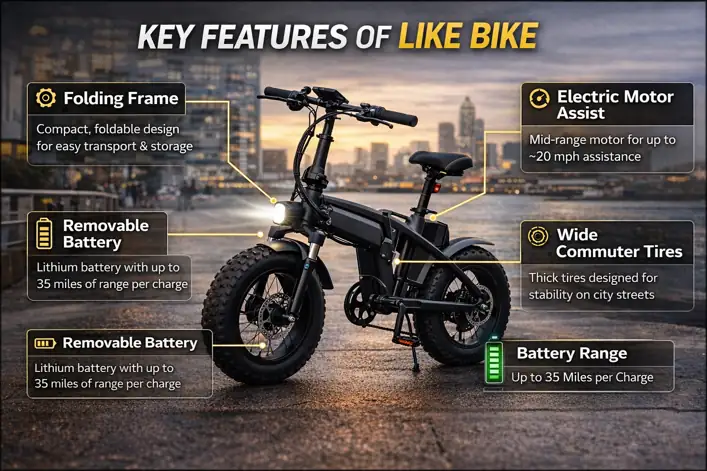
On paper, the feature set sounds familiar for an urban electric bike, but that does not mean it is unimportant. The details still matter because commuter bikes succeed or fail on usability. A folding frame is not useful if the folding process is frustrating. Battery range is not useful if it falls apart the moment roads get hilly. Wide tires are not useful if they make the bike feel sluggish and heavy.
In real-world terms, the biggest appeal here is not speed. It is reduction of effort. Electric assistance can take the sting out of wind, incline, and fatigue. That changes who a bike is for. It is no longer only for people who enjoy the exercise side of cycling. It becomes transport. That is a major difference.
The removable battery is another strong practical feature. It means charging can happen indoors without dragging the entire bike to a power outlet. That can be the difference between a bike that fits naturally into a home routine and one that becomes a hassle. For apartment dwellers, it is especially important.
The projected range sounds adequate for typical city use. Most riders are not doing marathon distances every day. They are commuting, running errands, and making short-to-medium urban trips. For that kind of use, moderate range matters more than extreme range, especially when the tradeoff is a smaller and more manageable package.
Design, Build, and Usability
Design is not just about looks. On an e-bike, it is about whether the machine asks too much of the owner. A practical commuter bike should be easy to mount, simple to understand, and forgiving in normal use. Like Bike seems to score best when viewed through that lens.
The folding design gives it a reason to exist beyond style. That makes it more than another electric bicycle in a busy market. A foldable format can help with storage, with transport, and with general flexibility. It also makes the bike more realistic for people who are not buying it as a pure hobby object but as part of daily life.
Wide tires should help with rider confidence. Newer cyclists often care less about razor-sharp handling than about feeling secure. The urban environment is full of imperfect surfaces, painted lines, cracked asphalt, and wet stretches of road. A bike that feels more composed over that terrain has a better chance of becoming someone’s regular choice.
That said, usability is always the area where crowdfunding products have to earn trust. The fit and finish of the frame, the behavior of the folding mechanism over time, the long-term quality of the brakes and drivetrain, and the everyday reliability of the motor system all matter more than a polished campaign page. A product can look sensible and still disappoint once months of use expose weak points.
Who This Bike Is Designed For
The strongest argument in favor of Like Bike is that its target user is easy to understand.
Urban commuters
This is the most obvious audience. Riders navigating city streets often want something smaller, easier to store, and easier to use than a full-size e-bike. They may also want something that feels less cumbersome in traffic. For those riders, a compact electric bicycle makes a lot of sense.
Casual riders
Not everyone who buys a bike wants cycling to become a performance hobby. Some people simply want the freedom of riding without the strain that can come with hills or longer urban routes. Electric assistance makes that possible. It widens the pool of people who can realistically enjoy regular riding.
First-time e-bike buyers
This may be the most important group of all. Plenty of potential buyers are curious about e-bikes but hesitate when they see premium prices. A product like this has a clear opening if it can feel approachable without seeming flimsy. First-time buyers do not necessarily need the most advanced machine. They need one that feels worth trusting.
Comparison With Key Competitors
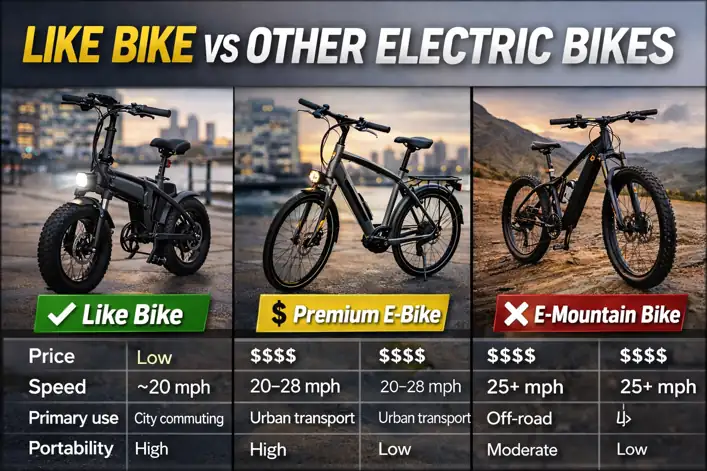
Like Bike enters a market where the comparison is not only about raw specifications. It is also about role. Different e-bikes solve different problems. That means the fairest way to compare this model is by asking what sort of rider it serves and what kind of compromise it represents.
| Category | Like Bike | Premium Urban E-Bike | Electric Mountain Bike |
|---|---|---|---|
| Primary use | City commuting and short everyday trips | Urban transport with stronger components and refined finish | Off-road riding, trails, rougher terrain |
| Portability | High, thanks to folding format | Usually lower, often full-size and heavier | Low, built for stability and toughness rather than compactness |
| Price positioning | More accessible entry point | Higher-cost investment | Often expensive due to frame and suspension demands |
| Storage convenience | Strong advantage in apartments and smaller spaces | Moderate | Limited |
| Audience | Commuters, casual riders, first-time e-bike buyers | Daily riders willing to pay for premium refinement | Performance-focused riders and trail users |
This comparison highlights something important. Like Bike does not need to beat premium e-bikes at everything. It only needs to make a persuasive case for its own lane. If it can deliver competent urban performance, reasonable comfort, and easy day-to-day ownership, it has a place in the market.
What It Gets Right
The project’s biggest strength is its clarity. It knows what it wants to be. That sounds basic, but plenty of products fail because they try to serve too many roles at once. Like Bike looks focused. It is trying to be a manageable city e-bike, not an everything machine.
Portability is one of its clearest wins. A folding frame makes practical sense, and practicality is the area where many e-bikes lose people. Storage and handling can become serious obstacles. A bike that removes some of those obstacles immediately becomes more realistic for normal buyers.
The wide-tire setup also feels smart for the intended use case. It should help create a more forgiving ride, especially for people who are not experienced cyclists. Comfort and confidence often matter more than aggressive responsiveness on a commuter bike.
There is also something appealing about the general tone of the product. It does not seem to be selling an extreme fantasy. It is selling convenience. That is often the better bet.
Where It Still Has to Prove Itself
This is where any honest review of a crowdfunding e-bike has to slow down. There are limits to how much confidence can be drawn from launch material alone. A product like this may have a sensible design and a promising pitch, but that is not the same as established trust.
Durability is one open question. Entry-level and mid-tier electric bikes often look strong in early impressions, then reveal weaknesses through repeated use. Folding systems, in particular, need to feel secure over time. If they loosen, creak, or wear badly, the whole user experience changes.
Battery longevity is another major issue. A commuter bike does not just have to perform well in week one. It has to keep doing so after months of charging cycles and ordinary daily use. Replacement support matters, too. If the battery becomes the weak link and replacement options are limited, value declines quickly.
After-sales support may be the biggest unanswered question of all. Established bike brands have dealer networks, service options, and more mature parts pipelines. Newer brands and crowdfunded products often need time to build those systems. Buyers who are comfortable taking some risk may accept that. Others will not.
Pricing and Value for Money
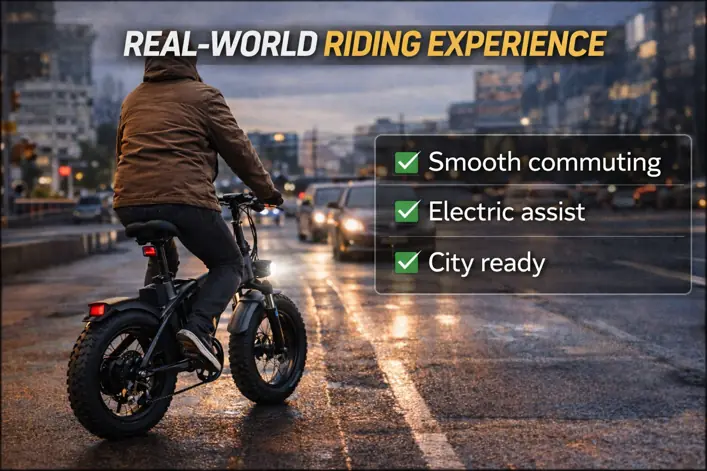
Value is where Like Bike has its chance to stand out. Electric bikes can become very expensive, very quickly. That has created a gap between curiosity and purchase. Many people like the idea of an e-bike but do not like the price of entry. A more affordable product can reach that audience if it avoids feeling disposable.
The best way to think about the bike’s value is not as a bargain-bin replacement for premium commuter models. It is better seen as a simpler and more approachable route into electric riding. If the execution is solid, that can be enough. Most riders do not need the most advanced e-bike on the market. They need one that feels sensible and dependable for their actual routines.
That is also why expectations matter. If a buyer expects premium build quality at an entry-style price, disappointment is likely. If a buyer expects a competent urban machine that prioritizes convenience over prestige, the proposition starts to look stronger.
Buy It If / Skip It If
Buy it if
You want a compact e-bike for city life, you value easier storage, and you are more interested in practical commuting than in premium branding. It also makes sense for people stepping into the e-bike category for the first time and looking for something that appears less intimidating than larger, pricier alternatives.
Skip it if
You want proven dealer support, premium long-term refinement, or a bike intended for hard off-road use. It is also not the obvious choice for someone who values brand heritage and established service infrastructure above all else.
Media Attention and Public Reaction
The broader reaction around products like this usually follows a familiar pattern. Interest tends to cluster around accessibility, portability, and price. Those are the subjects that speak to a wider audience beyond cycling enthusiasts. In that sense, Like Bike benefits from launching into a category that already has public momentum. Electric bicycles are no longer niche technology. They are now discussed as practical urban tools, not just recreational gadgets.
That shift works in its favor because the product makes the most sense when framed as transport rather than novelty. Public curiosity around commuter-friendly e-bikes remains strong, especially when a model appears manageable for ordinary use rather than overbuilt for a specialized audience.
For readers who want to explore the original launch material and brand information directly, the main references are the Kickstarter campaign page and the official Likebike website.
Final Verdict
Like Bike looks most convincing when judged on realism rather than hype. It is not trying to become the most advanced e-bike in the category, and that is probably wise. Its appeal lies in being smaller, more approachable, and potentially easier to fit into daily life than many of the heavier, costlier machines competing in the same space.
That does not make it a sure thing. A crowdfunded e-bike still has to prove itself in the places that matter most: reliability, support, battery life over time, and the quality of the ownership experience after the initial excitement wears off. Those are not small caveats. They are central to whether a commuter bike becomes a trusted habit or a frustrating experiment.
Still, the concept is sensible. The audience is real. And the design choices seem rooted in everyday use rather than marketing theater. If the final product delivers solid build quality and dependable day-to-day performance, it could earn a place as a practical option for riders who want a compact electric bike without drifting into premium-bike pricing.
In a crowded category, that may be enough. Sometimes the most interesting product is not the one making the loudest promise. It is the one trying to solve a normal problem in a cleaner, more livable way.