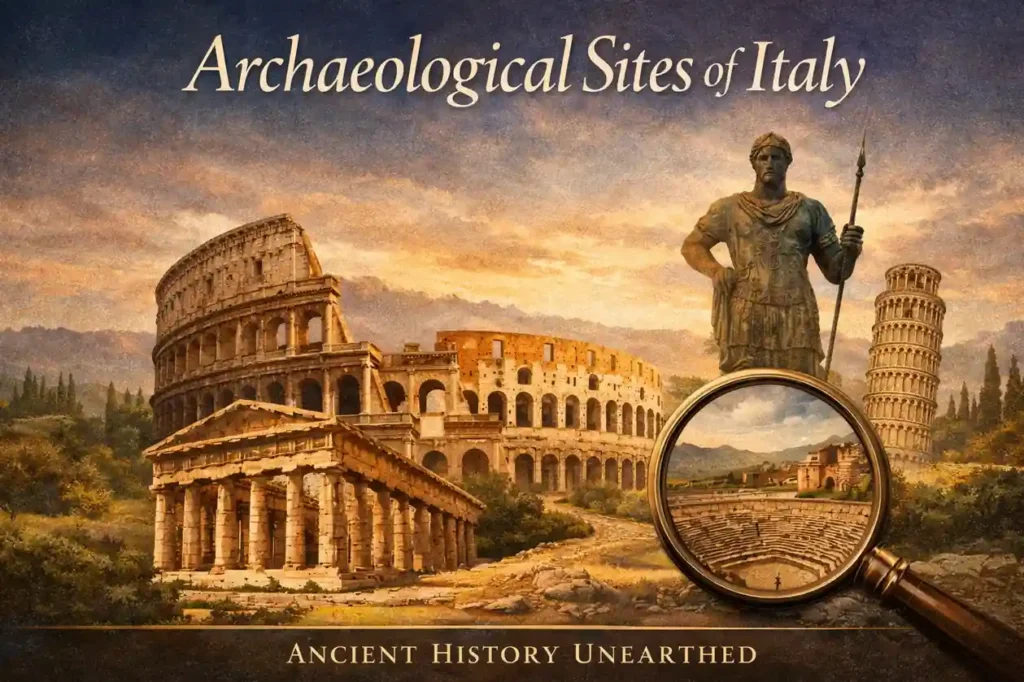
Italy is one of the rare places where the physical layers of history remain visible almost everywhere, from volcanic plains and river valleys to island plateaus and buried ports. Archaeological Sites in Italy offer an unusually dense record of prehistoric settlement, Etruscan ritual, Greek colonization, Roman statecraft, and the afterlives of empires that continued to shape the peninsula long after political systems changed. What makes that richness so compelling is not only the grandeur of famous monuments, but the way modest walls, drainage channels, household shrines, workshops, roads, and graves preserve the habits of ordinary people alongside the ambitions of rulers.
For readers trying to understand how the peninsula became a crossroads of the Mediterranean, the evidence on the ground is more illuminating than any simplified national myth. The material record shows movement, adaptation, conflict, continuity, and reinvention, and it also demonstrates how communities answered practical questions about trade, water, religion, defense, prestige, and memory. Seen together, Archaeological Sites in Italy form a civilizational archive: not a single story, but a long conversation between local traditions and far wider worlds.
This is also why the country remains central to global historical research. The peninsula preserves not just monumental Rome, but traces of the ancient civilizations of Italy in many forms: Nuragic towers in Sardinia, Greek sanctuaries in the south, Etruscan painted chambers in central regions, and late antique urban fabrics that reveal continuity as much as collapse. A serious survey has to move beyond postcard recognition and look instead at how each site helps explain lived experience, political power, religious practice, exchange networks, and the long stewardship of memory.
Why Italy Matters Archaeologically
Italy matters archaeologically because it was never shaped by a single culture at a single moment. Long before Rome became dominant, the peninsula and its islands were occupied by Neolithic farming communities, Copper Age groups, Bronze Age societies, and regional cultures that built distinctive ritual and defensive landscapes. Later came the Villanovan horizon, the Etruscans, the Greek colonies of Magna Graecia, Phoenician and Carthaginian contacts in the islands, Italic peoples across the interior, and finally the expanding Roman Republic and Empire. Each left durable traces in settlement planning, burial traditions, art, engineering, and sacred space.
Geography also made the peninsula historically consequential. Italy sits between central Europe, the Adriatic, the Tyrrhenian, and the wider Mediterranean sea-lanes, so migration, warfare, commerce, and cultural borrowing repeatedly converged there. Rivers, volcanic soils, sheltered bays, mountain passes, and fertile plains encouraged dense occupation but also competition over land and routes. That helps explain why the archaeological record is not merely abundant; it is layered, regionally varied, and unusually good at revealing transitions between cultures rather than only their endpoints.
Archaeology in Italy is therefore valuable not only because of famous ruins, but because the country preserves continuities between domestic life and imperial scale. Drainage systems, house plans, inscriptions, cemeteries, theaters, sanctuaries, warehouses, villas, and fortifications allow scholars to reconstruct social relations in concrete ways. The result is a record that can show how power was staged, how trade was organized, how faith was localized, and how older landscapes remained meaningful even after new states claimed them.
Archaeological Sites in Italy and the Deep Historical Record
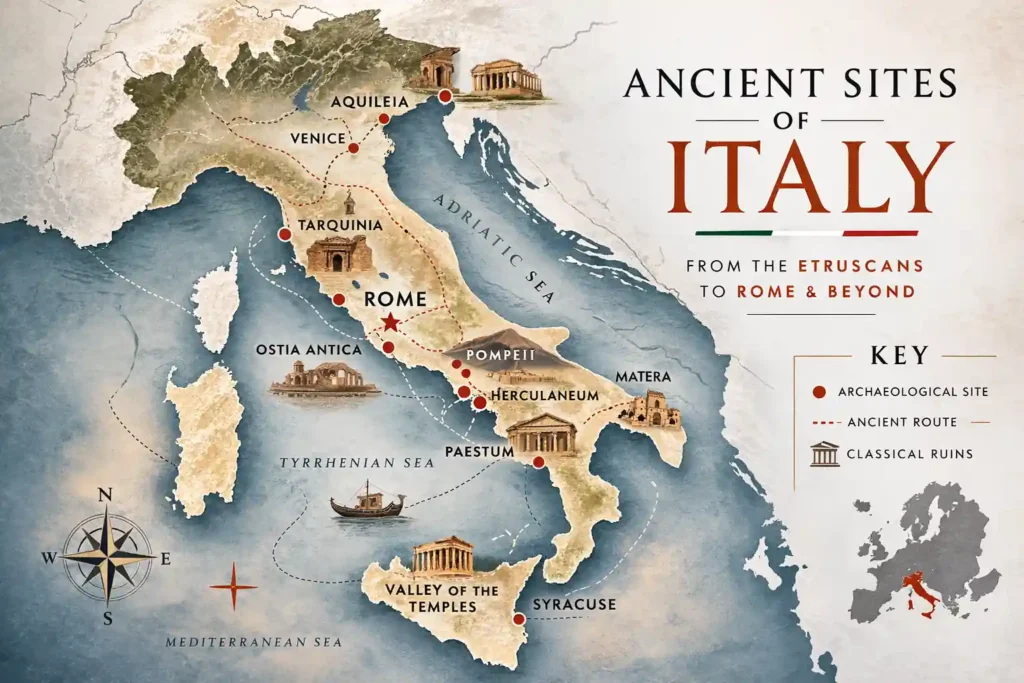
The density of sites across Italy is historically meaningful because it reflects a long pattern of settled life connected by roads, ports, river systems, mountain corridors, and ritual centers. Coastal colonies were tied to inland agricultural zones; upland strongholds watched over movement and pasture; urban nodes absorbed influence while preserving local traditions. Instead of a clean sequence in which one culture neatly replaced another, the country’s excavated landscapes show overlap, reuse, adaptation, and strategic reinvention across centuries.
That continuity is especially striking in places where later builders occupied earlier sacred or political ground. Greek temples were repaired, Roman forums incorporated older routes, Christian communities reused classical masonry, and medieval populations often lived beside or above much earlier remains. For that reason, the site list below should be read not as a set of isolated attractions but as evidence of a durable human geography. Together, these places reveal how communities repeatedly made use of the same land while redefining authority, identity, and memory.
A Brief Historical Timeline of Italy
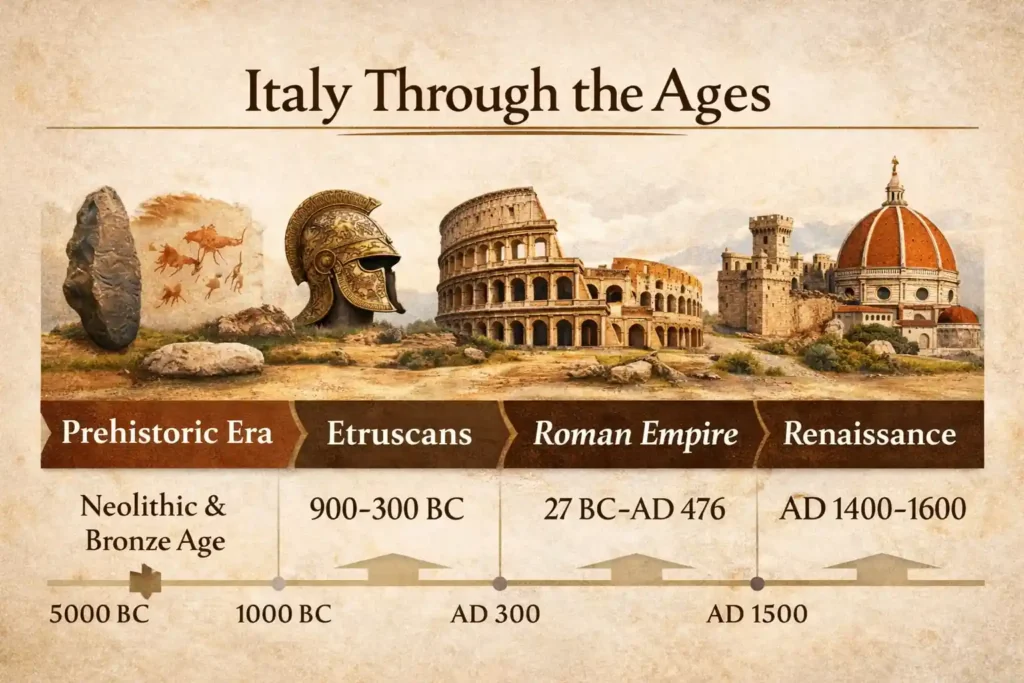
Italy’s archaeological sequence begins with Paleolithic occupation and expands through Neolithic farming settlements, Chalcolithic burial cultures, and Bronze Age communities whose fortified villages and ritual landscapes reveal increasing social complexity. By the early first millennium BCE, the Villanovan culture and related regional groups were shaping central Italian funerary and metalworking traditions, while the Nuragic world in Sardinia had already produced its stone tower settlements. These early phases established the archaeological heritage of Italy long before classical empires unified the peninsula under one political story.
From roughly the eighth century BCE onward, the timeline becomes more visibly interconnected. Greek settlers founded major colonies in southern Italy and Sicily, bringing urban planning, monumental temple architecture, and new economic networks. In central Italy, the Etruscans developed wealthy cities, elite tombs, and sophisticated craft production, while Italic peoples maintained their own social and military structures. As Rome expanded from a city-state into a republic and then an empire, it absorbed, reshaped, and monumentalized earlier traditions, creating the civic, legal, and infrastructural framework most associated with Italy today. For readers wanting a broad historical primer, History’s overview of Ancient Rome offers a useful external frame for the Roman phase that so deeply marked the peninsula.
Late antiquity, the early medieval period, and later regional states did not erase that earlier material world. Instead, they reused quarries, roads, walls, temples, and urban cores, leaving a patchwork in which Roman, post-Roman, and local continuities frequently overlap. That is why a chronological summary is only a bridge: the real force of Italy’s past emerges when specific places show how political transitions were lived on the ground.
Pompeii: A Landmark Among the Archaeological Sites in Italy
- Location: Campania, near modern Pompeii and Naples
- Period / Civilization: Samnite origins, later Roman city, destroyed in 79 CE
- Type of Site: Buried urban settlement
- Why It Matters: Exceptionally preserved evidence of urban life, economy, and domestic culture
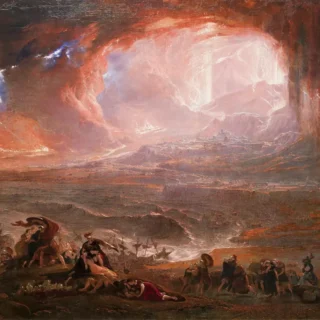
Pompeii was first shaped by Italic and Samnite communities before becoming a Roman colony, and that layered history matters because the city was not created in a single imperial gesture. By the first century CE it had become a thriving urban center with streets, baths, temples, shops, workshops, theaters, and elite houses integrated into a functioning local economy. Its destruction during the eruption of Vesuvius in 79 CE froze a working city rather than a ceremonial ruin, preserving a rare moment in time. In Italy’s wider historical story, Pompeii anchors the study of Roman municipal life: not the capital, not a frontier outpost, but a prosperous regional town whose built fabric reveals how empire was experienced at a human scale.

The site’s distinctive feature is the breadth of preservation across entire neighborhoods. Excavations have exposed wall paintings, electoral notices, carbonized food, amphorae, fountains, bakeries, brothels, temples, bath complexes, and the casts of victims created from voids left in hardened ash. Scholars continue to debate details of chronology, daily routines, and even the exact seasonal timing of the eruption, but the material record remains astonishingly rich. Pompeii is especially valuable because it preserves both monumental architecture and minute traces: graffiti, street ruts, storage jars, stairways, shrines, and garden layouts that rarely survive so completely elsewhere.
As a human document, Pompeii reveals crowding, ambition, inequality, devotion, labor, leisure, and the ordinary improvisations of urban existence. House sizes and decoration reflect status; shop fronts show commerce embedded in residential life; shrines and temples show religion intertwined with neighborhood routines; and food remains illuminate diet and trade. The city matters far beyond tourism because it allows historians to test broad claims about Roman society against physical evidence from daily life. Ongoing conservation, however, is difficult: weathering, visitor pressure, unstable walls, and drainage problems mean that preservation is never finished. Pompeii endures because it makes the ancient city feel inhabited rather than abstract.
Herculaneum
- Location: Campania, modern Ercolano
- Period / Civilization: Samnite and Roman, destroyed in 79 CE
- Type of Site: Buried coastal town
- Why It Matters: Extraordinary preservation of organic materials and upper architectural levels
Herculaneum shared the same catastrophic eruption as Pompeii, yet its archaeological character is strikingly different. Once a smaller and wealthier coastal town, it developed under earlier Italic influence and then flourished within the Roman world as an elite residential center with baths, houses, shops, and waterfront structures. Because it was overwhelmed largely by pyroclastic flows rather than thick pumice accumulation alone, the site preserved a denser and in some respects more intimate urban snapshot. Within the broader story of Italy, Herculaneum provides a counterpoint to Pompeii: a place where the domestic architecture of the Roman affluent classes can be studied in unusually fine detail.
The town is famous for carbonized wood, preserved door frames, furniture fragments, shelving, staircases, and structural elements that rarely survive in Roman archaeology. Multi-story houses, rich wall decoration, and the famous Villa of the Papyri area, associated with carbonized scrolls, make Herculaneum one of the most distinctive excavation zones in the Mediterranean. Finds from boat chambers and shoreline contexts have also added significantly to the study of the victims’ final movements. The survival of timber and upper floors allows archaeologists to reconstruct vertical space, storage practices, and circulation patterns with unusual confidence.
What Herculaneum reveals most clearly is the texture of lived interiors: how light entered rooms, how movement worked between levels, how luxury and practicality met in kitchens, baths, courtyards, and service spaces. It helps scholars examine class, literacy, domestic religion, and seaside urban planning in ways that flatter but less complete monuments cannot. Today, it is also a major case study in conservation ethics, because Archaeological Sites in Italy that preserve fragile organic remains require constant technical intervention and careful limits on exposure. The site matters because it narrows the gap between archaeological ruin and the actual environments in which people once ate, argued, prayed, and slept.
Roman Forum
- Location: Rome, Lazio
- Period / Civilization: Archaic Rome through the Roman Empire and late antiquity
- Type of Site: Civic, religious, and political urban core
- Why It Matters: Central stage of Roman public life and state ritual
The Roman Forum was the political and ceremonial heart of Rome for centuries, evolving from a low-lying area gradually drained and monumentalized into the nucleus of public life. Temples, basilicas, triumphal arches, meeting spaces, shrines, and commemorative monuments accumulated there as the republic expanded and emperors reshaped the city’s symbolic center. In Italy’s broader archaeological landscape, the Forum is essential because it shows how public space became an instrument of law, memory, legitimacy, and spectacle. It was where processions moved, decrees were enacted, business was transacted, and the Roman state physically staged its own authority.
Its distinctive feature is not a single building but the density of historically consequential structures within one compressed zone. Excavations have identified temples dedicated to major deities, speaker’s platforms, basilicas for legal and commercial use, the House of the Vestals, and arches commemorating imperial victories. Because later phases often cut into earlier ones, interpretation can be complex, but that very complexity makes the Forum invaluable: among the Archaeological Sites in Italy, it preserves the archaeology of political change, where every new regime sought to inherit and rewrite the same symbolic ground. The Forum is invaluable because it preserves the archaeology of political change, where every new regime sought to inherit and rewrite the same symbolic ground.
The Forum reveals how power in Rome worked through performance as much as administration. Spatial hierarchy shaped who could gather where, what could be seen, and how civic rituals communicated belonging and exclusion. Religious and political life were intertwined, and the arrangement of monuments shows how memory itself became a public resource. Present-day visitors often encounter the Forum as a field of broken columns, yet scholars read it as a system of controlled movement, visual messaging, and ritual repetition. It matters today because it remains one of the clearest material records of how a state turns architecture into ideology.
Colosseum
- Location: Rome, Lazio
- Period / Civilization: Flavian Roman Empire, late first century CE
- Type of Site: Amphitheater
- Why It Matters: Iconic monument of imperial spectacle, engineering, and social order
The Colosseum was commissioned under the Flavian emperors in the late first century CE and built on land reclaimed from Nero’s private palace complex, a political gesture as meaningful as the structure itself. As an immense amphitheater for staged hunts, executions, spectacles, and gladiatorial combat, it embodied the Roman state’s ability to entertain, discipline, and impress the urban populace. In Italy’s deeper historical story, the building is not merely a symbol of Rome’s grandeur; it is evidence of how imperial power translated conquest, labor, and engineering expertise into public ritual on a monumental scale.
The amphitheater’s defining features include its tiered seating system, complex circulation routes, and, among the Archaeological Sites in Italy, one of the clearest surviving demonstrations of Roman use of arches, vaults, and concrete. Excavations and structural studies have revealed service corridors, lifts, cages, and logistical systems that supported elaborate performances. Inscriptions, marble seating evidence, and later repairs help scholars understand how social rank was built into the viewing experience. The Colosseum is distinctive because it joins spectacle with architecture so completely: the building itself organized the crowd, turning hierarchy into physical form and making entertainment inseparable from governance.
What the Colosseum reveals about ancient life is often uncomfortable, and that is precisely why it matters. It shows the normalization of public violence, the political uses of mass entertainment, and the disciplined management of urban crowds. It also reveals craftsmanship, logistics, and labor hidden behind imperial display, from stone quarrying to stage machinery and animal transport. As one of the most recognized monuments in Italy, it remains a global shorthand for Rome, yet its real value lies in showing how empires choreograph loyalty and fear. Preserving it means preserving evidence of both human ingenuity and institutional brutality.
Ostia Antica
- Location: Near the Tiber delta, Lazio
- Period / Civilization: Roman Republic through late antiquity
- Type of Site: Port city
- Why It Matters: Major evidence for trade, urban infrastructure, and everyday Roman commerce
Ostia Antica began as Rome’s harbor settlement and grew into a major port and distribution hub that connected the capital to maritime supply networks across the Mediterranean. Warehouses, apartment blocks, baths, guild buildings, religious structures, and commercial spaces make the site one of the best places to study the mechanics of an imperial city beyond its monumental center. In the broader history of Italy, Ostia is crucial because it demonstrates how the Roman world actually functioned: grain, oil, wine, labor, administration, and transport all converged in a dense urban environment shaped by logistics.
The site is especially notable for its insulae, mosaic floors, storage facilities, and the Piazzale delle Corporazioni, where evidence of trade associations illuminates commercial organization and long-distance exchange. Temples dedicated to different cults, including eastern religions introduced through port traffic, show how mobility reshaped local belief. Archaeologists have also reconstructed drainage, sanitation, and street systems that supported a crowded population. Ostia stands out because it preserves not just elite monuments but the urban fabric of movement and provisioning, making it one of the clearest windows into ancient economic life.
What Ostia reveals is that empire depended on coordination as much as conquest. Dock laborers, merchants, officials, craftspeople, sailors, and tenants all inhabited a city built around supply and circulation. The site helps scholars trace diet, trade routes, migration, and multicultural interaction, while its domestic and religious spaces remind us that a port is also a lived community. Today, Ostia also shows why Archaeological Sites in Italy must be read in environmental terms, since its partial distance from the modern shoreline underscores how landscapes change and why archaeological interpretation must account for those shifts. Ostia matters because it makes the infrastructure of Rome visible in everyday human terms.
Paestum
- Location: Campania, south of Salerno
- Period / Civilization: Greek colony of Poseidonia, later Lucanian and Roman
- Type of Site: Urban sanctuary and settlement
- Why It Matters: Among the best-preserved Greek temples in the western Mediterranean
Founded as the Greek colony of Poseidonia, Paestum became one of the most important centers of Magna Graecia before later Lucanian and Roman phases transformed its civic life. The site matters in Italy because it preserves the material reality of Greek colonization not as an abstract cultural label but as a built urban world with sanctuaries, roads, walls, and public institutions. Its development also shows that colonial identities changed over time, absorbing local influences and later Roman political control. Paestum therefore sits at an important junction between Greek, Italic, and Roman histories on the peninsula.
The site’s most distinctive features are its three monumental Doric temples, preserved with extraordinary architectural clarity. Excavations have also uncovered domestic zones, roads, fortifications, inscriptions, and painted tombs associated with later phases. The nearby museum’s famous Tomb of the Diver remains a key find because it offers rare figurative painting from the Greek world in southern Italy, and it continues to shape debate about ritual and identity. Paestum is exceptional because the relationship between temple architecture and surrounding settlement can still be read with unusual coherence on the ground.
Paestum reveals how sacred architecture anchored community identity, but it also illuminates trade, adaptation, and the layering of political control in a coastal colony. Its monumental form can overshadow the subtler evidence, yet the site is just as valuable for showing changing burial customs, local elite behavior, and the coexistence of imported styles with regional realities. Today, preservation at Paestum involves balancing exposure, environmental wear, and public interpretation, a challenge shared by many Archaeological Sites in Italy. The site matters because it gives physical weight to the western spread of Greek urban culture without erasing the local worlds it entered.
Valley of the Temples
- Location: Agrigento, Sicily
- Period / Civilization: Greek Akragas, later Roman and later reuse
- Type of Site: Sacred and urban archaeological landscape
- Why It Matters: Monumental temple zone illustrating the wealth and ambition of Greek Sicily
The Valley of the Temples at ancient Akragas is one of the most important archaeological landscapes in Sicily and one of the clearest expressions of Greek civic ambition outside mainland Greece. Although the name emphasizes the temple ridge, the wider area includes parts of the ancient city, defensive circuits, necropolises, and later layers of reuse. In the context of Italy, the site is indispensable because it demonstrates how Greek settlers in the western Mediterranean created monumental urban identities tied to religion, prestige, and competition. It also reminds readers that Sicily’s past cannot be reduced to a single cultural sphere.
The surviving temples, especially the Temple of Concordia, are the site’s defining visual features, but excavations have also revealed altars, water systems, fortifications, residential traces, and evidence for changing occupation after the classical peak. Architectural fragments, inscriptions, and stratified remains help archaeologists reconstruct both sacred and civic functions. The valley is distinctive because the alignment of temples across the landscape turns topography itself into a statement of power. Monumentality here was not accidental; it was a deliberate expression of wealth, piety, and urban self-confidence in a contested region.
As evidence of ancient life, the valley shows that monumental religion was inseparable from politics, public identity, and resource control. Building and maintaining such structures required labor organization, stone extraction, planning, and sustained elite investment, while the broader city points to households, agricultural ties, and defensive concerns behind ceremonial display. Today, the site’s fame risks reducing it to scenic grandeur, but its real importance lies in showing how cities used sacred architecture to project permanence. That lesson still matters because the ruins preserve not only beauty, but the social systems that made beauty possible.
Tarquinia Necropolises
- Location: Tarquinia, Lazio
- Period / Civilization: Etruscan, mainly seventh to third centuries BCE
- Type of Site: Necropolis with chamber tombs
- Why It Matters: Major source for Etruscan painting, funerary ritual, and elite culture
The painted tombs of Tarquinia are among the most informative Etruscan sites ever excavated. Rather than an urban center preserved in full, Tarquinia gives historians a cemetery landscape whose chamber tombs preserve ritual expression, family memory, and elite self-representation across generations. In Italy’s broader past, the necropolises matter because they offer a crucial counterweight to Rome-centered narratives. The Etruscans were not a footnote to Roman greatness; they were a sophisticated and regionally powerful civilization whose funerary art, ritual language, and social structures profoundly shaped central Italy before and during Rome’s rise.
The site’s distinctive feature is the survival of wall paintings depicting banquets, dancers, musicians, athletic scenes, mythic references, and funerary symbolism. Tomb architecture itself often imitates domestic interiors, suggesting a deliberate relationship between the house of the living and the house of the dead. Tarquinia stands out because, among the Archaeological Sites in Italy, much of what is known about Etruscan visual culture and elite ideology comes from burial contexts, where memory was carefully staged for both family and posterity.
These tombs reveal attitudes toward death, identity, feasting, gender roles, and ancestry that written Roman sources alone cannot reliably supply. They show that burial was not simply disposal, but a social performance communicating continuity, belonging, and prestige. They also preserve rare evidence for pictorial traditions in pre-Roman Italy. Today, the site requires careful conservation because painted chambers are extremely vulnerable to moisture, temperature change, and visitor impact. Tarquinia matters because it restores voice to a civilization often filtered through its conquerors, and it does so through art made for the most solemn of human thresholds.
Su Nuraxi di Barumini
- Location: Sardinia
- Period / Civilization: Nuragic Bronze Age, later reuse
- Type of Site: Nuragic tower complex and village
- Why It Matters: Premier surviving example of Nuragic architecture and settlement planning
Su Nuraxi di Barumini is the best-known and most substantial surviving complex of the Nuragic world, the Bronze and Iron Age culture that shaped much of Sardinia long before Roman annexation. Centered on a multi-towered stone stronghold and surrounded by a village, the site preserves a distinctly Sardinian architectural tradition whose full social and political meaning is still debated. In the wider history of Italy, Su Nuraxi is indispensable because it widens the frame beyond mainland classical antiquity and demonstrates that major, regionally specific societies developed on the islands with their own engineering practices and community structures.
The site’s most distinctive feature is the tholos-like corbelled construction of its towers and the way the central bastion expanded through multiple building phases. Excavations have identified hut foundations, courtyards, defensive arrangements, and evidence of long occupation and reuse. Material finds including ceramics and other domestic traces help scholars reconstruct habitation, storage, and local exchange. Because written records for the Nuragic world are absent, interpretation depends heavily on architecture and context, making Su Nuraxi especially important as a place where built form itself is a primary historical source.
Su Nuraxi reveals that complex social organization in prehistoric Sardinia did not require urban forms identical to later Mediterranean cities. The settlement suggests community coordination, technical skill, and strong concern for visibility, defense, and collective identity. It also shows how later contacts, including Phoenician and Roman influence, interacted with an older local landscape rather than wiping it away. Present-day preservation is crucial because Archaeological Sites in Italy built from exposed stone can deteriorate gradually but decisively. The site matters because it reminds readers that Italy’s past includes robust non-Roman traditions with their own logic, scale, and durability.
Villa Romana del Casale
- Location: Piazza Armerina, Sicily
- Period / Civilization: Late Roman, mainly fourth century CE
- Type of Site: Elite rural villa
- Why It Matters: Exceptional mosaics illuminating elite life, labor, and visual culture
Villa Romana del Casale is a late Roman villa complex whose scale and decoration make it one of the most revealing elite residences in the former empire. Likely belonging to a wealthy landowning or administrative figure, the villa was not a simple country retreat but a statement of status, management, and cultivated taste within a productive landscape. In the context of Italy, it is vital because it shows that power in the Roman world was not confined to cities. Landed wealth, agricultural oversight, and prestige display also shaped provincial life and tied rural estates to imperial culture.
The villa’s defining feature is its extraordinary mosaic program, which includes hunting scenes, mythological imagery, processions, athletic figures, and richly detailed decorative floors across numerous rooms and corridors. Excavations have also clarified bath facilities, reception spaces, service areas, and the organization of movement between public and private zones. The mosaics are not merely ornamental; they are a major discovery in their own right, preserving visual evidence for dress, animals, labor, and elite ideals. The site is distinctive because its decoration remains central to historical interpretation rather than secondary to architecture.
What the villa reveals is the social grammar of wealth: how elite households displayed education, command over labor, and access to distant resources. It also helps scholars study the relationship between spectacle and management, since scenes of hunting and processional order reflect both ideology and hierarchy. Though often presented as a masterpiece of Roman art, the site is equally important as evidence for the working systems behind luxury. Conservation remains a major issue because mosaics are fragile under moisture, environmental stress, and heavy visitation. The villa matters because it turns decorative brilliance into hard evidence about rank, labor, and taste.
Hadrian’s Villa
- Location: Tivoli, Lazio
- Period / Civilization: Roman Empire, second century CE
- Type of Site: Imperial villa complex
- Why It Matters: Vast experimental landscape of imperial architecture, water design, and cultural reference
Hadrian’s Villa at Tivoli was created as an expansive imperial retreat, administrative environment, and architectural laboratory associated with Emperor Hadrian in the second century CE. Rather than a single palace block, it consists of a dispersed complex of residences, baths, gardens, theaters, libraries, water features, and service structures spread across a broad landscape. In Italy’s broader history, the villa is crucial because it shows how imperial authority could withdraw from the capital while still expressing scale, control, and cosmopolitan ambition. It is a monument not only to power, but to curated space and orchestrated experience.
The site is distinctive for its varied architectural vocabulary, engineered water systems, and references to places and styles from across the empire. Structures such as the Maritime Theater, Canopus, and large bath complexes demonstrate experimentation in geometry, circulation, and sensory effect. Excavation has yielded sculpture, decorative fragments, and structural evidence that illuminate both elite aesthetics and later spoliation. Hadrian’s Villa stands apart because it is less a conventional residence than a deliberately composed environment, where architecture, hydraulics, and landscape design served political image and personal intellectual ambition at once.
The villa reveals how imperial identity could be built through curated movement and controlled vistas rather than solely through urban public monuments. It also shows the dependence of luxury on invisible labor, maintenance, and technical expertise, from water management to service circulation. Today, archaeologists and conservators study it not only as an imperial masterpiece but as a vulnerable large-scale site affected by vegetation, erosion, and the complexities of preserving expansive remains. It matters because it captures the Roman elite at its most self-conscious: powerful enough to redesign landscape itself as a statement of rule.
Aquileia
- Location: Friuli-Venezia Giulia
- Period / Civilization: Roman Republic, Roman Empire, late antiquity
- Type of Site: Colonial city and trading center
- Why It Matters: Strategic northern hub linking the Adriatic, the Balkans, and inland Europe
Aquileia was founded as a Roman colony in the second century BCE and grew into one of the most important urban centers of the northern Adriatic. Its position made it a military, commercial, and administrative hinge between Italy, the Danubian world, and eastern trade routes. That strategic role gives the site lasting historical importance: it demonstrates that the peninsula’s past was shaped not only by Rome and the south, but also by northern corridors where movement, defense, and exchange converged. Aquileia helps explain how Roman expansion and commerce were sustained through regional nodes rather than iconic capitals alone.
The archaeological zone includes forum remains, roads, river and port-related structures, houses, warehouses, and extensive late antique evidence, alongside the famous basilica mosaic tradition nearby. Excavations have recovered inscriptions, sculpture, glass, and other materials that testify to wealth, trade, and diverse cultural contacts. Aquileia is distinctive because its significance spans multiple historical phases: republican foundation, imperial prosperity, and late antique transformation. That long duration allows scholars to examine how cities adapt when military priorities, trade directions, and religious life all begin to change.
What Aquileia reveals is the importance of connectivity. Goods, people, officials, and ideas moved through such centers, and with them came new cults, administrative routines, and social opportunities. The site also clarifies how frontier-oriented regions participated fully in the economic and cultural life of the Roman world. Preserving Aquileia is especially important because its remains are dispersed across a living landscape, where visibility can be lower than at more compact ruins but historical value is no less profound. It matters because it turns the map of empire into a lived network rather than a distant abstraction.
Fiesole
- Location: Tuscany, above Florence
- Period / Civilization: Etruscan origins, later Roman
- Type of Site: Hill settlement with theater, temple, and urban remains
- Why It Matters: Clear example of Etruscan-to-Roman continuity in a strategic upland setting
Fiesole began as an Etruscan hill settlement and later developed under Roman control, preserving the history of a place that remained strategically useful across major political transitions. Its elevated position above the Arno valley made it valuable for oversight, defense, and regional control, while later Roman interventions reshaped the urban environment without erasing the significance of the location itself. In the broader story of Italy, Fiesole is important because it shows how Romanization often built upon older local centers rather than replacing them wholesale. The continuity of place is one of the site’s key lessons.
The site includes a Roman theater, temple remains, baths, and traces of urban organization, all of which help archaeologists reconstruct a smaller but highly informative civic center. Excavations have also contributed to understanding the settlement’s pre-Roman phases, even though those are less visibly monumental. Fiesole is distinctive because it offers a compact, readable example of layered occupation in which topography strongly shapes interpretation. Rather than overwhelming scale, its value lies in how clearly it demonstrates continuity, adaptation, and the selective reworking of an already meaningful landscape.
Fiesole reveals how communities used hilltop geography to structure social and political life, and how later powers could incorporate such places into wider state systems. It also highlights the relationship between local identity and regional integration, showing that smaller centers played essential roles in administration, ritual, and communication. Today, the site remains relevant because it allows readers to see Roman and pre-Roman history outside the shadow of mega-monuments. It matters because archaeology here teaches an important truth: durable history is often written not only in capitals, but in the strategic smaller places that connected them.
Segesta
- Location: Western Sicily
- Period / Civilization: Elymian, with Greek and later Roman interactions
- Type of Site: Temple, theater, and hill settlement landscape
- Why It Matters: Key site for understanding non-Greek western Sicily in dialogue with Greek forms
Segesta is especially valuable because it complicates simplistic categories. Associated with the Elymians rather than a purely Greek civic identity, it nonetheless preserves a striking Doric temple and theater that reflect intense interaction with the Greek world. The site therefore resists easy labels and instead reveals a western Sicilian landscape where local identity, diplomacy, rivalry, and cultural borrowing were constantly negotiated. In Italy’s wider archaeological picture, Segesta matters because it shows that monumental form does not always equal straightforward ethnic or political origin. Style can be adopted, adapted, and strategically displayed.
The unfinished-looking temple is the site’s most famous feature, and its condition has long fueled debate about chronology, construction history, and intended function. The theater, hilltop setting, fortifications, and associated settlement evidence broaden the interpretive frame well beyond one celebrated monument. Excavations and landscape study have clarified how the surrounding terrain shaped visibility and defense, while material remains reveal continued occupation and later phases. Segesta is distinctive because it preserves ambiguity in productive ways: archaeologists must read architecture alongside politics, identity, and regional rivalry rather than relying on labels alone.
What Segesta reveals about ancient life is the practical reality of cultural contact. Communities could adopt architectural languages associated with prestige while still maintaining local traditions and political interests. The site also illuminates how sacred, civic, and strategic functions overlapped in elevated landscapes. Today, preservation and interpretation must balance the drama of the setting with the subtler evidence that explains how the place actually worked. Segesta matters because it reminds readers that the past was rarely neat, and that archaeology is most valuable when it preserves complexity instead of flattening it.
What These Sites Reveal About Ancient Life in Italy
Taken together, these places show that daily life in the peninsula was structured by movement, status, and ritual as much as by monumental architecture. Archaeological Sites in Italy collectively reveal crowded urban neighborhoods, rural estates dependent on labor hierarchies, maritime exchange points, sacred landscapes, and burial spaces designed to communicate memory. They show food systems through ovens, amphorae, animal remains, and storage areas; craft through ceramics, mosaics, inscriptions, metalwork, and construction methods; and political power through the physical choreography of roads, seating plans, temples, villas, and public squares.
They also reveal just how interconnected the peninsula was. Ports like Ostia and cities tied to wider Mediterranean traffic show the circulation of goods, beliefs, and people, while Greek and Etruscan sites demonstrate that identity in Italy was never singular. Religion appears everywhere, but not in one form: household shrines, civic sanctuaries, funerary paintings, imperial monuments, and repurposed sacred spaces all point to a world in which devotion was local, public, familial, and political at once. Seen this way, the archaeological record does not preserve only exceptional elites; it also captures the material conditions that shaped working routines, family structure, and social aspiration.
The deeper lesson is that monuments become most meaningful when read alongside infrastructure and domestic evidence. A temple tells one story; a drainage system, a workshop, a painted tomb, and a warehouse complete it. That is why the country’s cultural landmarks of Italy deserve to be read as lived environments rather than isolated masterpieces. Archaeology restores scale to human experience: the grand gesture, the ordinary habit, and the fragile traces in between.
Preservation Challenges Facing Archaeological Sites in Italy
Preserving Archaeological Sites in Italy is a constant, technically demanding task because exposure is both their strength and their vulnerability. Rain, salt, biological growth, seismic risk, pollution, and changing temperature cycles all wear down masonry, frescoes, mosaics, and painted surfaces. At heavily visited sites, tourism brings essential revenue and public attention, but it also increases vibration, humidity shifts, surface abrasion, and pressure on fragile circulation routes. Urban expansion can complicate excavation zones, while funding and staffing realities often force difficult choices about what can be stabilized, documented, limited, or left unexcavated for future generations.
Looting and illicit trafficking remain concerns in some contexts, but so do more ordinary forms of loss: delayed maintenance, poor drainage, emergency repairs, and inadequate interpretation that encourages careless public behavior. Large sites face especially difficult conservation ethics because exposing more remains can create new deterioration faster than institutions can manage it. The long-running tensions around Pompeii’s care have been widely discussed, and Smithsonian Magazine’s reporting on Pompeii’s conservation struggles remains a useful reminder that international fame does not guarantee easy stewardship.
Preservation matters because archaeological loss is usually irreversible. Once painted plaster flakes away, once a context is disturbed without documentation, once a wall collapses or a mosaic dries and cracks, evidence disappears with it. Museums, site authorities, archaeologists, conservators, and local communities all play a role in protecting what survives, but responsible stewardship also depends on public patience and restraint. The goal is not simply to keep ruins standing for photographs; it is to protect the evidence that allows future historians to ask better, more precise questions.
The Archaeological Legacy of Italy
The great strength of Italy’s archaeological record is that it reveals duration without pretending to be uniform. Archaeological Sites in Italy show how communities on the peninsula built, borrowed, competed, worshipped, buried their dead, and reoccupied meaningful ground over very long spans of time. They make clear that modern Italy rests not on one ancient inheritance, but on many: Etruscan, Greek, Italic, Roman, island-based, regional, urban, and rural. That layered reality is intellectually richer than any simplified origin story, and it is one of the reasons the country remains central to global historical imagination.
The same record also challenges modern audiences to think more carefully about continuity. Archaeological Sites in Italy are not merely relics beneath the present; they are part of how the present is understood, governed, displayed, and contested. Place names, museum cultures, education, tourism economies, restoration policies, and civic identity are all shaped by what survives and how it is interpreted. The country’s historic sites in Italy therefore matter as active cultural resources, not passive leftovers. They shape how people imagine citizenship, heritage, memory, and belonging.
In that sense, archaeology in Italy is not only about the ancient past. It is also about the ethics of inheritance: what is conserved, what is emphasized, what remains understudied, and what stories become national or global symbols. The long material record gives the country unusual power to speak across eras, but it also imposes an unusual duty of care. The legacy is not just abundance; it is responsibility.
Conclusion
From buried cities and imperial arenas to painted tombs, Greek sanctuaries, island tower complexes, and working ports, Italy preserves one of the most varied archaeological landscapes on earth. Archaeological Sites in Italy matter because they turn broad historical categories into physical evidence: empire becomes street paving and warehouses, belief becomes painted plaster and temple alignments, hierarchy becomes seating plans and villa corridors, and memory becomes burial architecture designed to outlast the living. That is what makes the country so essential to serious historical understanding.
To study these places responsibly is to recognize both their grandeur and their fragility. They are not inexhaustible backdrops, and they do not survive by accident. The more carefully they are preserved, interpreted, and visited, the more clearly they can continue to illuminate the long human story of the peninsula. Italy’s past still feels close because so much of it remains materially present – and because many of the ancient ruins in Italy continue to ask urgent questions about power, identity, continuity, and care.
Q1: Why is Italy considered one of the world’s most important countries for archaeology?
Q2: Which site in Italy gives the clearest picture of everyday Roman urban life?
Q3: Are Archaeological Sites in Italy only Roman?
Q4: What makes Herculaneum different from Pompeii?
Q5: Why do painted Etruscan tombs matter so much?
Q6: What is the biggest challenge facing these sites today?