Spain is often described through its cathedrals, imperial cities, and layered regional cultures, yet its deepest archive lies underground. The Archaeological Sites in Spain form a map of human adaptation stretching from deep prehistory to the Roman, Visigothic, and Islamic worlds. Across caves, fortified hilltops, planned colonies, necropoleis, and palace-cities, the country preserves evidence of how people hunted, farmed, traded, governed, worshipped, buried their dead, and remade landscapes over thousands of years.
What makes this record especially powerful is its range. In one national frame, readers can move from early human fossil evidence to megalithic engineering, from Iberian and Celtiberian strongholds to urban Roman infrastructure, and from the courtly sophistication of al-Andalus to later patterns of reuse and preservation. The Archaeological Sites in Spain are not isolated monuments but connected witnesses to migration, conquest, exchange, memory, and survival. They also illuminate the ancient ruins in Spain as part of a longer story about environment, technology, and political change.
For Maxmag, this is where archaeology becomes more than a catalog of old stones. It becomes a way of reading how power was built, how communities organized daily life, and how cultural continuity can survive even after languages, dynasties, and religions shift. Spain rewards that kind of attention because its terrain – Atlantic, Mediterranean, plateau, river valley, mountain corridor, and island zone – helped generate one of Europe’s richest long-term historical landscapes.
Why Spain Matters Archaeologically
Few countries in western Europe compress as many major historical layers into one territory as Spain. The Iberian Peninsula saw early hominin occupation, Paleolithic symbolic expression, Neolithic settlement, Copper and Bronze Age social complexity, and the rise of regional cultures such as the Iberians, Tartessians, Celtiberians, and Argaric communities. Later came Phoenician and Greek contact, Carthaginian intervention, Roman conquest, late antique transformation, Visigothic rule, and the Islamic polities of al-Andalus. That sequence matters because the land did not simply host different peoples in succession; it preserved traces of how each phase absorbed, displaced, or adapted what came before.
Geography helped make that density possible. Mountain chains created defensible zones and distinct cultural regions, river systems encouraged settlement and agriculture, and long coastlines opened the peninsula to Mediterranean and Atlantic exchange. For archaeologists, that means Spain offers not one story but many parallel archives: cave deposits, fortified oppida, funerary monuments, villas, roads, amphitheaters, hydraulic systems, and courtly complexes. The result is a historical record that helps explain the ancient civilizations of Spain not as a mythic single origin, but as a layered and often contested process of settlement, contact, and state formation.
Archaeology in Spain is therefore essential to understanding broader European history. It clarifies how prehistoric mobility became sedentary life, how local communities engaged with imperial systems, and how post-Roman societies reworked inherited spaces. The country’s material record is distinctive because it captures both continuity and rupture at unusual depth. When read carefully, it explains not just when things were built, but how people lived within changing political worlds.
Archaeological Sites in Spain and the Deep Historical Record
Seen together, Spain’s major sites reveal a remarkably long chain of occupation rather than a series of disconnected highlights. Human groups repeatedly settled zones with water access, defensible terrain, arable hinterlands, mining potential, or maritime reach. That is why caves, river terraces, hillforts, Roman colonies, and palace-cities often cluster in landscapes that remained attractive across centuries. Archaeology turns those recurring choices into evidence of long-duration historical logic.
The density matters because it shows historical continuity in place, even when cultures and languages changed. A prehistoric corridor could become a tribal frontier, then a Roman road network, then a medieval route of reuse or memory. Settlement did not happen in a vacuum; it accumulated. Spain’s archaeological map is therefore a deep record of adaptation – proof that geography, economy, and political ambition repeatedly converged in the same strategic spaces.
This is what makes the site list below more than a ranking. Each entry belongs to a wider civilizational chain: communities shaping stone, controlling metal, managing water, organizing labor, displaying status, and marking belief in visible ways. Read collectively, these places reveal how the archaeological heritage of Spain is structured by repetition, reinvention, and the stubborn persistence of meaningful ground.
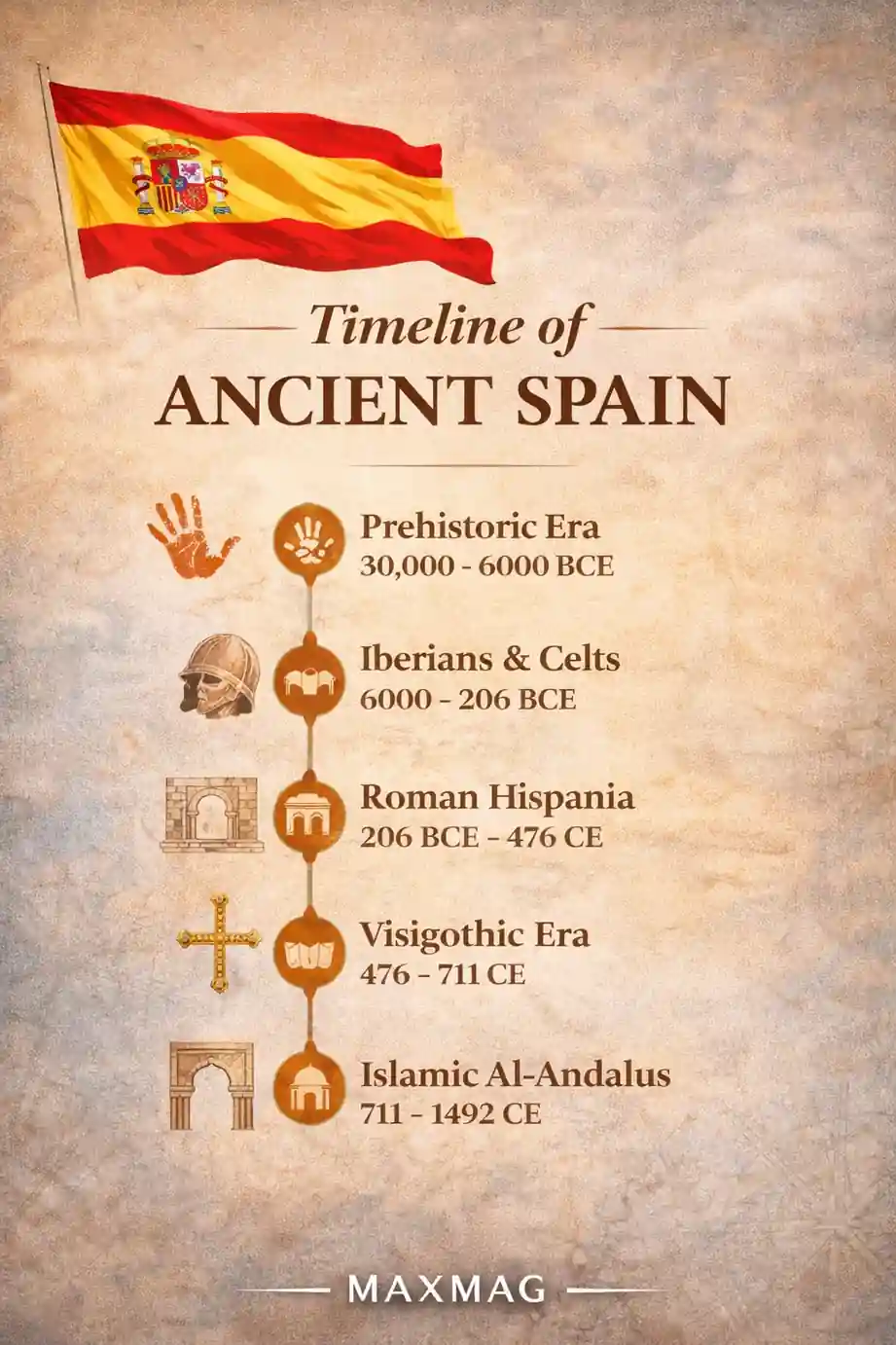
A Brief Historical Timeline of Spain
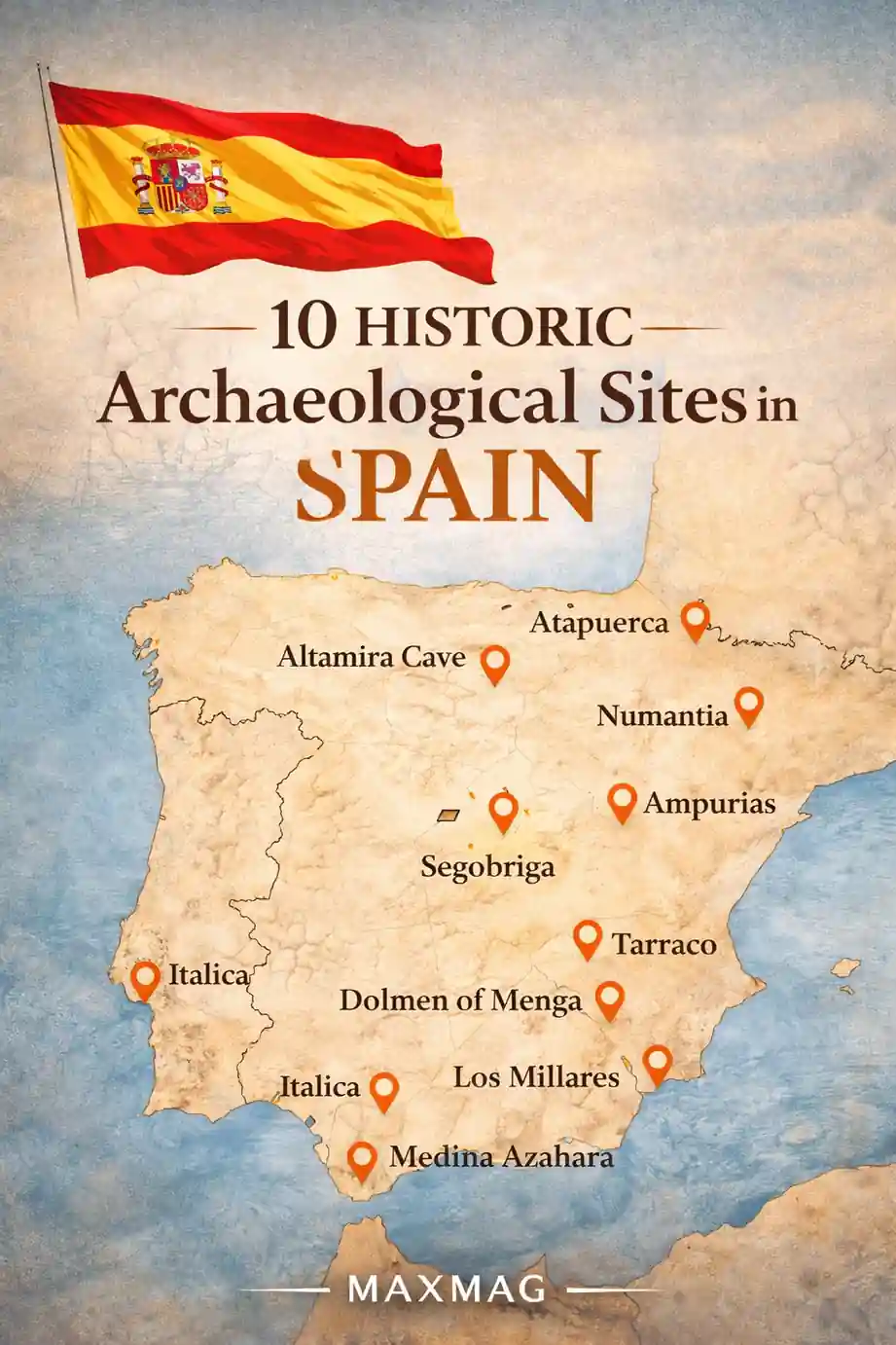
Spain’s archaeological chronology begins with some of the oldest hominin evidence in Europe, especially in the Sierra de Atapuerca, where fossil-bearing deposits have transformed debates about early human presence on the continent. By the Upper Paleolithic, communities were leaving symbolic art in caves such as Altamira. Neolithic and Chalcolithic societies then introduced farming, monument building, and more permanent settlement patterns, while Copper and Bronze Age communities like Los Millares and the Argaric culture developed fortifications, metallurgy, and sharper social hierarchy.
During the first millennium BCE, regional societies including Iberian and Celtiberian groups consolidated power in hilltop settlements and interior strongholds. Phoenician and Greek traders linked the peninsula to wider Mediterranean exchange, while Carthaginian and then Roman expansion reoriented the region politically and economically. A concise PBS overview of the Roman Empire is useful here because it reminds readers that Roman rule extended across vast, interconnected territories, including Hispania, where cities, roads, theaters, forums, aqueducts, and villas permanently reshaped the built landscape.
After Rome, the Visigothic period brought new political arrangements, followed by the Islamic conquest of the early eighth century and the emergence of al-Andalus, whose urban, scientific, agricultural, and artistic achievements left major material traces. Medieval Christian expansion, early modern state formation, antiquarian interest, and modern heritage policy all affected what survived and how it was interpreted. The sequence matters because Spain’s historic sites in Spain are not frozen relics from one era; they are products of repeated occupation, reuse, excavation, and revaluation.
Atapuerca: A Landmark Among the Archaeological Sites in Spain
- Location: Province of Burgos, Castile and Leon
- Period / Civilization: Lower to Upper Pleistocene, early hominins and later prehistoric communities
- Type of Site: Cave and karst complex with fossil-bearing deposits
- Why It Matters: One of the most important paleoanthropological landscapes in Europe
Atapuerca is not a single cave but a wider system of deposits, trenches, and chambers in the Sierra de Atapuerca, where railway cutting exposure helped reveal an extraordinary archive of early human presence. The complex includes famous areas such as Gran Dolina, Sima del Elefante, and Sima de los Huesos, each preserving evidence from different periods. What makes the site historically decisive is that it anchors debates about who the earliest inhabitants of western Europe were, how they moved, and how they evolved. Rather than offering one dramatic monument, Atapuerca offers layered deposits that allow researchers to reconstruct deep time from sediment, fossils, tools, and faunal remains.
Excavations have produced hominin fossils, stone tools, butchered animal bones, and environmental evidence that together transformed European prehistory. Finds associated with Homo antecessor and the remarkable accumulation of human remains in Sima de los Huesos have generated major scholarly discussion about human evolution, mortuary behavior, and population relationships. The site is also important methodologically: dating, stratigraphy, taphonomy, and interdisciplinary analysis all play central roles in interpretation. Atapuerca’s significance lies not in a single treasure but in the density of evidence that allows long-term patterns to be tested rather than guessed.
For the broader story of Spain, Atapuerca proves that the Archaeological Sites in Spain begin far earlier than kingdoms or empires. It reveals mobility, survival strategies, tool use, and environmental adaptation at a time when human life was precarious and local conditions mattered enormously. The human story here is one of persistence in a harsh world, and that makes Atapuerca relevant far beyond specialist paleoanthropology. It is a place where the origins of European settlement stop being abstract and become materially visible.
Altamira Cave
- Location: Near Santillana del Mar, Cantabria
- Period / Civilization: Upper Paleolithic, especially Magdalenian
- Type of Site: Decorated cave
- Why It Matters: Home to some of the world’s most famous prehistoric cave paintings
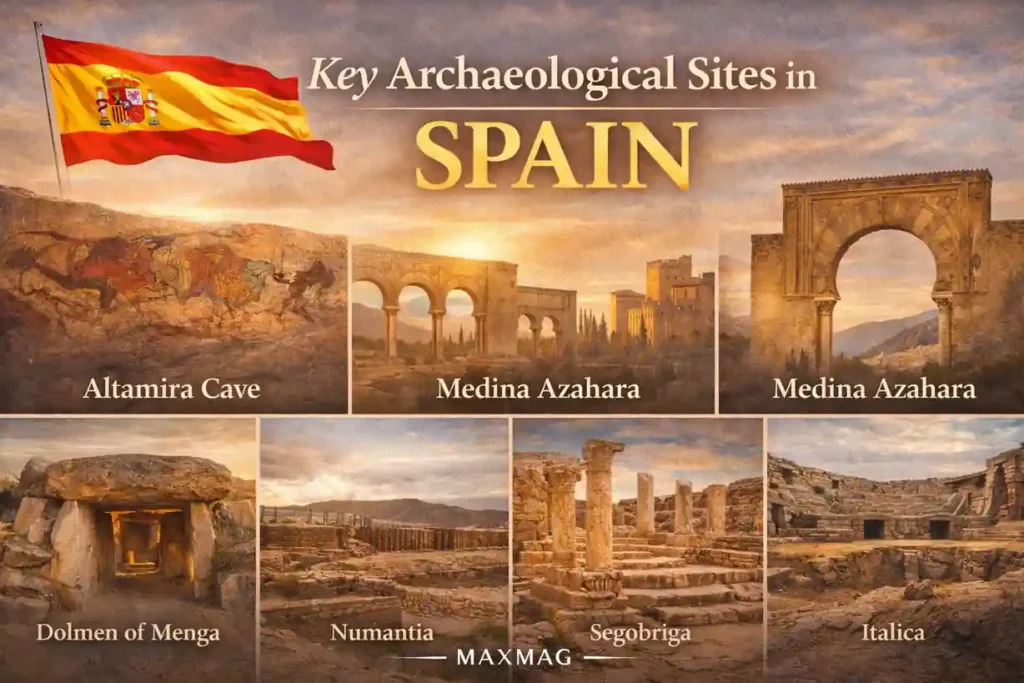
Altamira occupies a central place in the history of archaeology because it changed how scholars understood Paleolithic intelligence and symbolic life. Its decorated ceiling, with bison, horses, deer, and hand-related imagery, demonstrated that Ice Age communities possessed extraordinary artistic ability, observational skill, and ritual imagination. When the paintings were first publicized in the nineteenth century, many experts doubted their authenticity, partly because the art seemed too sophisticated to be prehistoric. That skepticism is now an important part of the site’s story: Altamira forced the discipline itself to become more intellectually humble.
The cave’s polychrome paintings are famous for their use of natural rock contours, which create a striking illusion of volume in animal bodies. Pigments, engraving, and spatial composition all show deliberate technical control. Beyond the celebrated ceiling, the site also yielded tools, habitation evidence, and stratified deposits that help place the art within lived contexts rather than treating it as isolated genius. Research at Altamira has contributed to debates about ritual use, domestic activity, and the social meaning of image-making in Upper Paleolithic communities.
Altamira matters because it reveals that visual culture, memory, and shared symbolic systems were already central to human life many millennia ago. In the wider constellation of Spain’s archaeological record, it reminds us that cognitive sophistication and artistic intentionality are not late developments tied only to urban civilization. The cave also raises modern preservation questions, since humidity, tourism, and microclimatic change can damage fragile surfaces. Its lesson is simple and profound: fragile images can carry immense historical weight.
Los Millares
- Location: Santa Fe de Mondujar, Almeria
- Period / Civilization: Chalcolithic / Copper Age
- Type of Site: Fortified settlement and necropolis
- Why It Matters: A key site for early metallurgy, fortification, and social stratification
Los Millares is one of the foundational sites for understanding later prehistoric complexity on the Iberian Peninsula. Occupied in the third millennium BCE, it combined a large fortified settlement with an extensive cemetery of collective tombs, making it unusually rich for reconstructing both daily life and mortuary practice. The settlement’s walls, bastions, and outer defensive works suggest a society already investing heavily in protection, organization, and territorial control. That alone makes it a landmark in the study of early complex communities in southern Iberia.
Archaeologists have documented copper-working evidence, domestic structures, storage spaces, and a necropolis dominated by tholos-style tombs. Material finds include tools, weapons, ornaments, and ceramics that indicate differentiated access to prestige goods and technical skills. The architecture of defense is especially revealing: multiple lines of fortification and outworks imply planning and labor coordination on a scale beyond simple village life. Researchers continue to debate exactly how centralized political power was, but few dispute that Los Millares reflects a highly organized society with visible hierarchy.
As part of the Archaeological Sites in Spain, Los Millares shows how early metallurgy changed social relations as much as technology. Control over resources, labor, burial display, and defended space suggests communities negotiating inequality, risk, and competition long before classical antiquity. It also offers a sobering reminder that social complexity and conflict often grow together. The site matters now because it helps readers see prehistory not as a vague beginning, but as a period of real political innovation and tension.
Dolmens of Antequera
- Location: Antequera, Andalusia
- Period / Civilization: Neolithic and Chalcolithic
- Type of Site: Megalithic funerary complex
- Why It Matters: Among Europe’s most impressive megalithic burial monuments
The Antequera megalithic complex, especially Menga, Viera, and El Romeral, reveals the scale and ambition of early monumentality in Iberia. These are not rough piles of stone but carefully engineered funerary structures built with immense slabs, interior chambers, corridors, and highly deliberate orientations. Menga in particular is remarkable for its massive orthostats and unusual alignment toward the Peña de los Enamorados, a prominent natural landmark. The complex demonstrates that prehistoric communities in southern Spain organized labor, engineering knowledge, and ceremonial practice at a sophisticated level.
Excavation and study have shown that the dolmens were tied to funerary ritual, communal memory, and symbolic geography. Their architectural differences suggest multiple traditions of burial design, while their orientations indicate that landscape itself may have carried sacred meaning. These monuments are essential cultural landmarks of Spain because they show how Neolithic and Chalcolithic societies linked the dead, the living, and the surrounding terrain through constructed permanence. The dolmens also preserve clues about social organization, technical skill, and long-term territorial identity.
What they reveal about ancient life is not a royal narrative but a communal one. Megalithic tombs imply cooperation, shared beliefs about ancestry, and a desire to materialize memory for generations. Their continued survival also underscores how vulnerable prehistoric architecture can be to neglect, environmental stress, and over-simplified interpretation. The Dolmens of Antequera matter because they remind us that even very early societies could build with monumental ambition and symbolic precision.
Empuries
- Location: L’Escala, Catalonia
- Period / Civilization: Greek and Roman
- Type of Site: Coastal settlement and urban archaeological complex
- Why It Matters: One of the clearest places to trace Greek and Roman presence in Iberia
Empuries, ancient Emporion and later Emporiae, is one of the most illuminating coastal sites in Spain because it captures cross-cultural contact in an unusually visible way. Founded as a Greek trading settlement and later transformed under Roman control, it preserves evidence of maritime exchange, urban planning, and political transition. The site’s coastal position was no accident: it linked Iberian communities to wider Mediterranean circuits of goods, ideas, and artistic influence. That makes Empuries indispensable for understanding how local societies engaged with incoming powers rather than merely receiving them passively.
Its excavated remains include street grids, domestic structures, public spaces, mosaics, walls, and ritual areas that reflect both Greek and Roman urban habits. The juxtaposition of phases allows archaeologists to track how built space changed when imperial priorities changed. Imported ceramics and other material culture help reconstruct trade networks, while the urban plan demonstrates how colonial and later imperial systems reshaped the local coastline. Empuries is especially valuable because it makes geopolitical change legible at the scale of streets, houses, and harbor-facing settlement.
The site reveals daily life shaped by commerce, multilingual interaction, religious plurality, and gradual institutional change. In the broader field of the Archaeological Sites in Spain, Empuries shows that Mediterranean contact was not a footnote but a structural force in the making of Iberian history. It also remains important today as a place where archaeologists, conservators, and visitors can still read the layered grammar of exchange. Few Spanish sites make cultural contact feel so materially immediate.
Numancia
- Location: Near Garray, Province of Soria
- Period / Civilization: Celtiberian and Roman
- Type of Site: Hilltop oppidum and siege landscape
- Why It Matters: A defining site for resistance, conquest, and memory in ancient Iberia
Numancia occupies a special place in Spanish historical imagination because it embodies the clash between local autonomy and Roman expansion. Originally a Celtiberian oppidum, it became famous for its resistance to Roman siege in the second century BCE. Ancient literary sources amplified that struggle, turning Numancia into a moral and political symbol, but archaeology grounds the story in settlement patterns, fortification, and the practical realities of war. The site therefore matters both as a physical settlement and as a case study in how memory and evidence interact.
Excavation has revealed house plans, storage areas, defensive remains, and traces of the wider military landscape connected to the Roman siege. Finds from the site and its surrounding context help reconstruct domestic routines as well as violent disruption. Rather than reducing Numancia to heroic legend, archaeology shows an inhabited place whose destruction and transformation took place in a specific material environment. The combination of indigenous settlement evidence and Roman military intervention makes it unusually rich for interpreting conquest from both sides.
Numancia reveals what resistance cost: interrupted households, broken infrastructure, and the forced reordering of local life under imperial pressure. Among the Archaeological Sites in Spain, it offers one of the clearest windows into warfare, identity, and the making of political myth. Its present-day significance lies in the fact that it is still invoked as a symbol, which means the site continues to shape modern narratives about endurance and sovereignty. Archaeology helps keep that symbolism accountable to evidence.
Segobriga
- Location: Near Saelices, Province of Cuenca
- Period / Civilization: Celtiberian origins, developed under Rome
- Type of Site: Urban archaeological park
- Why It Matters: A major inland Romanized city with exceptionally legible public architecture
Segobriga is one of inland Spain’s most instructive Roman urban sites because its remains preserve the logic of a provincial city with unusual clarity. Though earlier occupation existed, the site flourished under Roman rule, when administrative status, extraction, and regional communication gave it new weight. The city was connected to local resources and wider imperial systems, and its layout reflects a world in which civic display, governance, and infrastructure were inseparable. Unlike fragmentary ruins that force visitors to imagine the whole, Segobriga still communicates the outline of urban order.
The archaeological park includes a theater, amphitheater, forum area, baths, walls, and other structures that reveal how Roman civic life was staged in stone. The proximity of performance buildings is especially striking, while inscriptions and architectural remains help situate the city in its political and economic context. Segobriga is also valuable because it shows how Roman urbanism worked away from the most famous coastal and capital centers. Its public buildings are not decorative leftovers; they are evidence of social management, civic identity, and elite investment.
For modern readers, Segobriga reveals a society structured by spectacle, administration, patronage, and shared civic ritual. It is one of the Archaeological Sites in Spain where the machinery of Roman provincial life becomes unusually readable, from leisure to law to status performance. Preservation here matters because large open-air complexes can deteriorate through weathering and visitor pressure, even when they seem robust. Segobriga teaches that urban order itself can become an artifact.
Italica
- Location: Santiponce, near Seville, Andalusia
- Period / Civilization: Roman
- Type of Site: Roman city
- Why It Matters: One of Roman Hispania’s great urban centers and birthplace of emperors Trajan and Hadrian
Founded in the context of Rome’s expansion after the Second Punic War, Italica became one of the most prominent Roman cities in Hispania and later held exceptional symbolic value because it was associated with Trajan and Hadrian. The site shows how a settlement in southern Iberia could become deeply integrated into imperial political culture while retaining its regional importance. Its urban footprint reflects prosperity, civic ambition, and elite patronage on a large scale, making it indispensable for understanding Romanization as a local and imperial process at once.
Italica is especially known for its amphitheater, spacious streets, domestic quarters, and celebrated mosaics. The preserved houses, with named modern designations and elaborate floor decoration, help archaeologists reconstruct elite domestic life in ways that connect architecture to social display. Urban planning, drainage, and monumentality all signal a city built to express status. The site also benefits from long-standing scholarly attention, which has refined understanding of its phases, expansions, and relation to surrounding settlement.
In human terms, Italica reveals how provincial elites lived inside the cultural language of Rome while participating in regional society. Within Spain’s Roman archaeological landscape, it is a key place for seeing how empire was normalized through streets, entertainment, decoration, and civic ambition rather than through conquest alone. Its continued relevance lies in how effectively it makes Roman provincial identity visible. It shows that power survives not only in laws and armies, but in the textures of everyday urban life.
Roman Theatre of Merida
- Location: Merida, Extremadura
- Period / Civilization: Roman
- Type of Site: Monumental theater within a wider urban archaeological ensemble
- Why It Matters: A defining monument of Augusta Emerita and one of the best preserved Roman theatrical spaces in the peninsula
The Roman Theatre of Merida is often treated as a single monument, but its importance is best understood within the wider archaeological ensemble of Augusta Emerita, a major Roman foundation created for veterans and administrative control. The theater itself formed part of a larger civic and ceremonial landscape that included an amphitheater, roads, bridges, religious spaces, and domestic quarters. Its scale and setting show how culture, politics, and urban prestige worked together in a provincial capital. Merida matters because it preserves not only architecture, but an entire vision of civic life.
The stage front, seating structure, and adjoining architectural context make the theater one of the most visually powerful Roman survivals in Spain. Excavation and restoration have clarified construction phases, decorative programs, and how audiences moved through the building. As with many Roman theaters, the monument was about more than performance: it was also about hierarchy, order, and public self-presentation. The broader city has yielded inscriptions, sculpture, hydraulic works, and other remains that deepen interpretation far beyond one celebrated facade.
Among the Archaeological Sites in Spain, Merida reveals how imperial urbanism turned entertainment into civic discipline and social cohesion. It also shows how ancient monuments can remain culturally active, since the theater is still associated with performance in the modern city. That continuity is powerful, but it also complicates conservation, requiring careful balance between use and protection. Merida endures because it links living cultural memory to a rigorously studied ancient framework.
Medina Azahara
- Location: Near Cordoba, Andalusia
- Period / Civilization: Tenth century, Umayyad Caliphate of Cordoba
- Type of Site: Palace-city
- Why It Matters: A major material expression of caliphal power in al-Andalus
Medina Azahara, or Madinat al-Zahra, was conceived as a palace-city for the Umayyad Caliphate of Cordoba and remains one of the most sophisticated archaeological testimonies to statecraft in Islamic Iberia. Rather than growing organically like a long-inhabited town, it was an intentional political project: a designed seat of authority that fused administration, ceremonial display, residential space, and landscape control. Its terraces, architecture, and courtly organization reveal a ruling culture deeply invested in visibility, hierarchy, and refinement.
Excavations have uncovered reception halls, administrative spaces, gardens, decorative stonework, carved capitals, inscriptions, ceramics, and infrastructure that together point to a highly articulated court environment. The site’s destruction and partial abandonment also make it historically revealing, since its remains preserve both grandeur and rupture. Archaeologists continue to refine understanding of how the complex functioned, how it was supplied, and how it related to Cordoba itself. Medina Azahara is especially valuable because it gives material form to political ideology, not just domestic or military activity.
It reveals a world of court ceremony, ranked access, luxury production, and carefully managed perception. Within the Archaeological Sites in Spain, Medina Azahara broadens the narrative beyond prehistory and Rome by showing how al-Andalus transformed the peninsula’s built environment through intellectual ambition and aesthetic discipline as well as political force. The site remains vital today because it complicates simplistic national histories and foregrounds Spain’s Islamic past as central, not peripheral. Its ruins are an argument for historical honesty.
What These Sites Reveal About Ancient Life in Spain
Taken together, these places do far more than document monumental architecture. They reveal subsistence strategies, household organization, craft specialization, warfare, long-distance exchange, burial custom, religious symbolism, and the choreography of political power. The Archaeological Sites in Spain show that daily life in the peninsula was never static: food production changed with climate and technology, trade connected inland and coastal communities, and built environments evolved to express rank, piety, defense, or civic belonging. From cave art to palace administration, the evidence repeatedly links symbolic life to material practice.
They also expose profound differences in social hierarchy. At some sites, communal ritual and collective burial dominate; at others, elite houses, administrative terraces, or urban performance spaces make status visibly unequal. Weapons, storage capacity, imported goods, and funerary treatment can all hint at who held power and how that power was justified. Archaeology is especially valuable here because it captures routine behavior that written texts often ignore: how grain was stored, how streets organized movement, how domestic decoration signaled aspiration, and how bodies were treated after death. In short, these sites restore ordinary and extraordinary life to the same historical frame.
Preservation Challenges Facing Archaeological Sites in Spain
Preserving major archaeological landscapes in Spain is not a simple matter of fencing them off. Open-air ruins face erosion, temperature fluctuation, biological growth, flooding risk, and the slow wear created by constant exposure. Cave environments require strict control of humidity and visitor access. Urban sites must coexist with modern infrastructure, real-estate pressure, and the demands of living cities. Even celebrated monuments can suffer from underfunded maintenance, uneven interpretation, or restoration choices that privilege spectacle over long-term stability.
Looting and illicit collecting remain serious threats, especially where burial contexts or portable artifacts are involved. So does mass tourism, which can produce micro-damage, crowding, and pressure for simplified presentation. Responsible stewardship depends on archaeologists, conservators, local authorities, museums, and public education working together. A useful contemporary reminder comes from Smithsonian Magazine’s report on conservators reassembling Roman murals found in Spain, which illustrates how excavation is only the beginning and how painstaking conservation determines what future audiences will actually be able to study.
Preservation matters because archaeological loss is usually irreversible. Once stratigraphy is disturbed, once a painted surface is destabilized, or once an artifact is ripped from its context, knowledge disappears with it. Ethical heritage work therefore protects more than tourist assets: it protects evidence, memory, and the ability of future scholarship to ask better questions. Good preservation is not nostalgic; it is intellectually responsible.
The Archaeological Legacy of Spain
The deepest value of Spain’s archaeological record lies in its refusal to support a single, simplified origin story. The Archaeological Sites in Spain instead reveal a long sequence of encounters: hunter-gatherer adaptation, megalithic monumentality, fortified prehistoric inequality, Mediterranean exchange, Roman statecraft, and Islamic courtly power. That diversity is precisely the point. Spain’s past was made through accumulation, conflict, coexistence, and reinvention, and its surviving material record preserves those processes better than any slogan ever could.
This legacy also shapes how the country is imagined today. Regional identities, local museums, heritage routes, educational programs, and public debates about conservation all draw energy from the fact that the past remains physically present. The Archaeological Sites in Spain are not just destinations for specialists; they are active reference points in national and regional culture. They challenge modern audiences to accept that the peninsula’s history is plural, multilingual, and materially entangled, and that its greatest historical strength may be precisely that complexity.
Seen in that light, archaeology becomes a civic discipline as much as an academic one. It teaches patience, evidence-based interpretation, and respect for ambiguity. It also counters shallow myths by showing how places were actually built, inhabited, abandoned, and rediscovered. Spain’s archaeological legacy is therefore not only about what survived underground, but about the intellectual habits required to read it honestly.
Conclusion
Spain is archaeologically important because it preserves an exceptional time depth across many kinds of evidence: fossils, caves, megaliths, fortified settlements, Roman cities, funerary landscapes, and Islamic state architecture. Read together, the Archaeological Sites in Spain reveal a peninsula shaped not by one civilization, but by successive communities that adapted land, built institutions, negotiated power, and left durable traces of belief and daily life. That breadth is what makes Spain indispensable to anyone trying to understand the long history of Europe and the western Mediterranean.
The real lesson of these places is not simply that they are old or visually impressive. It is that they still speak – about survival, hierarchy, creativity, trade, memory, and the consequences of political change. To preserve them is to preserve context, evidence, and the chance to keep revising the stories we tell about the past. That is why serious archaeology matters, and why Spain’s buried record remains one of its most important intellectual and cultural inheritances.
There is also a practical lesson in reading Spain through archaeology. Material evidence slows down easy assumptions and forces attention to sequence, context, and coexistence. A cave deposit, a burial chamber, a city wall, a forum, or a caliphal reception hall each preserves different kinds of truth, and none of them can be understood properly in isolation. Together they show that the peninsula was shaped through repeated negotiation between environment and ambition: communities adapted to drought, defended strategic terrain, absorbed foreign influences, and built new identities over earlier foundations. That long view matters in the present because it encourages a more mature understanding of heritage – one that values research, public stewardship, and careful interpretation over nostalgia or spectacle. The most important sites in Spain endure not only because stone survives, but because scholars, conservators, and local institutions continue the difficult work of protecting context. When that work is done well, archaeology does more than preserve ruins; it preserves the evidence needed for future generations to think more clearly about power, change, and human resilience.
Q1: What is the most famous prehistoric site in Spain?
Q2: Why is Altamira Cave so important?
Q3: Which Roman sites in Spain are most significant?
Q4: What do Archaeological Sites in Spain reveal that written history cannot?
Q5: Are Spain's major archaeological places only from the Roman period?
Q6: Why is preservation such a major issue?