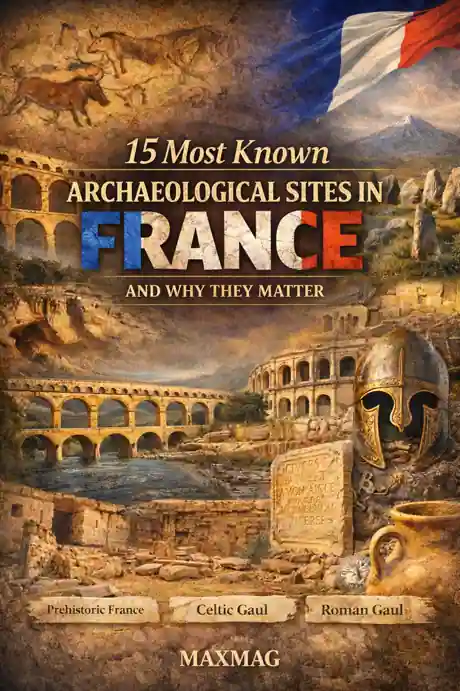
France is often approached through art, cuisine, monarchy, and revolution, yet its deepest story begins far below the modern surface. In scholarly and cultural terms, Archaeological Sites in France offer one of Europe’s richest continuous records of human presence, from Ice Age image-making to Iron Age power centers and Roman urbanism. That long span matters because the territory now called France sat at the meeting point of Atlantic routes, Mediterranean exchange, river-based settlement, and continental migration, making it a landscape where successive communities left unusually legible traces. For readers trying to understand the country beyond postcard Paris, archaeology reveals a slower, older, and more layered civilization.
What makes France especially compelling is not simply the number of excavated places, but the range of stories they preserve: painted caves, megalithic alignments, fortified hilltop settlements, ritual spaces, roads, aqueducts, theaters, and necropolises. The Archaeological Sites in France examined here show how people hunted, traded, worshipped, governed, buried their dead, and adapted to changing climates and empires. They also illuminate the transition from prehistoric societies to the Celtic worlds of Gaul and then to the Roman transformation of the landscape. Across regions as different as Dordogne, Brittany, Provence, and Burgundy, the archaeological map of France still shapes how the nation understands time, place, and identity.
This is also a story of stewardship. Some sites survive only through strict conservation, some are threatened by erosion or visitor pressure, and some remain partly debated in interpretation despite decades of study. Taken together, they form a serious intellectual archive rather than a simple list of attractions. To read them well is to see how landscapes become memory, and how the ancient ruins in France continue to influence scholarship, public heritage, and national imagination.
Why Archaeological Sites in France Matter
France matters archaeologically because its terrain preserves evidence from many turning points in European history. In the southwest, caves record some of the world’s most celebrated Upper Paleolithic art. In Brittany, megalithic traditions testify to complex ritual and memorial cultures long before written history. In the center and east, fortified hill settlements and elite centers associated with late Iron Age Gaul reveal the political and economic sophistication of pre-Roman societies. Then, under Roman rule, towns, aqueducts, arenas, sanctuaries, villas, and roads transformed local settlement patterns and left a durable built environment that still shapes the geography of modern cities.
The French record is also distinctive because it preserves overlapping layers rather than isolated moments. A hill used in one period could be reused, monumentalized, abandoned, and reinterpreted centuries later. Archaeology therefore helps explain not only what existed, but how memory, power, and territory were repeatedly rewritten. That is one reason historians still use material evidence from France to discuss the ancient civilizations of France, the Romanization of Gaul, and the regional diversity that continued even under imperial frameworks.
Archaeological Sites in France and the Deep Historical Record
The density of archaeological evidence across France is meaningful because it reflects long continuity between geography and human choice. River valleys such as the Dordogne, Rhône, Saône, and Seine offered water, transport, fertile land, and strategic defensibility. Limestone shelters preserved organic traces and imagery; Mediterranean corridors encouraged trade and colonial contact; upland plateaus and ridges became ideal places for fortified settlements. The result is not random abundance, but a pattern in which landscape repeatedly attracted, constrained, and organized human life.
Seen together, these places form more than a national checklist. They reveal how settlement moved from caves and ceremonial zones to proto-urban oppida and then to Roman civic networks. They also show how local traditions persisted inside larger political systems. To read the map of French archaeology is to understand how continuity and rupture coexist: people adapted new religions, new building methods, and new forms of administration, but they did so on older ground with older habits and memories.
A Brief Historical Timeline of France
Prehistoric France begins with Paleolithic occupation stretching back hundreds of thousands of years, but it becomes especially vivid during the Upper Paleolithic, when groups associated with Aurignacian, Gravettian, Solutrean, and Magdalenian traditions left tools, habitation traces, and cave art. Neolithic communities later introduced farming, built megalithic monuments, and reshaped landscapes through more permanent settlement. By the Bronze and Iron Ages, regional societies had developed complex exchange systems, metallurgy, and more formalized social hierarchies.
In the late Iron Age, Celtic-speaking peoples in Gaul organized settlements, sanctuaries, and political centers that linked local power with wider trade networks. Julius Caesar’s conquest in the first century BCE accelerated the incorporation of Gaul into the Roman world, leading to urban building, road systems, monumental architecture, and new religious forms. Late antiquity and the early medieval centuries did not erase this material past; instead, many Roman and pre-Roman sites were reused, quarried, reinterpreted, or woven into local memory. For a broad public overview of Gaul’s transformation, the History overview of the Celts and the wider ancient world helps frame why pre-Roman and Roman France belong in the same longer story.
Lascaux Cave: A Landmark Among the Archaeological Sites in France
- Location: Montignac-Lascaux, Dordogne, Nouvelle-Aquitaine
- Period / Civilization: Upper Paleolithic, commonly associated with the Magdalenian period
- Type of Site: Decorated cave sanctuary / parietal art site
- Why It Matters: It preserves some of the most famous prehistoric paintings in the world and remains central to debates about symbolism, ritual, and cognition.
Lascaux is one of the defining prehistoric sites in Europe because it preserves an extraordinary painted cave interior created by Upper Paleolithic communities roughly seventeen millennia ago. Discovered in 1940, the cave quickly became central to the study of Ice Age imagery, not only because of its beauty but because of the sophistication of composition, shading, and placement. Its walls and chambers contain large animals—aurochs, horses, deer, bison—arranged in ways that suggest more than casual depiction. Whether the site functioned as a ritual space, a place of teaching, a symbolic map, or some combination of these remains debated, yet no serious interpretation treats it as mere decoration. In the wider story of France, Lascaux anchors the idea that symbolic complexity and technical control were already highly developed long before farming, cities, or writing reshaped European life.
Its most distinctive feature is the scale and dynamism of the paintings, especially in the Hall of the Bulls, where animals appear in motion and are adapted to the contours of the cave wall. Archaeologists and conservators have studied pigments, engraving marks, lamp traces, and floor deposits to understand how artists worked in the darkness. The cave’s closure to the public in the twentieth century, after carbon dioxide, humidity, and microorganisms began threatening the paintings, became a landmark conservation case. Replicas and digital reconstructions now carry much of the visitor burden. Though many details of chronology and use remain open to interpretation, Lascaux transformed how scholars think about early symbolic behavior and the cognitive worlds of hunter-gatherers.
The human story at Lascaux is powerful because it shifts attention from survival alone to imagination, memory, and social meaning. The cave suggests that Paleolithic communities in southwestern France invested labor in places that may have been ceremonial, initiatory, or cosmological. It also indicates highly developed knowledge of animals, movement, and perhaps seasonal cycles. For modern readers, Lascaux matters not as an isolated masterpiece but as a rare preserved environment where art, place, and belief meet. That is why Archaeological Sites in France are never only about stones or walls: at Lascaux, they are about the deep history of human thought itself.
Chauvet Cave
- Location: Ardèche, Auvergne-Rhône-Alpes
- Period / Civilization: Upper Paleolithic, with art often dated to the Aurignacian
- Type of Site: Decorated cave / prehistoric art site
- Why It Matters: It contains exceptionally early and sophisticated figurative art, challenging older assumptions about artistic development.
Chauvet Cave, discovered in 1994, radically expanded scholarly understanding of early symbolic culture because many of its paintings appear to date to far earlier phases of the Upper Paleolithic than once expected for such artistic complexity. The cave contains lions, rhinos, bears, horses, and other animals rendered with a sense of movement and overlap that surprised specialists accustomed to treating advanced cave art as a later phenomenon. As at Lascaux, the question is not only what was painted, but why this underground space mattered so much. Human visits seem to have been episodic, and the cave’s interior preserves traces of both human activity and animal presence, including cave bears, producing a layered record of occupation, avoidance, and encounter.
Among Chauvet’s distinctive features are its use of charcoal drawing, wall preparation, and visual sequencing across chambers. Researchers have examined footprints, torch marks, hearth residues, and cave bear remains to reconstruct movement through the space. Radiocarbon dating played a crucial role in the cave’s interpretation, and early dates initially provoked debate because they seemed to overturn linear assumptions about artistic progress. Over time, the evidence made clear that sophisticated representational art emerged very early. The site is therefore important not just for its images but for how it changed the intellectual framework of prehistoric archaeology.
Chauvet reveals a world in which dangerous animals, darkness, memory, and image-making may have been linked in ways now only partly recoverable. It suggests that Paleolithic people were participating in symbolic systems rich enough to justify repeated investment in inaccessible spaces. That insight matters because it reminds us that early societies in Europe were not culturally simple. In present-day France, Chauvet also stands as a reminder that preservation sometimes requires distance: like Lascaux, the original cave is tightly protected, proving that careful conservation can be as important as discovery itself.
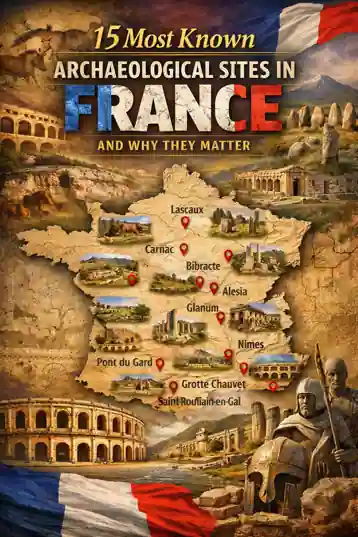
Carnac Stones
- Location: Carnac, Morbihan, Brittany
- Period / Civilization: Neolithic
- Type of Site: Megalithic alignments, tumuli, and ritual landscape
- Why It Matters: It is one of the most extensive megalithic landscapes in the world and key to understanding Neolithic monumentality.
The Carnac complex is not a single monument but a broad ritual landscape of standing stones, alignments, burial mounds, and associated structures created over centuries in the Neolithic period. Its vast arrays of upright stones, set out across the Breton landscape, have fascinated antiquarians, archaeologists, and local communities alike. While the exact meanings of the alignments remain debated, few scholars doubt that their construction required planning, labor coordination, and a durable ceremonial logic. Carnac therefore stands as evidence that Neolithic communities in western France possessed both social organization and symbolic ambition on a scale often underestimated in public narratives of prehistory.
What makes Carnac distinctive is its monumental repetition: rows of stones seem to structure movement, attention, and perhaps ceremonial sequence across open ground. Excavations in and around the area have clarified that the wider landscape includes tombs, cairns, and other megalithic features, indicating that the stones were part of a larger ritual system rather than an isolated construction. Archaeologists continue to debate whether the alignments had funerary, territorial, astronomical, or processional significance. Whatever the final balance of interpretation, Carnac demonstrates that monument-building in Neolithic Europe was both technically demanding and socially meaningful.
As a window into daily life, Carnac is important precisely because it moves beyond domestic evidence and points to collective labor, shared memory, and public ceremony. These stones imply communities able to marshal workforces, transmit design ideas, and embed belief into the landscape. They also raise questions about leadership, kinship, and the politics of monument creation. Today, the site remains one of the most recognizable historic sites in France, but its value extends beyond visibility: Carnac preserves the scale of prehistoric intention in a way that still forces modern audiences to think differently about Neolithic society. Within the broader study of Archaeological Sites in France, it stands for collective labor on a monumental scale.
Bibracte
- Location: Mont Beuvray, Burgundy
- Period / Civilization: Late Iron Age, associated with the Aedui of Gaul
- Type of Site: Oppidum / fortified urban center
- Why It Matters: It is one of the most important late Celtic political and economic centers known in France.
Bibracte was a major oppidum of the Aedui, a powerful Gallic people whose strategic and political position made them central to the final centuries before Roman domination. Perched on Mont Beuvray, the site functioned as a fortified center combining defense, elite residence, craft production, trade, and political assembly. Classical sources connect the Aedui to the larger drama of Caesar’s campaigns, but archaeology allows Bibracte to be understood on its own terms rather than only through Roman narrative. Its scale and internal organization show that late Iron Age Gaul was capable of urban-like concentration and complex administration well before formal Roman city-building transformed the region.
Excavations at Bibracte have revealed fortifications, street layouts, workshops, imported goods, coinage, and residential zones, all of which complicate old stereotypes of “barbarian” Gaul. The site’s ramparts demonstrate major engineering effort, while material culture points to wide exchange networks reaching into Mediterranean trade. Archaeologists have also studied changing building styles and imported objects to understand the transitional moment when Roman influence increased but local structures remained active. Bibracte is therefore distinctive not only as a Celtic stronghold but as a site where indigenous power and imperial pressure can be studied in close material detail.
The broader value of Bibracte lies in what it reveals about hierarchy, politics, and economic specialization in late Iron Age France. This was a place where authority was organized spatially, where artisans worked at scale, and where local elites navigated changing alliances in a high-stakes geopolitical landscape. For modern readers, Bibracte matters because it restores complexity to pre-Roman Gaul and helps explain how conquest altered an already sophisticated world. That makes the site essential for understanding the archaeological heritage of France as something more layered than a simple Roman inheritance. Among Archaeological Sites in France, few places so clearly dismantle the old myth of a culturally simple Gaul.
Alesia
- Location: Alise-Sainte-Reine, Burgundy
- Period / Civilization: Late Iron Age and Roman transition
- Type of Site: Oppidum and battlefield landscape
- Why It Matters: It is associated with the siege of Vercingetorix and the decisive Roman conquest of Gaul.
Alesia occupies an outsized place in the history of France because it is tied to the siege in 52 BCE that ended organized large-scale resistance under Vercingetorix and marked a turning point in Caesar’s conquest of Gaul. Whether approached through classical texts, national memory, or archaeology, the site represents a moment when political destiny and material evidence converge. The fortified hilltop was already a significant Gallic center before the siege, and its landscape offered clear defensive advantages. That setting helps explain why it became the scene of a confrontation that later generations treated as foundational to the transformation of Gaul into a Roman province.
The archaeological significance of Alesia lies in the combination of settlement evidence and siege-related remains found in the surrounding terrain. Excavations have identified fortification features and material linked to Roman encirclement works, strengthening the identification of the site despite older debates. Finds connected to both Gallic and Roman military presence have helped scholars reconstruct strategy, logistics, and the scale of the operation. Alesia is thus distinctive because it preserves not only an indigenous center, but a battlefield landscape where imperial warfare can be studied through terrain and artifact distribution rather than text alone.
Beyond the military narrative, Alesia reveals how conflict restructures communities. Sieges compress civilians, elites, food supplies, and political decision-making into moments of extreme pressure. The site therefore speaks to the human costs of conquest as much as to its strategic mechanics. Today, Alesia remains relevant because it sits at the intersection of archaeology, identity, and myth: it is a place where evidence must constantly be separated from patriotic storytelling. That tension makes it one of the most instructive places in France for understanding how archaeology disciplines memory.
Pont du Gard
- Location: Near Vers-Pont-du-Gard, Occitanie
- Period / Civilization: Roman Imperial period
- Type of Site: Aqueduct bridge
- Why It Matters: It is one of the best-preserved Roman hydraulic monuments in the world and demonstrates advanced engineering in Roman Gaul.
Pont du Gard is the monumental bridge section of the aqueduct that once carried water to the Roman city of Nemausus, modern Nîmes. Built in the first century CE, it shows the degree to which Roman rule in Gaul involved not only military administration but also ambitious infrastructural reshaping of the landscape. Its three tiers of arches crossing the Gardon Valley are the visible remnant of a much longer system designed with remarkable precision over distance and gradient. In historical terms, the monument captures the Roman belief that engineering, public utility, and prestige could be fused into a single durable statement of power.
The structure’s distinctive feature is its technical elegance. Massive stone blocks were assembled with extraordinary accuracy to maintain the gentle slope required for water flow, and the bridge remains a lesson in load distribution, surveying, and monumental design. Study of tool marks, construction methods, and sedimentary traces in the water channel has helped archaeologists and engineers reconstruct both original function and later alterations. Pont du Gard also matters because it survived in large part through changing reuse, local adaptation, and eventual heritage recognition rather than uninterrupted maintenance of its Roman purpose.
As evidence of ancient life, the aqueduct points to the demands of urban living: baths, fountains, sanitation, and public display all depended on reliable water supply. It also reflects taxation, labor organization, and the authority needed to plan and maintain regional infrastructure. For modern audiences, Pont du Gard is more than an emblem of Roman grandeur; it demonstrates that large public systems in antiquity were practical, political, and symbolic all at once. Few sites show so clearly how imperial technology changed everyday life in southern France. Within Archaeological Sites in France, it is the clearest lesson in how infrastructure itself can become a historical monument.
Nîmes Amphitheatre
- Location: Nîmes, Occitanie
- Period / Civilization: Roman Imperial period
- Type of Site: Amphitheatre / civic entertainment monument
- Why It Matters: It is one of the best-preserved Roman amphitheatres in the former western empire.
The amphitheatre at Nîmes, often called the Arènes de Nîmes, is among the clearest demonstrations of how Roman civic life took root in Gaul. Built in the early imperial period, the structure hosted spectacles that tied local populations to Roman norms of public entertainment, social display, and imperial culture. Its survival in the heart of a living city makes it especially valuable, because it allows scholars to study both ancient architecture and long-term urban continuity. The monument stands as a reminder that Romanization was not abstract; it was experienced in stone seating, crowd movement, programmed violence, and public ritual.
Architecturally, the amphitheatre is notable for its elliptical plan, tiered seating, internal circulation passages, and structural durability. Archaeologists and architectural historians have examined masonry, vaulting systems, access routes, and later modifications to understand how the building functioned and how it was adapted over time. Its preservation owes much to continuous reuse, including later defensive and residential phases, which paradoxically helped prevent total destruction. That long afterlife is one reason the monument remains so instructive: it is not simply a Roman shell, but a structure repeatedly folded into new urban needs.
The human story here is about hierarchy and spectacle. Seating was socially organized, access was controlled, and public events reinforced status distinctions while binding crowds into a common civic experience. The site also reveals the economics of performance, the logistics of managing large audiences, and the symbolic centrality of Roman public life. In the study of Archaeological Sites in France, Nîmes matters because it shows how empire entered daily rhythms, turning architecture into a stage on which identity, power, and belonging were repeatedly performed.
Maison Carrée and the Roman Sanctuary District of Nîmes
- Location: Nîmes, Occitanie
- Period / Civilization: Roman Imperial period
- Type of Site: Temple and civic sacred precinct
- Why It Matters: It preserves one of the best-surviving Roman temples in the world and illuminates religion and civic patronage in Roman Gaul.
The Maison Carrée is often discussed as architecture, but it is equally important archaeologically because it belonged to a larger sacred and civic landscape in Roman Nîmes. Built in the early imperial era and linked to the imperial cult, the temple demonstrates how religion, political loyalty, and urban prestige intersected in provincial cities. Its placement within the city helped create a ceremonial center where local elites and imperial ideology could meet in public space. In this sense, the building is not merely a classical monument; it is evidence of how Roman religious practice was localized and made visible in Gaul.
Its most distinctive feature is its extraordinary state of preservation, including the temple’s podium, portico, and carefully proportioned façade. Archaeological study of the surrounding urban fabric, inscriptions, and nearby remains has helped reconstruct the broader district in which it functioned. The monument’s dedication is tied to imperial figures, which allows it to be read as a statement of political theology as much as a place of cult. That dual identity gives the site unusual interpretive force for understanding how architecture materialized allegiance.
What the site reveals about ancient life is the public nature of religion in Roman cities. Ritual was not confined to private devotion; it was staged, visible, and integrated into civic hierarchy. Temples could reinforce local status, connect provincial communities to imperial centers, and shape the ceremonial rhythm of urban life. Today, the Maison Carrée remains relevant not because it is pristine, but because it shows how belief and statecraft once occupied the same carefully designed urban stage.
Glanum
- Location: Saint-Rémy-de-Provence, Provence-Alpes-Côte d’Azur
- Period / Civilization: Originally pre-Roman, later strongly Romanized
- Type of Site: Urban settlement / sanctuary complex
- Why It Matters: It preserves the layered transition from indigenous settlement to a Romanized town in southern Gaul.
Glanum is one of the most revealing archaeological sites in Provence because it documents a settlement that developed from an indigenous center into a Romanized town without erasing the complexity of its earlier phases. Situated near a spring and along routes of exchange, it became a place where local religious traditions, Mediterranean influence, and later Roman urban forms intersected. That layered development gives the site unusual value: instead of showing a single moment, Glanum preserves a sequence of adaptation, appropriation, and civic reshaping. It helps readers see that Roman Gaul was not built on empty ground but on landscapes already meaningful to earlier communities.
Excavations have exposed streets, houses, public buildings, a sanctuary area, and monumental remains including structures associated with civic and religious life. The nearby triumphal arch and mausoleum, though often discussed separately, reinforce the site’s importance in understanding Roman visual and commemorative culture in the region. Archaeologists have used architecture, inscriptions, and material assemblages to trace changing identities within the town. Glanum is distinctive because it offers a highly legible example of cultural layering, where indigenous and Roman elements can be studied in relation rather than isolation.
The wider significance of Glanum lies in what it reveals about everyday adaptation under empire. People continued to live, worship, trade, and bury their dead within systems that were changing politically and architecturally. The site therefore speaks to continuity as much as transformation. For present-day France, Glanum remains important as a place where the dialogue between local traditions and Mediterranean empire can still be read directly in stone, plan, and setting.
Arles Cryptoporticus
- Location: Arles, Provence-Alpes-Côte d’Azur
- Period / Civilization: Roman Imperial period
- Type of Site: Subterranean gallery complex beneath the forum
- Why It Matters: It helps explain how Roman civic centers were engineered and stabilized in difficult urban terrain.
The cryptoporticus beneath the forum of Roman Arles is an unusually revealing survival because it preserves the hidden infrastructure of a Roman city rather than only its visible monumental face. Built to support and regularize the forum above, the vaulted galleries solved topographical challenges while also creating usable substructures. This makes the site especially valuable for understanding the practical intelligence behind Roman urban planning. Arles, a major city in Roman Gaul, was shaped by commerce, administration, and regional connectivity, and the cryptoporticus shows how engineering underpinned those civic ambitions.
Its distinctive features include long vaulted corridors, masonry techniques designed for support and stability, and a spatial relationship to the civic center above that can still be reconstructed. Archaeologists and architectural historians study such spaces because they reveal what grand public architecture needed in order to stand and function. The cryptoporticus also preserves atmospheric evidence of how hidden urban environments were used, accessed, and repurposed over time. Unlike an arena or temple, it teaches through infrastructure—through the supporting logic that made visible prestige possible.
This site sheds light on labor, planning, and urban hierarchy. Civic power required not only monuments but also technical systems that most residents would rarely see directly. In that sense, the cryptoporticus is a lesson in the buried work of empire. Today it remains important because it expands public understanding of Roman cities beyond façades, showing that durability and administration depended on unseen architecture as much as on spectacle.
Alyscamps
- Location: Arles, Provence-Alpes-Côte d’Azur
- Period / Civilization: Roman with Late Antique and early Christian continuities
- Type of Site: Necropolis
- Why It Matters: It preserves a long-used burial landscape that reflects changing beliefs about death, memory, and status.
Alyscamps is one of the most important funerary landscapes in France, originally a Roman necropolis outside the walls of Arles and later an early Christian burial zone of exceptional prestige. The site matters because cemeteries often preserve social history in concentrated form: they encode status, ritual, family memory, and evolving belief. Arles was a major urban center with strong regional and Mediterranean connections, and its burial landscapes reflect that prominence. Alyscamps therefore allows archaeologists to track not only Roman funerary customs but also the transformations that came with late antique Christianity and changing ideas of sacred proximity.
The site’s distinctive features include sarcophagi, burial arrangements, road-side placement, and long continuity of use. Over centuries, spolia, relocation, and reuse altered the funerary landscape, but that very complexity is part of its interpretive value. Excavated remains, inscriptions, and sculptural fragments help scholars reconstruct patterns of commemoration and social differentiation. Alyscamps is especially useful because it shows that the archaeology of death often records both continuity and doctrinal change more clearly than domestic sites do.
What the necropolis reveals about ancient life is indirect but profound: burial choices reflect wealth, family strategy, religious affiliation, and ideas of the afterlife. They also show how the dead remained embedded in the geography of the living. For modern readers, Alyscamps matters because it links archaeology to memory in one of its clearest forms. A civilization’s treatment of its dead is never a minor detail; it is one of the deepest clues to how that society understood itself.
Vaison-la-Romaine
- Location: Vaucluse, Provence-Alpes-Côte d’Azur
- Period / Civilization: Roman Imperial period
- Type of Site: Roman urban settlement with domestic, civic, and theatrical remains
- Why It Matters: It offers one of the richest windows into urban domestic life in Roman Gaul.
Vaison-la-Romaine is unusually valuable because it preserves a broad spread of urban remains rather than one isolated monument. Houses, streets, public areas, and a theater combine to create a more complete picture of Roman provincial life than many better-known single structures can provide. The site was an important settlement in Roman Gaul, and its remains demonstrate how civic infrastructure and domestic comfort could coexist in a regional center. This makes it especially useful for readers who want to understand not only imperial power, but the texture of everyday urban existence.
Among its distinctive features are substantial domestic quarters with mosaics, architectural detailing, drainage, and spatial organization that reveal status differences and domestic routines. Archaeologists have also studied shops, movement routes, and public spaces to reconstruct how inhabitants navigated work, display, and leisure. Because the site preserves multiple categories of remains in close relation, it allows unusually detailed discussion of how homes connected to streets and how urban planning shaped daily experience. That integrated evidence is its greatest strength.
Vaison-la-Romaine reveals family life, consumption, social aspiration, and the local forms of Roman urban culture. It shows that provincial towns were not passive copies of Rome but places where local wealth and imperial models were combined in distinctive ways. In the study of Archaeological Sites in France, the site remains crucial because it replaces abstraction with lived detail: one can see how people inhabited Roman order, not merely how rulers proclaimed it.
Orange Roman Theatre
- Location: Orange, Provence-Alpes-Côte d’Azur
- Period / Civilization: Roman Imperial period
- Type of Site: Theatre / performance monument
- Why It Matters: It preserves one of the best surviving Roman theatre stage walls in existence.
The Roman Theatre of Orange demonstrates how performance architecture became central to urban identity in the provinces of the empire. Constructed in the early imperial period, it was not a marginal luxury but a civic institution where public culture, social hierarchy, and imperial legitimacy could be staged before large audiences. In Roman Gaul, theaters helped integrate local populations into a shared world of language, ceremony, and performance. Orange is especially important because its famous scaenae frons survives so impressively, allowing archaeologists and historians to study not just plan but theatrical visual experience.
The site’s distinctive feature is the monumental stage wall, whose scale and preservation make the building exceptional. Study of seating, access routes, acoustic considerations, and decorative fragments helps reconstruct how performances were organized and how audiences were sorted. The theatre also sits within a wider Roman urban context that included civic spaces and routes of movement, reinforcing its role as part of an integrated cityscape rather than an isolated showpiece. Its survival makes it a rare teaching tool for understanding ancient performance environments at near-monumental scale.
Orange reveals the politics of leisure. Public entertainment in the Roman world was bound to civic identity, social ranking, and the demonstration of elite generosity. The theatre also shows how architecture shaped perception, guiding spectators toward shared focal points and emotional experiences. Today, it remains a vivid reminder that performance was part of governance in antiquity, and that culture itself can be a durable instrument of political order. That is why Archaeological Sites in France are not only records of administration and war, but of public emotion, staged identity, and shared urban experience.
Ensérune Oppidum
- Location: Near Béziers, Occitanie
- Period / Civilization: Iron Age with later Roman-era continuities
- Type of Site: Hilltop oppidum / settlement
- Why It Matters: It preserves a strategically placed settlement linked to trade, storage, and regional exchange in southern Gaul.
Ensérune offers a crucial perspective on Iron Age southern France because it was a hilltop settlement positioned near major communication routes between inland and Mediterranean zones. Before and during the spread of Roman influence, such sites helped manage exchange, agriculture, and regional authority. Ensérune’s location made it both strategic and economically useful, and the site’s remains show that upland defensibility and commercial access often worked together rather than in opposition. For understanding pre-Roman southern Gaul, this combination is essential.
Archaeological work has identified housing remains, storage areas, fortification elements, and associated material that illuminate everyday settlement rather than only elite monumentality. The nearby funerary evidence and broader regional context help scholars interpret the site within trade networks connected to Mediterranean goods and local production. One distinctive aspect of Ensérune is how clearly it shows the practical relationship between topography, storage, and control of movement. It is a place where landscape itself functioned as infrastructure.
What Ensérune reveals is a world of agricultural management, exchange, and defensible community life. It suggests social organization capable of coordinating storage, movement, and oversight in a politically dynamic region. For today’s readers, the site matters because it broadens the story of ancient France beyond famous Roman monuments. It reminds us that many of the most consequential places in history were not imperial showpieces but strategically useful communities embedded in everyday economic life.
What These Sites Reveal About Ancient Life in France
Read together, these places show that the past of France was never singular. Caves point to symbolic worlds and long memory; megalithic landscapes imply collective labor and ceremonial planning; oppida reveal political authority, trade, and defensive strategy; Roman towns and monuments expose infrastructure, religion, spectacle, and civic order. The value of Archaeological Sites in France lies in this collective portrait of lived experience. They help historians move from isolated masterpieces to systems of life: how food moved, how labor was organized, how social ranking was displayed, how the dead were honored, and how belief was made visible in architecture and landscape.
These sites also reveal how connected ancient communities were. Imported goods, urban planning models, metallurgical evidence, and architectural forms all indicate networks that linked local settlements to regional and Mediterranean exchange. At the same time, local variation persisted. Different ecologies, resources, and traditions produced distinct responses to common pressures. That is why the material record matters so much: it shows not just power from above, but adaptation on the ground. From hunting knowledge in painted caves to civic engineering in Roman cities, the archaeological record captures how people in different eras solved practical problems while also creating meaning. It is through such evidence that the cultural landmarks of France become legible as records of work, belief, and social imagination.
Preservation Challenges Facing France’s Ancient Sites
Preserving ancient places is never a neutral technical exercise. Caves are vulnerable to shifts in temperature, humidity, fungus, and human breath; open-air monuments face erosion, pollution, plant growth, and climate stress; urban sites must compete with development pressure and infrastructure demands. The study of Archaeological Sites in France therefore depends on constant negotiation between access and protection. Lascaux and Chauvet famously show that public enthusiasm can endanger what it admires, while Roman and Iron Age sites across the country face slower threats such as groundwater change, urban encroachment, fragmented funding, and the wear produced by mass visitation.
Preservation also raises ethical questions. How much reconstruction is acceptable? When should replicas substitute for access to originals? How should local communities, national heritage authorities, museums, and researchers share authority over interpretation? These are not abstract issues. They shape which sites receive resources, which narratives are highlighted, and which forms of damage are considered urgent. A useful public example of why careful conservation and interpretation matter can be found in Smithsonian Magazine’s discussion of what Lascaux cave art reveals about humanity’s early symbolic life, which underscores how fragile context is when a site becomes globally famous.
The Archaeological Legacy of France
The long historical importance of France is not explained by a single civilization, period, or monument. It emerges from accumulation: prehistoric image-making, Neolithic monumentality, Iron Age political organization, and Roman civic transformation all left durable marks on the same broad territory. In that sense, Archaeological Sites in France reveal the country not as a fixed identity but as a layered historical environment repeatedly reshaped by migration, conflict, adaptation, and memory. Modern France inherits not one past, but many overlapping pasts, each still visible in the landscapes people inhabit today.
This legacy also matters intellectually. The best sites in France continue to shape debates about symbolism, urbanization, state formation, ritual, and cultural exchange across Europe. They are essential not only to national heritage but to broader human history. That is why Archaeological Sites in France remain so compelling to scholars and general readers alike: they show how local evidence can answer continental questions. The deepest value of French archaeology is that it links highly specific places to very large ideas—how societies organize labor, imagine power, represent animals, build memory, and absorb change over long durations.
Conclusion
To understand France only through its modern capitals, dynasties, or artistic movements is to begin the story very late. The country’s deeper archive lies in caves, hillforts, sanctuaries, burial grounds, theaters, temples, and hydraulic works that preserve far older patterns of human life. From Paleolithic image-makers to Roman engineers, the communities who occupied this land left evidence of adaptation, imagination, hierarchy, ritual, and exchange on an extraordinary scale. For anyone seeking the full historical depth of the country, Archaeological Sites in France provide the most grounded and illuminating path into that longer narrative.
They also remind us that preservation is a civic obligation, not a luxury. Archaeology does more than recover objects; it protects context, resists myth-making, and gives future generations a disciplined way to encounter the past. France’s material record still shapes its intellectual profile and public identity, and its greatest sites continue to reward careful reading. To preserve them is not simply to save monuments, but to protect the evidence of how human societies became what they are.
Q1: What is the most famous prehistoric cave site in France?
Q2: Which French site best represents Neolithic monument building?
Q3: Why is Bibracte important in Gallic history?
Q4: What do Archaeological Sites in France reveal most clearly?
Q5: Why are some major cave sites closed to the public?
Q6: Which French Roman monuments are especially important?