

The THIEAUDIO Cypher arrives at a crowded moment for enthusiast headphones, which is precisely why it is interesting. It is not a nostalgia play, not a luxury-status object, and not a bass-heavy lifestyle product pretending to be serious hi-fi. It lands instead as a reference-leaning open-back designed for listeners who want clean tonal balance, proper build quality, and enough technical performance to justify sitting down and actually listening, rather than just collecting gear. The Kickstarter launch positions it as a flagship for THIEAUDIO’s headphone line, while the official materials pitch a newly developed 50mm dynamic driver, a 20-core N45 magnetic array, 32-ohm impedance, 96 dB sensitivity, and a $399 retail target with lower early campaign pricing.
What the product is
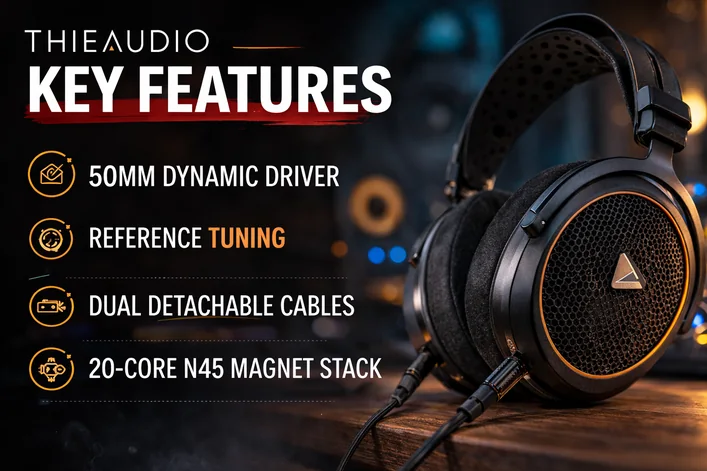
On paper, the THIEAUDIO Cypher is a wired open-back over-ear headphone aimed at the overlap between audiophile listening and light professional monitoring. Linsoul’s product page describes a 50mm dynamic driver built around a 20-core N45 magnetic array, a semicrystalline polymer-and-rubber composite diaphragm, and high-tension copper-aluminum voice coils; the store listing also states a warm-neutral “reference” target, a 1.5-meter braided cable, 32-ohm impedance, and 96 dB sensitivity. THIEAUDIO’s own site confirms the brand identity and professional-leaning message, while Linsoul’s February preview said the model had already been shown at major audio events before launch. For readers who want the source pages, the article links to the <a href=”https://www.thieaudio.com/”>THIEAUDIO official website</a> and the <a href=”https://www.kickstarter.com/projects/linsoul/thieaudio-cypher-flagship-dynamic-driver-headphones”>Kickstarter launch page</a>.
That positioning matters, because THIEAUDIO is not entering the over-ear market with the kind of halo-product pricing that usually accompanies the word “flagship.” Instead, it is trying to land in that tricky upper-midrange space where buyers expect premium materials, serious tuning, and very few obvious mistakes. That is also the price band where people start comparing every newcomer against a decade’s worth of trusted classics.
First impressions
The first thing many reviewers noticed about the THIEAUDIO Cypher was not only the sound, but the sense that THIEAUDIO wanted this model to feel more mature than “first big headphone effort” suggests. Linsoul’s own materials lean heavily on aluminum, leather, and structural solidity, and independent early reviews broadly agree that the build feels unusually substantial for the money. Headfonia highlighted the steel-and-aluminum feel, strong finish quality, and confidence-inspiring hardware, though it also flagged the possibility that the very soft pads may age faster than the rest of the chassis. Headfonics likewise praised build, design, and visual polish, even while noting a tuning quirk around the upper mids and the lack of balanced connectivity in the box.
That combination gives the Cypher an immediate editorial angle. It does not come across like a product trying to win through spectacle. The design seems to be saying: here is the engineering, here is the tuning target, here is the chassis, now judge it like an actual listening tool. That is a smarter way to enter this part of the market than chasing “wow” factor for ten minutes and fatigue after an hour.
Key features and specifications in real-world terms
The spec sheet on the THIEAUDIO Cypher sounds technical, but most of it translates into a pretty clear promise in everyday use. The 50mm dynamic driver suggests THIEAUDIO is betting on physicality, natural timbre, and a more speaker-like sense of impact rather than the slightly different presentation many listeners associate with planar magnetic rivals. The 32-ohm impedance and 96 dB sensitivity also mean this should not be a drama queen to drive. Headfonia’s listening notes say it reached satisfying volume from modest sources such as a laptop or dongle DAC, while still scaling up with better electronics. That is exactly where a modern audiophile headphone should be: easy enough to use, revealing enough to reward a better chain.
Linsoul’s tuning description is also revealing. The company says there is a 5 dB bass shelf from 20 Hz to 300 Hz, a flat midrange, and treble shaped for precise but natural decay. Read past the marketing language and the claim is basically this: you should get bass extension without bloated warmth, mids that are not scooped or romanticized, and treble that aims for clarity without the knife-edge sheen that can make “detail” sound fake. That matches the general direction described by Headfonia, Headfonics, and SoundGuys, all of which paint the headphone as neutral to warm-neutral rather than aggressively analytical.
In real listening terms, that probably matters more than the exotic driver language. People shopping this category are often not asking for fireworks. They are asking for believable vocals, good instrument separation, controlled bass, and long-session comfort. That is a much harder brief to nail than “make it exciting.”
Design, build, and everyday usability
Where the THIEAUDIO Cypher appears to win early trust is in how little it asks the buyer to excuse. The dual 3.5mm earcup connection is a welcome standard choice, several reviews note the included braided cable is perfectly serviceable, and the general mechanical design seems to avoid the toy-like feel that still plagues a lot of sub-$500 gear. Headfonia described the adjustment and pivot hardware as stiff but secure, while SoundGuys called the removable 3-meter cable studio-friendly and durable.
There are caveats. Headfonics criticized the lack of balanced connectivity out of the box, and that is a fair point because hobbyists at this level often have 4.4mm outputs ready to go. Weight is another practical issue. Reviewers like the material quality, but metal-heavy construction rarely disappears on the head the way a lighter plastic frame can. For a headphone that seems squarely aimed at desk listening, that trade-off may be acceptable, though it does mean comfort will depend a lot on head shape, clamp, and how those plush pads age over time.
Still, usability here feels thought-through. This is not one of those “audiophile” products that behaves like it resents being owned. It uses common connectors, looks repairable enough, and does not appear to demand an exotic amplifier just to wake up.
How it sounds in plain English
The tricky thing with early coverage is that many outlets heard the headphone in review conditions, not in the messy long-term way ordinary buyers will. Even so, a pattern emerges. The THIEAUDIO Cypher is consistently described as balanced, neutral or warm-neutral, and more interested in coherence than showmanship. Headfonia praises the absence of typical open-back sub-bass weakness, solid imaging, and an overall honesty that works across genres. Headfonics likes the vocal presentation, detail retrieval, and overall neutrality, though it warns of a slightly peaky 2 kHz area. SoundGuys emphasizes the durable build, studio-ready cable, and wired-first practicality. That is not universal agreement on every sonic detail, but it is a pretty clear consensus on the broad shape of the tuning.
That matters because a lot of headphones in this price band pick a lane that is easier to market than to live with. Some overdo warmth and start sounding thick. Some chase treble definition and become brittle. Some give you impressive left-right spread but not much density in the middle. The descriptions around Cypher suggest THIEAUDIO tried to build a headphone people can keep on for an evening, not just admire on first listen.
Bass, if the reviews are representative, is one of the real selling points. Headfonia’s notes are especially useful here: they describe sub-bass extension as unusually strong for an open-back dynamic, with weight and control rather than chest-thumping excess. Midrange seems to be where the product will make or break itself for many buyers. If you like natural vocal placement and instrument timbre, the praise around separation and tonal balance is encouraging. Treble seems more divided: some hear refined smoothness, others hear a slightly softened top end, and Headfonics’ mention of an upper-mid hotspot suggests synergy and personal tolerance will matter.
One other real-world point deserves mention: openness cuts both ways. Any buyer coming from closed-back consumer headphones should expect leakage both in and out. That makes this kind of design a poor office choice unless you work alone, and a terrible commuter choice unless your commute happens in a private room. But it is also why open designs remain so beloved among enthusiasts. They can sound less boxed-in, less pressurized, and more natural with acoustic instruments, jazz ensembles, ambient music, and well-recorded vocals. If Cypher really delivers the bass extension reviewers describe without collapsing that sense of openness, that may end up being its most persuasive trick.
There is also a broader market story here. Crowdfunding in audio can mean two very different things. Sometimes it is genuinely about financing a product that may or may not mature. Other times it is effectively a modern launch strategy: build anticipation, collect early adopters, control the first wave of pricing, and turn the campaign itself into publicity. Basic Tutorials explicitly frames Cypher’s Kickstarter as more of a strategic rollout and community-building tool than a desperate funding mechanism, and that interpretation fits the rest of the launch. The model was teased ahead of time, shown at audio events, and then supported by a coordinated wave of coverage. That does not guarantee quality, obviously. But it does suggest THIEAUDIO is treating this as an important category statement rather than a casual side project.
And then there is the question enthusiasts always ask, even when they pretend not to: is it memorable? Plenty of objectively competent headphones are not. They are accurate, comfortable enough, and responsibly priced, but they never quite become part of someone’s daily routine because they lack a pull. The early descriptions around this model hint at a product that could avoid that trap by threading a narrow line between analysis and enjoyment. Not lush, not sterile, not exaggerated, not sleepy. That sort of balance is difficult to market because it sounds modest on paper. In practice, it is often what keeps people listening.
Who it is for
If the THIEAUDIO Cypher succeeds, it will be because it targets a very specific kind of buyer: the listener who wants one open-back headphone around the $300 to $400 mark and would rather have tonal discipline than fireworks. That could mean someone moving up from entry-level audiophile gear, an IEM user who wants a more spacious desk setup, or even a musician or editor who wants a broad-reference home headphone without drifting into four-figure territory. Linsoul explicitly positions the model toward musicians, engineers, and audiophiles, and while marketing language always deserves caution, the spec choices and early listening impressions make that ambition sound at least plausible.
Who is it not for? Anyone wanting isolation, portability, wireless convenience, or a deliberately colored “fun” tuning should keep moving. This looks like a sit-down, at-home, cable-attached headphone for people who care what the recording is doing.
Media reaction so far
The outside reaction to the THIEAUDIO Cypher has been notably stronger than the usual polite blurbs that greet a crowdfunding audio launch. Linsoul previewed it ahead of release and tied the rollout to trade-show appearances including NAMM and CanJam Dubai. Since launch, early coverage from Forbes, Basic Tutorials, Headfonia, Headfonics, Root Nation, and SoundGuys has generally treated the headphone as a serious value-oriented entrant rather than a gimmicky campaign product. The recurring themes are reference-style tuning, solid materials, unusually ambitious build for the price, and the sense that THIEAUDIO is trying to translate its IEM credibility into full-size headphones.
That said, “positive launch buzz” and “long-term classic” are not the same thing. Forum chatter and first-impression videos are useful signals, but this category is full of products that wowed for a month and then quietly settled into niche status. The good sign for Cypher is that the praise is not built on a single exaggerated claim. Different outlets are circling similar strengths, which usually means there is something real there.
Comparison section: where it sits against key rivals
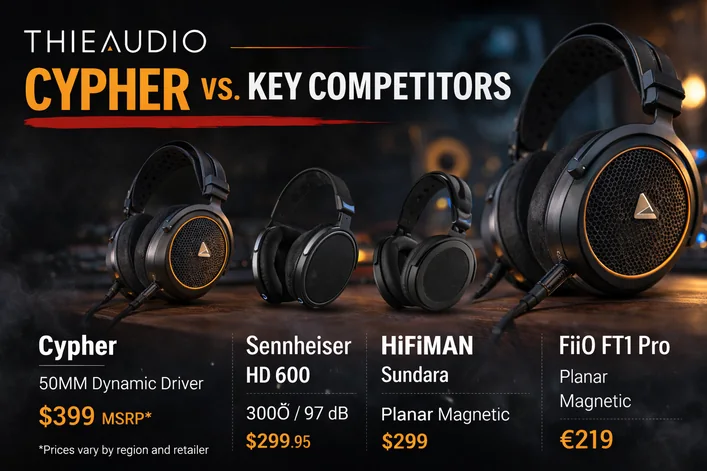
No headphone launches into a vacuum, and the THIEAUDIO Cypher is entering one of the most comparison-heavy brackets in personal audio. The natural rivals are not just products at the exact same price, but products people already trust: the Sennheiser HD 600 as the evergreen midrange-reference benchmark, the HiFiMAN Sundara as the accessible planar favorite, and newer value disruptors like the FiiO FT1 Pro. The table below uses official or launch-time specifications and currently listed official/store pricing where available, so think of it as a positioning guide rather than a universal street-price chart.
| Model | Driver type | Design | Impedance / sensitivity | Current listed price* | What it tends to offer |
|---|---|---|---|---|---|
| Cypher | 50mm dynamic | Open-back | 32Ω / 96 dB | $399 MSRP; Kickstarter from $329 | Reference-leaning tuning, premium materials, easy drivability |
| Sennheiser HD 600 | Dynamic | Open-back | 300Ω / 97 dB | $299.95 on Sennheiser US at time of search | Midrange benchmark, lighter frame, proven long-term reputation |
| HiFiMAN Sundara | Planar magnetic | Open-back | 32Ω / 92 dB | $299 | Planar speed, airy presentation, lighter price of entry |
| FiiO FT1 Pro | Planar magnetic | Open-back | not fully extracted here | €219 on FiiO Shop DE | Aggressive value play, bundled 3.5mm and 4.4mm cables |
*Prices vary by region, promotions, and timing.
Against the HD 600, Cypher’s challenge is philosophical as much as sonic. Sennheiser’s classic is still sold as a benchmark for analytical listening, with 300-ohm impedance, open dynamic design, and a modular long-life ecosystem that buyers know will still make sense years from now. Cypher seems to answer with easier drivability, more overtly premium-looking materials, and stronger sub-bass presence if early reviews hold up. Against the Sundara, the choice is more about flavor: planar openness and quickness versus a dynamic-driver presentation that may feel denser and more natural to some ears. Against the FT1 Pro, Cypher has to justify paying more for tuning maturity and chassis refinement, not just for the word “flagship.”
What it gets right
The smartest thing the THIEAUDIO Cypher appears to do is avoid a beginner’s version of “high end.” It does not seem engineered to scream detail by making the treble edgy. It does not inflate bass to fake scale. And it does not rely on boutique-driver mystique alone. Instead, the most consistent praise is for balance: strong extension, honest mids, useful imaging, and a build that feels like real money was spent in the right places. That is exactly the kind of profile that can keep a headphone relevant after launch-week excitement fades.
There is also a practical value to easy drivability here. Plenty of people love the HD 600, for instance, but not everyone wants a headphone that really appreciates dedicated amplification before showing its best. The Cypher’s lower impedance and moderate sensitivity make it friendlier to a broader range of setups without dropping into “made for phones” territory. That flexibility makes it easier to recommend to real people rather than just forum lifers with racks of gear.
Where it still has to prove itself
The THIEAUDIO Cypher still has two big tests ahead of it. The first is longevity. A launch campaign and a few enthusiastic reviews can establish momentum, but they do not prove that a headphone will still be recommended a year later once pad wear, comfort quirks, QC stories, and resale behavior all enter the conversation. The second is hierarchy. At this price, “very good” is not enough; buyers want to know whether a newcomer actually displaces trusted models or simply joins the maybe-list.
There are also smaller question marks. Headfonics’ note about a peaky 2 kHz region will matter to listeners who are sensitive to upper-mid energy. The lack of a balanced cable in the box is not fatal, but it weakens the out-of-box value argument a little when cheaper rivals increasingly bundle more connection options. And because the tuning seems built around discipline rather than overt coloration, some casual listeners may hear it as “correct” before they hear it as exciting. None of these are deal-breakers. But they are the sort of details that determine whether a headphone becomes respected or beloved.
Pricing and value for money
On value, the THIEAUDIO Cypher makes its strongest case at launch pricing. Kickstarter snippets and Linsoul coverage put the early campaign at $329 before moving through higher pledge tiers toward a $399 retail price. At $329, the proposition is easy to understand: premium-feeling materials, thoughtful tuning ambitions, and specs that suggest broad system compatibility. At $399, the conversation gets tougher, not because the product suddenly becomes overpriced, but because the competition stops being theoretical and starts being iconic.
Still, value is not just about the lowest price. It is about how many compromises feel cheap. Early coverage suggests Cypher keeps those compromises relatively minor: no wireless extras, no travel-first folding tricks, no flashy accessories, just a serious wired headphone that appears to put its budget into sound and structure. In enthusiast audio, that is often the better bargain.
Buy it if / Skip it if
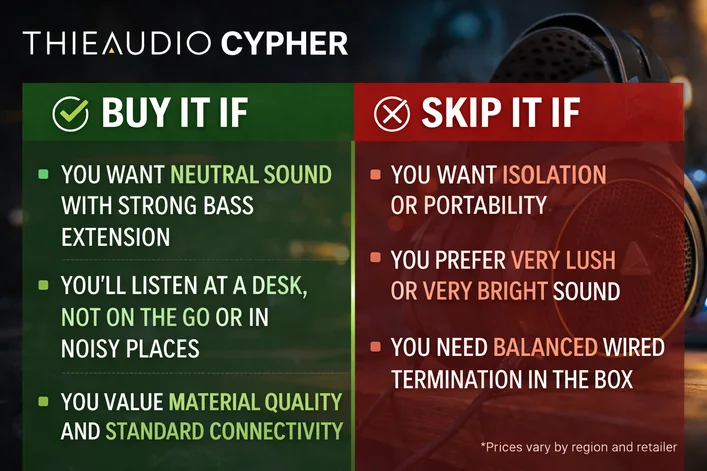
Buy it if you want a grown-up open-back with reference tuning ambitions, strong materials, good sub-bass reach for the format, and drivability that does not force an amp purchase on day one. The THIEAUDIO Cypher looks especially promising for listeners who want one do-it-most headphone for desk listening and care more about tonal balance than spectacle.
Skip it if you want a soft-focus, ultra-relaxed presentation, need isolation, insist on balanced termination in the box, or would rather spend less on a proven classic like the HD 600 or a cheaper planar alternative and live with their different compromises. If your taste runs toward obviously lush or obviously bright sound, Cypher may feel too measured to love instantly.
Final verdict
The THIEAUDIO Cypher looks like one of the more credible headphone launches of the year because it is chasing the right kind of ambition. It is not trying to reinvent personal audio. It is trying to earn a place among headphones people actually recommend to friends: honest, capable, nicely built, reasonably priced, and good enough to survive comparison with products that have already become shorthand for value. That does not mean the case is closed. The long game will decide whether Cypher becomes a staple or simply a very good 2026 debut. But based on the official specs, launch pricing, and the broad shape of early independent coverage, THIEAUDIO has done something harder than launching a flashy product: it has launched one that sounds plausible. And in this hobby, plausible is often the first sign of something genuinely good.