
There is a certain kind of e-bike that does not try to seduce you with oversized motors, motorcycle styling, or grand talk about “redefining mobility.” JIMOVE LC is more interesting than that because it aims at a narrower, tougher brief: be light enough to live with, small enough to store, and practical enough to justify itself on ordinary weekdays, not just sunny-weekend test rides. On paper, that means a compact folding frame, 14-inch wheels, a detachable 36V 9.9Ah battery, a claimed 40 to 60 km range, and a top assisted speed of 25 km/h, all wrapped in a product story that leans hard on portability and commuter convenience.
That last point matters because the surrounding story is almost as revealing as the bike itself. The official brand site describes JIMOVE as a Singapore-based maker focused on LTA-approved commuter and delivery e-bikes, while the current LC product page says the model has been discontinued but still receives after-sales repair support. At the same time, the Indiegogo campaign pitched the bike as a lightweight commuter with a 44 lb claim, a trunk-friendly footprint, a battery that doubles as a power bank, and unusually adjustable fit. In other words, this is not a blank-sheet startup fantasy. It is a real product with an existing life in the market that has been repackaged as a crowdfunding proposition. That does not make it bad; it just changes the way a smart buyer should read it.
What the bike actually is
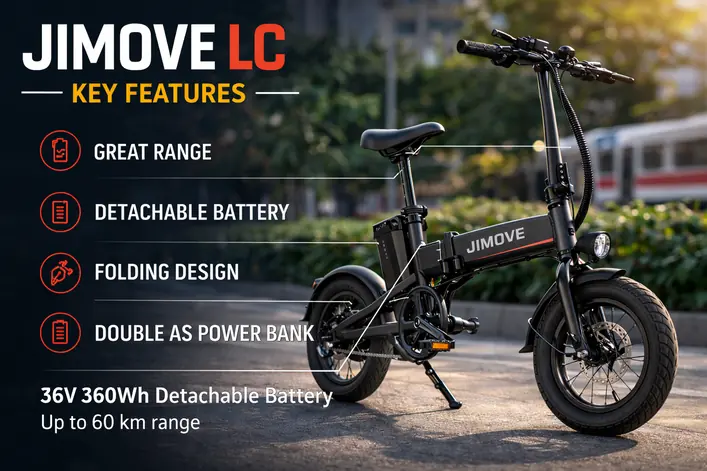
At its core, JIMOVE LC is a compact folding commuter e-bike designed less for sporty riding than for daily utility. The official product listing describes 14-inch tubeless sports tires, front and rear disc brakes, a detachable 360Wh battery, five pedal-assist levels, front and rear lights, EN15194 compliance, and IPX4 water resistance. The top speed is listed at 25 km/h, charging time at roughly 4 to 5 hours, and range at up to 40 to 60 km. Those are sensible, urban-oriented numbers: not thrilling, but realistic for short city hops, mixed errands, and first-mile/last-mile duty.
For readers who want the two essential reference points up front, the official JIMOVE website positions the company around commuter and delivery riding, while the Indiegogo campaign page frames the LC as the lightweight everyday option with the most portable personality in the lineup. Those two pages do not tell exactly the same story, and that gap is one of the most important things to understand before judging the bike.
First impressions: smart proportions, slightly old-school thinking
The immediate appeal of JIMOVE LC is obvious. It looks compact in a way many so-called folding e-bikes do not. Plenty of models advertise portability while still appearing awkwardly chunky, but the LC’s small wheels, short wheelbase, and compact frame genuinely suggest a bike that can be tucked into tighter spaces and managed by people who do not want to wrestle with a full-size machine every day. That basic promise is supported by the campaign’s 44 lb claim and by multiple retailer and review references that consistently treat the LC as one of the smaller commuter-focused options in its class.
But the first caveat arrives just as quickly. This is still a small-wheel e-bike built around utility rather than refinement. If you come from larger-wheel commuter bikes, the LC’s proportions are likely to feel twitchier, more abrupt over rough surfaces, and less naturally composed at speed. Small wheels help with storage and acceleration from stops, but they also shrink the margin for comfort. That does not disqualify the bike; it simply means the same design choice that makes it appealing in apartments, elevators, and car trunks also defines its limitations on cracked pavement and longer rides.
Key features and specifications in real-world terms
A spec sheet only matters if it predicts the day-to-day ride. On that front, JIMOVE LC makes more sense when translated into ordinary use. The 250W brushless setup and 25 km/h assisted speed tell you this is not built for adrenaline. It is built to take effort out of stop-start commuting. Five assist levels are helpful not because riders need endless tuning, but because city riding constantly shifts between flat stretches, mild inclines, and crowded shared spaces where subtle control matters more than raw shove.
The 36V 9.9Ah battery, roughly 360Wh, is modest by current long-range standards, but it is not absurd for the bike’s role. On a light, compact commuter e-bike, a battery of that size can be enough if your daily pattern is realistic: office commute, neighborhood errands, train connection, or local delivery work in shorter bursts. The official site claims up to 60 km, but real-world results are more likely to land somewhere between the lower and upper end depending on rider weight, terrain, assist level, and stop frequency.
The battery placement is one of the bike’s most practical ideas. The official product page emphasizes that it can be removed without the folding-and-unfastening routine required by some compact e-bikes. That matters more than flashy tech claims. A detachable battery is not just a convenience feature; it can be the difference between an e-bike that fits apartment living and one that becomes annoying after the novelty wears off. A commuter e-bike is only truly usable if charging it does not turn into a domestic ritual.
Then there is the power-bank angle from the campaign. It is a clever bit of marketing because it makes the battery sound more versatile than the average pack, but it also signals something broader about how the product is being positioned. The pitch is not performance-led. It is lifestyle-led, focused on convenience, compactness, and device-era practicality. That will either feel refreshingly grounded or slightly gimmicky depending on how much you value accessory logic over pure ride quality.
Design, build, and usability
The strongest design argument for JIMOVE LC is not that it is beautiful, though many hands-on impressions clearly like the look. It is that the design appears to prioritize everyday manageability over visual drama. Practical coverage around the bike tends to focus less on speed and more on transportability, handling it around public transit, and how livable it feels in dense urban settings. That is usually a good sign. When real-world reviewers spend their time discussing carrying, folding, or parking a bike, they are treating it as transport rather than a toy.
Build-wise, the official material gives the bike enough credibility without quite elevating it into premium territory. EN15194 compliance, dual disc brakes, integrated lights, and IPX4 resistance are all reassuring, especially for commuters who want baseline seriousness. But none of that automatically guarantees excellent ride feel, excellent finish quality, or long-term toughness under abuse. It guarantees that the bike is speaking the right language for an urban utility product. Whether it speaks that language fluently is harder to prove from public information alone.
There is also an important clue in older comparison coverage between the LC and the larger MC. The MC was often treated as the more rugged, more delivery-oriented option, while the LC came across as the lighter, simpler, more lifestyle-friendly choice. That suggests the LC’s portability is partly earned through compromise. For buyers in wet climates or riders who are particularly hard on equipment, that nuance matters.
Who this is really for
The clearest audience for JIMOVE LC is the rider who cares more about where the bike goes when they are not riding it than about how aggressive it feels when they are. Apartment dwellers, mixed-mode commuters, car-trunk users, and riders dealing with narrow storage spaces will understand the appeal instantly. Portability is the bike’s defining selling point, not power.
This also means the bike suits people entering the category through convenience, not through cycling culture. Riders who want a lightweight electric bike for errands, station hops, and practical daily movement are the target. Riders who want weekend-distance comfort, cargo capability, or the planted feel of a full-size commuter e-bike should look elsewhere. The LC is a problem-solver for limited space and short urban trips. It is not a universal answer to every kind of riding.

Comparison with key competitors
The most meaningful way to compare JIMOVE LC is not against giant international folding brands that play in very different price and specification brackets, but against compact commuter-oriented models around it. In that context, the bike sits in an interesting middle ground. The KUDU goes bigger on wheels and conventional everyday comfort, the JIMOVE MC goes bigger on battery and delivery-style endurance, and Venom-style compact folding alternatives focus on the same urban convenience logic from a slightly different angle.
| Model | Motor / Speed | Battery | Claimed Range | Wheel Size | Weight | Positioning |
|---|---|---|---|---|---|---|
| JIMOVE LC | 250W / 25 km/h | 36V 9.9Ah | 40–60 km | 14 inch | About 44 lb claim | Portable commuter |
| KUDU Electric Bicycle | 250W / 25 km/h | 10Ah class | Up to 60 km | 20 inch | Heavier, larger format | Comfort-focused commuter |
| JIMOVE MC | 250W / 25 km/h | Larger-capacity battery | Longer-range class | 14 inch | Less portable feel | Delivery / endurance leaning |
| Venom-style compact rivals | Varies | Compact battery class | Short to medium urban range | Compact folding format | Varies | Budget-friendly city use |
The table shows the LC’s actual niche. It is not the cheapest every time, not the longest-range, and not the most comfort-oriented. Its selling case is that it compresses enough battery, enough braking, and enough compactness into a package that still looks livable for daily use. Against the KUDU, it gives away wheel size and perhaps some comfort in exchange for a smaller folded presence. Against the MC, it gives away outright endurance in exchange for lighter, easier day-to-day handling.
What it gets right
The smartest thing JIMOVE LC does is avoid pretending to be more than it is. This is not a fake adventure bike or a bloated urban machine with pedals. It is a commuter e-bike that understands the daily friction points of city ownership: charging, storing, lifting, parking, and moving through crowded environments. The removable battery, small format, commuter-friendly top speed, and basic compliance credentials all support that honest positioning.
It also seems to have earned a steady, if modest, real-world reputation rather than a giant hype cycle. Public coverage is not dominated by major international tech outlets. Instead, most of the discussion comes from the campaign itself, retailer listings, local comparison pieces, and hands-on reviews from people using the bike in the environments it was built for. That kind of media footprint usually suggests a product that found a practical niche instead of chasing spectacle.
Where it still has to prove itself
The biggest unresolved question around JIMOVE LC is not whether the idea works. The idea is sound. The question is whether the specific execution is strong enough, in current terms, to feel like a great buy rather than a decent compact bike with a fresh marketing wrapper. The fact that the official site marks the LC as discontinued while still supporting repairs raises a fair question about lifecycle clarity, future inventory, and how buyers should interpret a current crowdfunding-style push around a model that already has market history.
There is also the comfort issue. Fourteen-inch wheels and a compact frame can be terrific for portability, but they rarely disappear beneath you the way a larger-wheel commuter does. For short trips that compromise is fine. For longer daily rides, rougher streets, or heavier riders, the LC could start to feel like a bike you tolerate because it stores well rather than one you genuinely enjoy for distance. That is not a flaw unique to this model, but it is central to its character.
And then there is durability. The official material gives you certifications and weather-resistance language, but independent coverage is still fairly thin. What exists is useful, yet it is mostly local, practical, and product-adjacent rather than the kind of deep teardown or long-term ownership evidence that would eliminate doubt. For buyers who value proof over promise, the bike remains somewhat under-documented.
Pricing and value for money
Value is where JIMOVE LC becomes tricky. Historically, the market positioning has shifted enough that value depends heavily on what price a buyer actually sees. At the lower end of its observed retail life, the bike starts to look quite compelling as a practical, portable commuter with enough battery and decent equipment. At the higher end, buyers are entitled to ask harder questions about ride comfort, product lifecycle, and whether a larger, more modern alternative would make better long-term sense.
So the right reading is this: the bike’s value is not absolute. It is situational. If you specifically need a commuter e-bike that is easy to store and easy to charge in a small living setup, the LC’s compromises become easier to forgive. If you just want the best e-bike for the money in a broad sense, the answer is less clear, because the LC is trading comfort and future-proofing for compactness. That is a legitimate exchange, but only if you actually need what it offers.

Buy it if / Skip it if
Buy JIMOVE LC if your life is built around constraints: stairs, tight hallways, apartment charging, mixed transport, or a commute where storage matters as much as riding. Buy it if you want a commuter e-bike that keeps things simple, stays within familiar legal-compliance boundaries, and looks designed for actual urban use rather than marketing photography.
Skip it if you want plushness, long-haul stamina, or the confidence of a current-generation full-size ride. Skip it if you do not truly need the compactness, because once that advantage disappears, the LC starts competing on grounds where small-wheel utility bikes are rarely unbeatable. And skip it if the only price available to you is near the higher end of its historical listings, because at that point the compromises become harder to romanticize.
Final verdict
In the end, JIMOVE LC succeeds more as a piece of urban problem-solving than as an object of desire. It is not the folding e-bike that will make enthusiasts swoon, and it is not the one that rewrites the category. But it does understand something a lot of e-bikes still miss: commuting is not just about what a bike feels like on the road. It is about what the bike asks of you before and after the ride. If your priorities are portability, removable charging, legal commuter-spec practicality, and a genuinely compact footprint, this remains a thoughtful design with a clear purpose. If your priorities are ride plushness, big-range confidence, or buying into the most current iteration of the category, there are stronger alternatives. That makes the LC neither a must-buy nor a pass. It makes it a very specific recommendation for very specific city lives, which is often the most honest kind of recommendation a bike can earn.