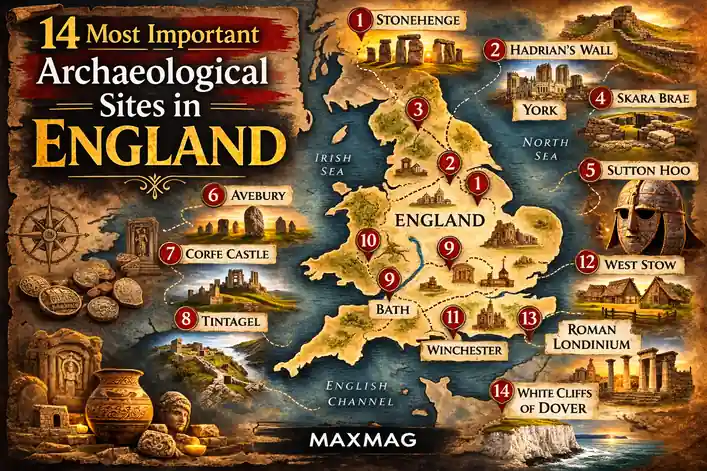




England’s landscape is often read through castles, cathedrals, and royal cities, yet its deeper story lies in soil layers that stretch far beyond the medieval and modern eras. Archaeological Sites in England form a remarkably dense record of prehistoric ritual, Roman statecraft, early medieval power, and long patterns of settlement that still shape the country’s geography. From chalk downs and river valleys to frontier zones and buried urban cores, the evidence preserved here shows how communities repeatedly adapted to changing climates, technologies, invasions, and belief systems. What survives is not a single civilizational line but a mosaic of ceremonial monuments, fortified enclosures, villas, tombs, roads, and working landscapes that together make England one of Europe’s richest archaeological terrains.
That breadth matters because English archaeology does not belong to one famous monument alone. It includes ceremonial complexes older than written history, military systems tied to imperial Rome, burial grounds that transformed understanding of early kingdoms, and domestic sites that reveal what ordinary people cooked, traded, feared, and revered. Many of the best-known remains were never meant to stand as “heritage” in the modern sense; they were practical, sacred, defensive, or commemorative spaces whose meanings shifted over centuries. Today, they also function as vital archives for historians, field archaeologists, conservators, and readers who want to see how the long past still lives beneath the present landscape.
Reading these places together offers more than a list of monuments. Archaeological Sites in England reveal how power was staged, how memory was built into the land, and how communities repeatedly reused older spaces rather than abandoning them completely. They also remind us that the most revealing evidence is not always monumental: postholes, crop marks, bone fragments, pollen traces, pottery scatters, and buried foundations can be just as important as standing stones. For anyone interested in deep time, historical continuity, and the making of place, England rewards close archaeological attention.
Why England Matters Archaeologically
England matters archaeologically because it compresses an extraordinary range of periods into a relatively compact territory. Long before Roman conquest, its river basins, chalk uplands, coastal edges, and fertile lowlands drew communities that built monuments, farmed intensively, buried their dead in formal ways, and marked the landscape with enclosures that still guide excavation today. The island’s position also made it a zone of contact: ideas, goods, migrants, and military systems moved in from continental Europe, while local traditions persisted and hybridized rather than disappearing. That layered interaction is one reason the archaeological record can feel both continuous and sharply disrupted at the same time.
Prehistoric ceremonial complexes in southern England, Iron Age hill forts across the countryside, Roman forts and towns, early Christian sites, and Anglo-Saxon elite burials all survive as pieces of a wider historical puzzle. Archaeology helps explain the deeper past because written sources are uneven, often late, and frequently written by outsiders or elites. Excavation, environmental sampling, geophysical survey, and material analysis therefore fill critical gaps. They allow scholars to reconstruct not only rulers and battles, but also farming routines, craft production, diet, long-distance exchange, and the social meanings of burial and ritual.
England is also significant because its archaeological landscapes are unusually dialogic: monuments sit in relation to other monuments, settlements to roads, forts to frontiers, and burial grounds to political change. A stone circle is rarely just a stone circle; it may belong to a wider ceremonial route, a mortuary landscape, or a later story of reuse and reinterpretation. The same is true for Roman walls, villas, and medievalized ruins. When read carefully, these places explain how different communities understood land, authority, ancestry, and sacred space over thousands of years.
Archaeological Sites in England and the Deep Historical Record
Geography is central to understanding why England’s archaeological density is so meaningful. The chalk of Wessex preserved great ceremonial earthworks; the northern frontier concentrated military installations; estuaries encouraged trade and movement; and fertile valleys supported long-lived agricultural communities whose field systems, settlements, and burial customs evolved over time. Because so many later communities built over earlier ones, England preserves a record of continuity through adaptation rather than through cultural stasis.
This deep record is especially valuable because it demonstrates how landscapes were repeatedly reinterpreted. A Neolithic enclosure could become a Bronze Age burial setting; a Roman road could shape later movement; an Anglo-Saxon cemetery could occupy land already heavy with memory. Archaeology in England often works by tracing those acts of reuse. The result is a national terrain where the past is cumulative, not neatly separated into sealed compartments.
The site list below should therefore be read as more than a ranking of impressive remains. Each place represents a different way human communities organized meaning in the landscape: through ritual, defense, administration, burial, domestic life, or exchange. Together they show why England’s archaeological archive is not only rich in individual discoveries, but also powerful as a long civilizational sequence.
A Brief Historical Timeline of England
England’s earliest archaeological story begins in prehistoric landscapes shaped by hunter-gatherers and later by Neolithic farming communities who cleared land, built monuments, and created enduring ceremonial centers. By the late Neolithic and Bronze Age, major ritual complexes such as Stonehenge and Avebury had transformed parts of southern Britain into symbolic landscapes tied to burial, procession, and celestial observation. During the Iron Age, communities increasingly organized themselves around enclosed settlements and large hill forts, indicating regional authority, agricultural control, and heightened concern with defense and display.
Roman conquest in the first century CE radically restructured much of the territory through forts, roads, towns, villas, industrial sites, and frontier systems. Yet Roman Britain did not erase earlier traditions; it absorbed and redirected them. When Roman administration receded in the fifth century, new power centers emerged through migration, local kingdoms, and evolving Christian institutions. It is in this shifting post-Roman world that elite sites like Sutton Hoo become historically pivotal. For a clear popular overview of how Stonehenge fits into this longer prehistoric sequence, National Geographic’s history of Stonehenge offers a useful survey. Across these eras, the ancient civilizations of England were never a single unified culture, but a succession of communities whose material remains still define the archaeological landscape.
Stonehenge: A Landmark Among the Archaeological Sites in England
- Location: Wiltshire, Salisbury Plain
- Period / Civilization: Late Neolithic to Early Bronze Age
- Type of Site: Ceremonial stone circle and ritual landscape
- Why It Matters: It is England’s most iconic prehistoric monument and the centerpiece of a much larger ceremonial complex.
Stonehenge is not a single act of construction but a monument built and modified in stages over many centuries, beginning with an earthwork enclosure around 3000 BCE and later developing into the megalithic setting known today. Its builders belonged to farming communities that had already begun reshaping the southern English landscape with cursus monuments, burial mounds, and timber structures. The site’s position on Salisbury Plain placed it within a broader ceremonial zone rather than in isolation. What makes Stonehenge historically crucial is that it appears to have combined ritual, commemoration, and social coordination on a large scale, drawing labor, planning, and probably shared belief from communities spread across considerable distances. As a result, it occupies a central place in any account of England’s prehistoric past.
Its distinctive features remain exceptional. The outer sarsen circle with lintels, the inner trilithons, the bluestones moved from Wales, and the monument’s solar alignments all suggest careful engineering and symbolic intention. Excavations have also revealed cremation burials, stone-working traces, and evidence that the surrounding landscape included avenues, related monuments, and activity areas linked to ceremonial movement. Scientific work on sourcing stones, dating organic remains, and mapping the wider landscape continues to refine interpretation, but debate remains active: was Stonehenge principally a ceremonial focus, a monument to ancestry, a place of healing, a political statement, or all of these at once?
For modern readers, Stonehenge matters because it turns abstract prehistory into a visible human project. It shows that communities without writing could still coordinate immense labor, align architecture to recurring cosmic events, and build places that shaped memory over generations. In that sense, Archaeological Sites in England are not important only because they are old; they matter because they reveal sophisticated social worlds that left material evidence instead of texts. Stonehenge also remains vulnerable to pressure from traffic, tourism, and the constant challenge of managing a world-famous site without flattening its wider landscape context. Its greatest lesson is that monumentality itself was a social language.
Avebury
- Location: Wiltshire
- Period / Civilization: Neolithic
- Type of Site: Henge monument and stone circle complex
- Why It Matters: Avebury is one of the largest prehistoric stone circle landscapes in Europe.
Avebury was created in the third millennium BCE as part of a vast ceremonial landscape that includes the henge, stone circles, avenues, nearby barrows, Silbury Hill, and West Kennet Long Barrow. Unlike Stonehenge, Avebury’s scale is expansive and spatially open, with the modern village now sitting inside the prehistoric enclosure. This immediately reminds visitors that ancient and modern occupation can coexist in the same topography, something that also makes them some of the most revealing historic sites in England. The builders were Neolithic communities for whom monumental construction seems to have been part ritual act, part communal labor, and part long-term statement of place. Avebury’s importance lies not simply in the stones themselves, but in the way the wider sacred landscape appears deliberately planned across a broad sweep of countryside.
The site’s most distinctive feature is its combination of an immense circular bank and ditch with multiple stone circles once standing within it. Excavation and survey have shown that the monument was shaped over time and connected to avenues leading into the surrounding terrain. Many stones were broken, buried, or removed in later centuries, which has complicated reconstruction but also revealed changing attitudes toward prehistoric monuments. Finds from the landscape, including human remains, pottery, and traces of activity, reinforce the sense that Avebury was a place of repeated ceremonial use. Among the great ancient ruins in England, few demonstrate spatial planning at such an ambitious ritual scale.
Avebury reveals that prehistoric ceremonial life was not confined to single-point shrines but could extend across a choreographed environment. Processional movement, visibility, sound, and the relation between earthworks and standing stones all mattered here. The site continues to shape archaeological debate about collective labor, ritual practice, and how Neolithic communities encoded meaning in monumental landscapes. Because the monument overlaps with living settlement, it also illustrates a modern preservation challenge: how to protect fragile buried archaeology where everyday life continues. Avebury matters today because it makes landscape itself the artifact, and it shows how Archaeological Sites in England can preserve choreography as well as stone.

Vindolanda
- Location: Northumberland, south of Hadrian’s Wall
- Period / Civilization: Roman Britain
- Type of Site: Fort, settlement, and military complex
- Why It Matters: It provides one of the most intimate archaeological windows into life on Rome’s northern frontier.
Vindolanda began as a Roman fort before the construction of Hadrian’s Wall and remained an important military and civilian site through multiple rebuilding phases. Positioned along a strategic corridor near the empire’s northern edge, it served soldiers, administrators, traders, families, and laborers who sustained frontier life. This was not simply a barracks in isolation; it was a working community tied to roads, supply lines, bathhouses, workshops, and domestic spaces. Historically, Vindolanda shows how imperial power functioned at ground level, where Rome’s reach depended on paperwork, logistics, local cooperation, and durable infrastructure as much as on force.
The site is famous for exceptional preservation created by waterlogged conditions, especially the Vindolanda tablets: thin wooden writing tablets that preserve letters, inventories, duty rosters, invitations, and administrative notes. These texts rank among the most important discoveries from Roman Britain because they give individual voices to frontier life. Excavations have also yielded shoes, tools, armor fragments, jewelry, and structural remains from several successive forts. The combination of written evidence and material culture makes Vindolanda unusually vivid, allowing archaeologists to compare architecture with actual daily routines recorded by the people who used the site.
Vindolanda’s human story is what makes it enduringly powerful. It shows soldiers complaining about supplies, officers managing obligations, women participating in elite social networks, and craftspeople sustaining a military economy. Archaeologists continue to study it because it bridges the gap between imperial history and ordinary experience. The site is also a reminder that preservation can be accidental and fragile: once excavated, organic remains require sustained conservation. Vindolanda matters now because it turns the Roman frontier from abstraction into lived reality, and it proves that Archaeological Sites in England can preserve voices as well as walls.
Hadrian’s Wall
- Location: Northern England, from the Tyne to the Solway
- Period / Civilization: Roman Britain, 2nd century CE onward
- Type of Site: Frontier wall, forts, milecastles, and military landscape
- Why It Matters: It was Rome’s most monumental frontier system in Britain and one of the empire’s clearest statements of controlled boundary.
Ordered under Emperor Hadrian in the second century CE, Hadrian’s Wall was far more than a linear barrier. It was an integrated frontier system that included the wall itself, ditches, roads, forts, milecastles, turrets, supply installations, and linked settlements. The purpose was administrative as much as defensive: to regulate movement, project authority, monitor trade, and define a controlled edge to Roman power in Britain. Stretching across northern England, it stitched together local topography into a militaryized landscape whose visibility alone carried political meaning. In England’s archaeological record, it is one of the clearest examples of empire materialized in stone.
Its distinctive feature is precisely that it combines architecture with system thinking. Excavations along the line of the wall have uncovered barracks, granaries, altars, inscriptions, gates, and everyday objects that reveal repeated phases of occupation and adaptation. Different sections also show how Roman engineers responded to terrain, building in stone or turf as conditions required. The associated forts produced evidence for multicultural garrisons drawn from across the empire, including units from regions far beyond Britain. This diversity makes Hadrian’s Wall a key case study in mobility, logistics, and frontier identity within Roman imperial structures.
The wall reveals that borders in the ancient world were managed zones, not simple lines. Troops lived, worshipped, ate, negotiated, and worked within an environment built to control passage but also to sustain communities. Scholars continue to study the site because it illuminates taxation, military supply, regional exchange, and the cultural blending that accompanied occupation. As a large, dispersed monument, it also faces preservation pressures from erosion, visitor impact, and landscape change. Its wider historical significance lies in showing how empires organize space to make power visible.
Sutton Hoo
- Location: Suffolk, near Woodbridge
- Period / Civilization: Early Anglo-Saxon, 6th–7th centuries CE
- Type of Site: Elite burial ground
- Why It Matters: The site transformed understanding of early medieval England and the sophistication of its ruling elites.
Sutton Hoo is an early medieval burial landscape whose most famous discovery is the great ship burial excavated in 1939. The burial is widely associated with elite, possibly royal, power in East Anglia during a formative period when post-Roman kingdoms were consolidating status, diplomacy, and identity. Before Sutton Hoo, the early Anglo-Saxon centuries were too often imagined in crude terms as culturally diminished after Rome’s departure. This site helped overturn that assumption. It showed that powerful rulers in eastern England participated in a world of skilled metalwork, imported luxury objects, ceremonial display, and complex burial practice.
Its most distinctive discoveries include the ship impression itself, the iconic helmet reconstructed from fragments, weaponry, gold fittings, silver vessels, garnet-inlaid objects, and other grave goods of astonishing craftsmanship. The acidic soil left little intact bone, which means interpretation relies heavily on object assemblages, burial setting, and comparative analysis. Even so, the richness of the finds is undisputed. Additional excavations across the wider cemetery have added depth to the site, showing that the famous ship burial belonged to a broader mortuary landscape rather than standing alone. The finds altered scholarly views of trade, kingship, and artistic exchange in early medieval Europe.
Sutton Hoo reveals a society deeply concerned with status, memory, martial identity, and links beyond its immediate region. The imported objects and technical artistry suggest far-reaching connections, while the scale of the burial indicates enormous labor and symbolic intent. Archaeologists still study the site because it sits at the intersection of political formation, ritual display, and cultural contact. In public history terms, few discoveries have had a bigger interpretive impact on early English identity. It matters now because one burial forced a wholesale revision of an era that had long been misunderstood, a reminder that Archaeological Sites in England can change historical narratives almost overnight.
Fishbourne Roman Palace
- Location: West Sussex
- Period / Civilization: Roman Britain, 1st–4th centuries CE
- Type of Site: Palatial residence and elite complex
- Why It Matters: It is one of the largest known Roman residences north of the Alps and a striking example of elite Romanized life in Britain.
Fishbourne Roman Palace was an immense elite residence built in the decades after the Roman conquest, probably for a high-status individual closely linked to Roman authority. Whether understood as the home of a client king, a major official, or a wealthy provincial elite, it demonstrates how power could be expressed architecturally in early Roman Britain. Located in the south, close to coastal routes and centers of exchange, the complex illustrates how the conquest was followed not only by military occupation but also by the deliberate planting of Romanized lifestyles, garden design, bathing culture, and monumental domestic display.
The site is especially renowned for its mosaics, formal gardens, bath suites, and the scale of its plan. Excavation uncovered an elaborate building with wings, courtyards, and high-status decorative schemes that rival elite residences elsewhere in the empire. Burn layers and later alterations also help chart the life history of the complex rather than freezing it at a single moment. Artifacts and architecture together show that Roman Britain could support not just forts and towns, but highly sophisticated elite households linked to imperial networks of taste, labor, and materials.
Fishbourne reveals what conquest looked like in domestic and ceremonial terms. It suggests that architecture itself was political, signaling allegiance, wealth, and cultural literacy. Scholars study it because it helps trace how local and imported practices mixed in the decades after annexation. The site’s preservation and interpretation remain important because large, complex villa-palace environments can easily be reduced to decorative spectacle if detached from their economic and social context. Fishbourne matters because it shows Roman power entering daily life through luxury, planning, and domestic performance.
Richborough Roman Fort
- Location: Kent
- Period / Civilization: Roman Britain, beginning in the 1st century CE
- Type of Site: Fortified port and military-administrative center
- Why It Matters: Richborough was one of the most important gateway sites for the Roman entry into Britain.
Richborough occupied a strategic position in Kent near what was once a key channel of access from the continent. In the early Roman period, it functioned as a bridgehead and logistical node, making it central to the mechanics of conquest and communication. Troops, goods, officials, and messages likely passed through or near this zone as Rome established itself in Britain. Over time, the site developed from a military foothold into a more complex fortified center, illustrating how invasion infrastructure could evolve into durable regional administration.
Excavations have revealed defensive works, roads, monumental remains, and later fortifications that chart several phases of Roman use. Richborough is also associated with the famous triumphal arch foundations, once part of a monumental statement of arrival and imperial presence. Coins, ceramics, building materials, and structural remains demonstrate sustained activity tied to transport and oversight. The site is distinctive because it captures the transition from first contact and military penetration to more settled forms of occupation, making it archaeologically important far beyond its surviving walls.
Richborough reveals how empires depend on controlled entry points. It tells us that conquest is not just a battlefield event but also an administrative process involving movement, supply, ceremony, and durable infrastructure. Archaeologists continue to value the site because it helps reconstruct the earliest Roman footprint in southeastern Britain and the long afterlife of strategic places. Today, its significance lies in reminding readers that seemingly partial ruins can represent pivotal nodes in continental exchange and imperial transformation.
Chedworth Roman Villa
- Location: Gloucestershire
- Period / Civilization: Roman Britain
- Type of Site: Villa estate
- Why It Matters: It is one of the finest surviving Roman villa sites in Britain and a key window into rural elite life.
Chedworth Roman Villa developed as a substantial rural estate, probably belonging to a wealthy Romano-British household whose prosperity rested on land, labor, and integration into regional exchange networks. Unlike frontier forts or urban centers, a villa site reveals how Roman rule functioned in the countryside, where elite households managed production, consumption, and status at the local level. Chedworth’s importance lies in showing that Roman Britain was not simply a world of soldiers and towns; it also supported complex rural estates that adopted sophisticated domestic technologies and decorative forms.
The site is especially known for its mosaics, bath suites, hypocaust heating, and layered structural development. Excavation has shown repeated adaptation rather than static occupation, while smaller finds help reconstruct domestic routines and patterns of use. Architectural evidence demonstrates not merely comfort but planning: heated rooms, bathing facilities, and decorative floors indicate both wealth and the social performance of refinement. Because villas are often treated only as elite residences, the wider working landscape around them is equally important, including the labor and agricultural systems that sustained such display.
Chedworth reveals social hierarchy in material form. It shows how status was lived through architecture, bathing, hospitality, and the control of land. Archaeologists study it to understand rural economy, Romanization, and the relationship between household luxury and agricultural production. The site also illustrates a broader interpretive lesson: high-status remains can only be understood properly when connected to workers, tenants, and local ecology. Chedworth matters now because it makes provincial wealth visible without losing sight of the social system behind it, showing how Archaeological Sites in England illuminate class as clearly as architecture.
Silbury Hill
- Location: Wiltshire
- Period / Civilization: Late Neolithic
- Type of Site: Artificial chalk mound
- Why It Matters: It is the largest prehistoric man-made mound in Europe and one of England’s great unresolved monuments.
Silbury Hill rises dramatically from the Wiltshire landscape as a massive artificial mound whose purpose remains uncertain. Built around the late Neolithic, it forms part of the wider Avebury ritual landscape and should not be viewed as an isolated oddity. The labor involved in constructing such a vast mound from chalk and earth implies coordinated communal effort, planning, and a compelling shared reason to invest in monumental earthmoving. Even without a definitive explanation, Silbury Hill holds enormous historical importance because it demonstrates how prehistoric communities could mobilize labor for projects whose value was symbolic rather than utilitarian.
The monument’s distinctive feature is precisely its ambiguity. Earlier intrusive investigations caused damage but did not produce the kind of dramatic central burial or treasure that older antiquarian expectations often sought. More recent archaeological work has emphasized construction phases, engineering, and landscape context instead of treasure-hunting assumptions. That shift in interpretation is itself important: Silbury Hill teaches modern archaeology to ask better questions. Its form, placement, and relation to surrounding monuments suggest ceremonial, territorial, or cosmological significance, even if certainty remains elusive.
Silbury Hill reveals that the absence of a simple answer is not the absence of meaning. It tells us prehistoric communities could build for memory, display, procession, or ritual effects that do not map neatly onto modern categories. Archaeologists continue to study the site because unresolved monuments sharpen method as much as they provide conclusions. Preservation matters here because past digging left scars, making the mound a reminder of why archaeological curiosity must be disciplined by conservation ethics. Its present relevance lies in showing that mystery can still be intellectually productive.
West Kennet Long Barrow
- Location: Wiltshire
- Period / Civilization: Early Neolithic
- Type of Site: Chambered tomb
- Why It Matters: It is one of Britain’s best-known Neolithic burial monuments and a key source for early farming communities.
West Kennet Long Barrow is a chambered tomb built in the early Neolithic, likely by some of the first farming communities to establish enduring settlement patterns in southern Britain. The monument functioned as a collective burial place rather than a memorial to a single elite individual, which is crucial to understanding its historical role. It reflects a world in which ancestry, kinship, and burial were tied to landscape marking. Positioned within the broader Avebury complex, it also shows that the Wiltshire ceremonial landscape developed across generations, with mortuary practices forming part of a larger sacred geography.
Excavation revealed human remains from multiple individuals, along with artifacts that help reconstruct use and later closure. The barrow’s chambers, mound form, and formal architecture make it distinctive as an intentionally structured house for the dead. Later blocking of the chambers suggests changing ritual practice or deliberate closure after a period of use. This sequence matters because it shows monuments could have life histories: creation, repeated use, transformation, and ceremonial ending. Such process is often more revealing than a single “event” model of burial.
West Kennet Long Barrow offers insight into how early agricultural communities understood death, memory, and collective belonging. Rather than celebrating one ruler, it appears to embody shared ancestry as a social resource. Archaeologists study it because it helps illuminate mortuary ritual, kin-based identity, and the emergence of durable monumentality in early farming societies. The site matters today because it preserves a rare chance to think about how the first settled communities in southern Britain made the dead part of the living landscape.
Maiden Castle
- Location: Dorset
- Period / Civilization: Iron Age, with later Roman activity nearby
- Type of Site: Hill fort
- Why It Matters: It is one of the largest and most impressive Iron Age hill forts in Europe.
Maiden Castle dominates its ridge-top setting in Dorset and represents the mature phase of Iron Age hill-fort construction on a monumental scale. Though the term “fort” can imply purely military use, sites like this likely combined defense, storage, social display, and community identity. The vast ramparts and enclosed area suggest a place that mattered regionally, whether as a refuge, political center, market point, or symbolic stronghold. Historically, Maiden Castle is essential because it shows how late prehistoric societies organized authority and space before and during the transition into Roman Britain.
The site’s most distinctive features are its massive multivallate defenses, complex entrances, and the sheer command it exerts over surrounding terrain. Excavation has uncovered occupation evidence, storage pits, burials, and traces of different phases that complicate any single interpretation. Earlier narratives emphasized dramatic conquest episodes, but later scholarship has treated those claims with greater caution, reassessing skeletal evidence and the extent to which Roman violence can be directly read from the finds. That debate is important because it shows how archaeological interpretation evolves as methods and assumptions change.
Maiden Castle reveals that social power in the Iron Age was deeply tied to enclosure, visibility, and collective labor. It offers insight into storage, defense planning, local hierarchy, and how communities gathered within engineered landscapes. Archaeologists still study it because large hill forts remain central to debates about political centralization, warfare, and identity in later prehistory. The site’s present relevance lies in its scale: it remains one of the clearest reminders that complex social organization flourished in Britain long before Rome.

Old Sarum
- Location: Wiltshire, near Salisbury
- Period / Civilization: Iron Age origins with Roman, Norman, and medieval reuse
- Type of Site: Hilltop enclosure and multi-period settlement
- Why It Matters: It preserves a rare sequence of reuse from prehistory into the medieval period.
Old Sarum began as an Iron Age hilltop enclosure but later became a Roman, Norman, and medieval center, making it one of England’s clearest examples of long-term site reuse. Its value lies in this continuity. Rather than representing a single civilizational phase, it shows how later communities repeatedly selected a place that already carried strategic and symbolic weight. Elevated terrain, commanding views, and defensible form made the site attractive in successive eras. For archaeology, Old Sarum is a reminder that places can accumulate importance through repeated occupation as much as through a single founding moment.
Its earthworks, defensive banks, internal divisions, and later structural remains allow archaeologists to read overlapping histories in one location. The visible medieval remains can overshadow earlier phases, but excavated evidence and landscape analysis demonstrate the site’s much deeper roots. That layered sequence is what makes Old Sarum distinctive: each period modified the site without erasing what came before. Such palimpsest archaeology is especially useful for understanding how strategic geography can outlast individual political systems.
Old Sarum reveals the long memory of place. Communities returned to it because earlier choices about defense, visibility, and control continued to make sense under new historical conditions. Archaeologists study the site because it helps explain continuity through radical change, from tribal enclosure to Roman presence to medieval authority. It matters now because it teaches that landscapes are not passively inherited; they are repeatedly reinterpreted, and each reuse leaves a new layer of evidence.
Wroxeter Roman City
- Location: Shropshire
- Period / Civilization: Roman Britain
- Type of Site: Roman city
- Why It Matters: Wroxeter was one of the largest urban centers in Roman Britain and an important case of urban transformation.
Wroxeter, the Roman city of Viroconium Cornoviorum, developed into one of the major urban settlements of Roman Britain. It grew from military origins into a city with civic buildings, baths, streets, and commercial functions, serving both regional administration and economic exchange. As a city site, Wroxeter helps balance the archaeological picture by showing that Roman England was not only a patchwork of forts and villas but also a network of urbanized centers. Its historical role lies in illustrating how local populations and imperial systems interacted through civic institutions, infrastructure, and organized public space.
Among its most distinctive remains are the substantial bath complex and the famous standing wall associated with the basilica-baths range, one of the most impressive Roman survivals in Britain. Excavation and survey have revealed street plans, domestic areas, industrial traces, and changing occupation beyond the formal Roman period. That afterlife matters, because Wroxeter was not simply abandoned overnight when Roman administration waned. Evidence suggests continued activity and adaptation, which makes the site valuable for studying the transition from late Roman to post-Roman life.
Wroxeter reveals how urban life organized power, commerce, and social interaction. Public bathing, market exchange, administration, and domestic routines all left material traces here. Archaeologists continue to investigate the site because it illuminates civic planning, local identity, and the persistence of settlement after imperial structures weakened. Its wider significance is that it complicates any simple story of collapse, showing instead that cities could contract, change, and remain meaningful in altered forms.
Flag Fen
- Location: Cambridgeshire
- Period / Civilization: Bronze Age
- Type of Site: Wetland ceremonial and timber causeway complex
- Why It Matters: It preserves rare evidence for ritual deposition and engineered timber construction in a prehistoric wetland.
Flag Fen is a Bronze Age wetland site centered on a remarkable timber causeway and associated depositional zone. Unlike stone monuments on dry uplands, this was a place where water, wood, and marshland structured ritual action. The environment itself is key to its historical meaning. Communities deliberately built across wet ground, suggesting movement, marking, and ceremonial encounter in a liminal landscape. Flag Fen expands the archaeological imagination of prehistoric England by proving that ritual architecture was not confined to stone circles or burial mounds.
The site became especially important because waterlogged conditions preserved wooden timbers and associated artifacts that would usually decay. Excavations uncovered weapons, tools, personal objects, and evidence of repeated deposition in water, indicating that valuable items were placed deliberately into the wetland rather than simply lost. This pattern links Flag Fen to wider Bronze Age traditions of votive offering. Its engineering is also significant: building and maintaining timber structures in marshy terrain required planning, labor, and a practical understanding of landscape conditions.
Flag Fen reveals a world in which watery places could hold ritual force, social memory, and carefully staged acts of offering. Archaeologists study it because wetland sites preserve unusual classes of evidence and challenge dry-land assumptions about prehistoric life. The site’s preservation is especially fragile, since changing water levels and environmental conditions can rapidly degrade organic materials. Flag Fen matters now because it shows that some of the most revealing evidence survives only when landscape and conservation are understood together.
Bignor Roman Villa
- Location: West Sussex
- Period / Civilization: Roman Britain
- Type of Site: Villa estate
- Why It Matters: Bignor preserves some of the most celebrated Roman mosaics in Britain and reveals the reach of villa culture in the south.
Bignor Roman Villa was a substantial country residence occupied by a prosperous Romano-British elite, likely tied to agricultural wealth and regional exchange. Like Chedworth, it belongs to the wider story of rural Romanization, but its importance lies in how vividly it demonstrates decorative ambition in a provincial context. This was not a peripheral household making do with reduced forms; it was a confident villa displaying cultural aspiration, domestic comfort, and social status. Sites like Bignor help archaeologists understand how Roman habits were adopted, adapted, and performed far from the Mediterranean core of the empire.
The villa is especially renowned for its mosaics, including richly patterned and figurative floors that remain among the most famous in Britain. Structural remains, room arrangements, and smaller finds also help reconstruct bathing, dining, circulation, and the ceremonial use of domestic space. Such evidence shows that elite life in Roman Britain involved not just possession of objects but the orchestration of movement and hospitality. Bignor is distinctive because artistic display and domestic planning are both so clearly legible in the surviving remains.
Bignor reveals that cultural identity in Roman Britain could be expressed through architecture, taste, and household routine. Archaeologists continue to study the site because villas illuminate economy, labor, aspiration, and the relationship between countryside wealth and imperial style. Preservation remains essential, since decorative remains are highly vulnerable to environmental stress and visitor pressure. Bignor matters today because it demonstrates how provincial households used built space to participate in a much larger world, and why Archaeological Sites in England are essential for reading everyday empire.
What These Sites Reveal About Ancient Life in England
Viewed together, these places tell a much richer story than any single monument can provide. Archaeological Sites in England reveal that ancient life was organized through recurring relationships between landscape, labor, ritual, and authority. At prehistoric ceremonial sites, movement and gathering seem to have mattered as much as fixed structures: people processed, buried, feasted, observed seasonal cycles, and repeatedly returned to places charged with ancestral meaning. At Iron Age enclosures, social hierarchy and security were built into defensive design, while Roman sites show a society structured by military logistics, taxation, domestic display, urban services, and long-distance trade. Burial sites such as Sutton Hoo expose a world in which status, memory, diplomacy, and belief converged in carefully staged acts of commemoration.
These remains also illuminate the texture of ordinary life. Vindolanda’s tablets show complaints, invitations, inventories, and daily administration. Villas reveal heating systems, bathing, kitchen work, agricultural dependence, and status performance. Wetland deposits at Flag Fen point to ritual offerings that tied material wealth to sacred behavior. Even where the evidence is fragmentary, foodways, craftsmanship, transport, warfare, and household organization can be reconstructed through pottery, animal bone, pollen, tools, coins, and building debris. This is the archaeological heritage of England at its most powerful: not only grand monuments, but the cumulative traces of how people worked, worshipped, traded, remembered, and imagined their place in the world.
Preservation Challenges Facing Archaeological Sites in England
Protecting archaeological sites is rarely as simple as fencing a ruin and adding signage. Across England, buried and standing remains face erosion, water damage, agricultural pressure, urban expansion, illicit metal detecting, visitor wear, and the slow but serious effects of climate change. Monumental sites can be overvisited, while less famous sites may suffer from underfunding and neglect. Organic material is especially at risk once exposed, and landscapes that depend on stable moisture levels can deteriorate rapidly when environmental conditions shift. Because Archaeological Sites in England often survive as parts of larger archaeological landscapes, preservation must extend beyond the obvious visible remains.
There is also an ethical dimension to conservation. Earlier archaeology sometimes damaged what it sought to understand, especially when excavation was driven by treasure-hunting logic or narrow expectations. Modern stewardship places greater emphasis on minimal intervention, careful recording, scientific conservation, and public interpretation that does not reduce complex sites to spectacle. Museums, site trusts, archaeologists, and heritage authorities all play vital roles in this work, as do planning systems that can prevent destructive development. The challenge is not only to preserve artifacts and structures, but to preserve context, because context is what turns objects into historical evidence.
Preservation matters because once a site is destroyed, the information it holds is usually gone forever. England’s archaeological record has value far beyond tourism: it anchors research, education, local identity, and long-term cultural memory. Responsible stewardship protects the fragile evidence that allows future generations to ask better questions than the present one can. In archaeology, survival is not passive luck; it is a continuing social choice.
The Archaeological Legacy of England
The long archaeological record of England reveals a land repeatedly reshaped by migration, adaptation, ritual reinvention, imperial control, and local continuity. Archaeological Sites in England show that the country’s development was never a straight line from “primitive” to “civilized,” but a sequence of overlapping social worlds, each with its own technologies, political forms, and ways of giving meaning to place. Monumental circles, hill forts, villas, frontier walls, wetland offerings, cities, and elite burials all belong to that longer narrative. They complicate any narrow national story by showing just how many kinds of communities contributed to the making of England across millennia.
This legacy also explains why the past remains culturally potent in the present. Many of these places still shape regional identity, public memory, and the visual imagination of England itself. Some have become symbols of prehistory, empire, or early kingship; others quietly preserve local histories that deserve equal attention. Archaeological Sites in England also remind us that the most important evidence is often collective rather than heroic: ordinary labor, repeated maintenance, shared ritual, and accumulated landscape knowledge built the worlds whose remains we study. As Smithsonian Magazine’s account of Sutton Hoo makes clear, a single excavation can radically change how an entire era is understood.
For modern readers, the real inheritance is not simply a list of famous monuments but a way of seeing. These sites encourage slower, more responsible thinking about time, evidence, and continuity. They also belong among the defining cultural landmarks of England because they connect the visible present to the buried realities that made it possible. The deeper the archaeological record is read, the harder it becomes to treat the past as static or ornamental. England’s legacy is dynamic precisely because its archaeology preserves change.
England’s archaeological importance does not rest on one era alone, and that is what makes it so intellectually compelling. From collective tombs and ceremonial landscapes to frontier forts and post-Roman burials, the record preserves not only spectacular monuments but also the everyday systems that sustained ancient societies. Archaeological Sites in England continue to matter because they let us test myths against evidence, connect local places to broader historical movements, and see how human communities repeatedly built meaning into land.
To study these places seriously is also to accept a responsibility toward them. Preservation, careful interpretation, and public access must work together if future generations are to inherit more than diminished fragments. England’s buried past is not exhausted; new methods, new finds, and new questions will keep reshaping what these sites mean. The most valuable conclusion is therefore a disciplined one: the past becomes most powerful when it is preserved well, read carefully, and allowed to remain complex.
Q1: What is the most famous archaeological site in England?
Q2: Which Roman site in England best shows daily life?
Q3: Why is Sutton Hoo so important?
Q4: Are Archaeological Sites in England only prehistoric?
Q5: What threatens archaeological sites in England today?
Q6: Why should readers care about these places now?